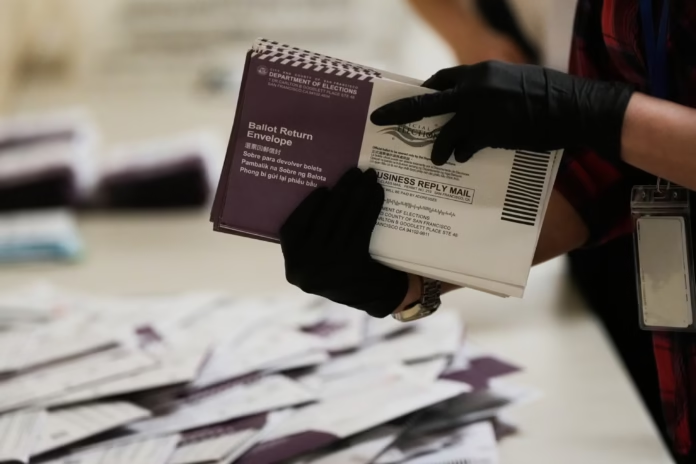
A federal appeals court has handed the Trump administration a significant, if temporary, legal victory in its months-long battle over mail-in voting, clearing the way for the U.S. Postal Service to advance a rule requiring states to submit voter rolls for citizenship verification before ballots can be delivered for the 2026 midterms. The D.C. Circuit’s decision pauses a lower court injunction while litigation continues, reviving a central piece of Trump’s March executive order on election integrity just months before voters head to the polls. States, election officials, and voting rights groups are bracing for further legal fights as the rule’s ultimate fate remains unresolved.
Story Highlights
- A three-judge D.C. Circuit panel temporarily stayed a district court order that had blocked USPS from advancing the citizenship-verification mail ballot rule
- The rule requires states to submit voter manifests, including names, addresses, and unique barcode identifiers, at least 60 days before federal elections
- The policy stems from Trump’s March 31 executive order, “Ensuring Citizenship Verification and Integrity in Federal Elections,” and has faced repeated setbacks in lower courts
What Happened
The U.S. Court of Appeals for the D.C. Circuit ruled Friday to temporarily lift a lower court’s block on a U.S. Postal Service proposal requiring states to submit detailed voter rolls for citizenship verification before USPS will deliver mail-in and absentee ballots for the November midterm elections. The three-judge panel’s decision pauses an order previously issued by a district court judge, allowing USPS to continue moving forward with the rule while the broader legal battle plays out on appeal.
The policy traces back to an executive order President Trump signed on March 31, titled “Ensuring Citizenship Verification and Integrity in Federal Elections.” The order directs the Department of Homeland Security, the Social Security Administration, and USPS to coordinate on verifying voter citizenship and preventing ineligible voters from receiving and casting mail ballots in federal elections. Under the rule as proposed, states would be required to submit manifests containing voter names, addresses, and unique barcode identifiers at least 60 days ahead of federal elections, allowing USPS to verify eligibility and track ballots through the mail system.
The rule has faced a turbulent path through the courts. In late June, U.S. District Judge Indira Talwani blocked major provisions of the executive order from taking effect, ruling that USPS lacked congressional authorization to control who receives mail-in ballots. Talwani’s injunction applied specifically to 24 jurisdictions, 23 states and the District of Columbia, whose attorneys general and governors had sued, including many Democratic-led and competitive swing states such as Arizona, Michigan, Pennsylvania, and Wisconsin. Just days later, U.S. District Judge Emmet Sullivan issued a separate ruling blocking the Postal Service from implementing the restrictions nationwide, finding the proposed rule violated a 2021 legal settlement with the NAACP that required USPS to take extraordinary measures to ensure timely delivery of election mail.
Friday’s D.C. Circuit ruling represents the administration’s first substantial win in the litigation, temporarily reversing course on those lower court blocks while the underlying legal questions are litigated on appeal. U.S. Attorney Bill Essayli called the decision “a win for election integrity” with particular significance for states like California that have refused to submit voter rolls to comply with the administration’s verification requirements. The ruling does not resolve the underlying legal dispute, and the appeals court is expected to continue reviewing the case in the coming weeks and months.
Voting rights organizations, including the NAACP Legal Defense Fund and Public Citizen Litigation Group, have argued throughout the litigation that the rule inserts USPS into an unprecedented gatekeeping role in federal elections, a function they say the Constitution reserves to states and Congress. Democratic members of Congress, including Rep. Raja Krishnamoorthi, have separately raised concerns that the policy rests on claims of widespread mail-ballot fraud that have not been substantiated with credible evidence, and warned that integrating disparate federal databases with state voter rolls could create administrative failures ahead of high-turnout elections.
Why It Matters
The legal fight over the USPS mail-ballot rule sits at the intersection of two of the most consequential issues in American democracy: who controls the machinery of federal elections, and how much authority the executive branch can exercise over a process the Constitution assigns primarily to states and Congress. The outcome of this litigation could reshape how tens of millions of Americans cast ballots by mail in the 2026 midterms and potentially in future federal elections.
For voters who rely on mail-in ballots, particularly elderly voters, disabled voters, military members stationed overseas, and residents of rural areas with limited access to polling places, the uncertainty created by shifting court rulings raises real concerns about whether their ballots will be delivered on time or at all. Even a temporary disruption to established mail voting procedures close to an election can create confusion that depresses turnout among populations who depend most heavily on the mail voting system.
For state election officials, the back-and-forth legal rulings create significant operational challenges. Officials in the 24 jurisdictions previously covered by Judge Talwani’s injunction must now navigate a period of legal uncertainty about whether they are required to submit voter data to the federal government, potentially forcing costly and time-sensitive changes to election administration procedures just months before ballots go out.
The case also carries broader implications for the separation of powers between the executive branch and Congress on election administration. Critics, including the nonpartisan Brennan Center for Justice, argue that both the 2025 and 2026 versions of Trump’s election executive orders exceed presidential authority because the Constitution grants only states and Congress the power to set election rules, a foundational question the courts have yet to definitively resolve.
Economic and Global Context
While the mail-ballot dispute is primarily a domestic legal and political matter, it carries meaningful costs for state and federal election administration budgets. Implementing new voter verification systems, cross-referencing state voter rolls with federal citizenship databases, and adopting new envelope and barcode requirements all require substantial technical and administrative investment from both USPS and state election offices, costs that will ultimately be borne by taxpayers regardless of which side prevails in court.
The dispute also reflects a broader national trend toward tightened voter eligibility requirements, running parallel to legislative efforts in Congress and various state legislatures to require documentary proof of citizenship for voter registration and to mandate more frequent purges of state voter rolls. This year’s Supreme Court term, which included 58 argued cases and a steady stream of shadow-docket rulings, has already touched on related citizenship and voting rights questions, signaling that the nation’s highest court may ultimately be asked to weigh in on the USPS rule as well.
Internationally, the dispute over federal control of mail voting procedures has drawn attention as an example of how established democracies manage tensions between election security concerns and ballot access, an issue that has become increasingly salient in democracies worldwide amid broader debates over voter identification and mail voting integrity.
Implications
In the immediate term, USPS is expected to continue advancing its proposed rule while the D.C. Circuit reviews the underlying appeal, though the ultimate outcome remains uncertain given the mixed record of lower court rulings on the issue. States that have resisted submitting voter rolls, including California, will face mounting pressure to decide whether to comply or continue litigating, with real consequences for how their mail ballots are processed in the lead-up to November.
For congressional Democrats, the ruling is likely to intensify calls for legislative action to explicitly bar USPS from conditioning ballot delivery on state compliance with federal verification demands, though any such legislation would face long odds in a Republican-controlled Congress. Expect continued oversight letters and public pressure campaigns targeting Postmaster General David Steiner and USPS leadership.
For the Trump administration, the ruling represents a notable, if provisional, validation of its broader election integrity agenda and is likely to embolden further executive action on voting procedures ahead of the midterms. Administration officials are expected to tout the decision as evidence that courts are increasingly receptive to its legal arguments, even as the case remains far from resolved.
For voters and campaigns alike, the coming months will require close attention to further court rulings, as the rule’s operational status could change again before ballots are mailed for the November elections, creating a genuine risk of last-minute disruption to established voting procedures.
Sources
“D.C. Circuit Court Clears the Way for USPS to Enforce President Trump’s Requirement”