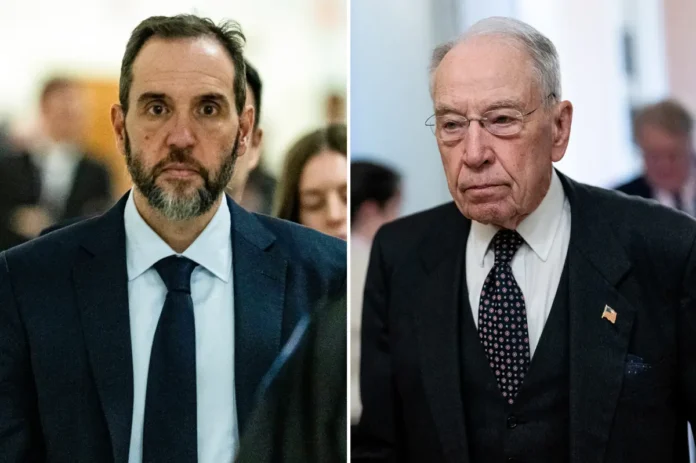
Senate Judiciary Committee Chairman Chuck Grassley released internal Justice Department messages this week suggesting personnel on former Special Counsel Jack Smith’s team may have mishandled classified material while prosecuting President Trump on related charges. The disclosure adds a new dimension to the ongoing reexamination of how the Biden-era Justice Department conducted its investigations of Trump, an effort Grassley says is central to restoring public accountability.
Story Highlights
- Grassley released messages between DOJ Litigation Security Group personnel and a member of Jack Smith’s special counsel team discussing the clearing of an individual without proper need-to-know confirmation
- Grassley says the messages indicate “hypocritical and careless behavior” meriting further investigation into classified document handling
- The senator praised the current DOJ and FBI under Acting Attorney General Todd Blanche and Director Kash Patel for cooperating with congressional oversight requests
What Happened
Senate Judiciary Committee Chairman Chuck Grassley of Iowa released a series of internal Justice Department messages this week that he says show personnel connected to former Special Counsel Jack Smith’s prosecution team may have mishandled classified material during the investigation into President Trump’s handling of government documents after leaving office in 2021. The messages, exchanged between Carli Rodriguez-Feo, who worked in the department’s Litigation Security Group, and Julie Edelstein, a member of Smith’s special counsel team, appear to discuss clearing an individual identified only as “Dan” without confirming he had the appropriate need-to-know authorization to access sensitive material.
In one message dated October 16, 2023, Rodriguez-Feo wrote regarding concerns about the clearance process, “‘[W]ere there any concerns’ … don’t care if there were!” Grassley characterized the exchange as evidence of a cavalier approach to classified information handling within the very team that was prosecuting Trump for alleged mishandling of classified documents himself. Edelstein, according to previous reporting, became involved in the Trump documents case even before Smith was formally appointed as special counsel.
Grassley, who chairs the committee with oversight responsibility for the Justice Department, framed the release as part of a broader pattern of accountability efforts targeting how the Biden-era DOJ conducted its investigations of Trump and his associates. “This is history, but if this stuff isn’t made known to the American people it could go on and on and on and get lost in the big bowels of bureaucracy,” Grassley said, adding that the goal was ensuring transparency around what he described as inconsistencies in how classified document laws were applied. He noted this followed an earlier disclosure in October, when the Judiciary Committee released an FBI document showing the Biden administration’s FBI had accessed cell phone “tolling data” belonging to several Republican lawmakers.
The senator also used the moment to praise the current Justice Department’s cooperation with his committee’s oversight requests, contrasting it with what he described as resistance from prior administrations. “I’ve had so many investigations that fall into this category of not having documents given to us,” Grassley said, crediting Acting Attorney General Todd Blanche and FBI Director Kash Patel for what he called an unusually transparent posture toward congressional oversight. He specifically praised Patel for “correcting whistleblower retaliation and increasing transparency more than any other FBI Director I’ve seen.”
Why It Matters
The disclosure feeds directly into an ongoing national debate over whether federal law enforcement agencies applied consistent standards when investigating Trump compared to how they have historically handled classified information within their own ranks. If accurate, allegations that special counsel personnel treated classified material informally while prosecuting a former president over similar conduct would represent a significant credibility problem for the department’s earlier handling of the case, regardless of the ultimate merits of the underlying prosecution.
For congressional oversight more broadly, the episode illustrates how document disclosures continue to shape the political narrative around the DOJ’s conduct during the Biden administration, years after the initial investigations concluded. Grassley’s committee has increasingly positioned itself as a vehicle for releasing internal government communications that Republicans argue demonstrate politically motivated or inconsistent enforcement, a framing that carries significant weight heading into the 2026 midterm election cycle.
The disclosure also intersects with separate reporting that special prosecutor Joseph diGenova has been cultivating new witnesses, including intelligence community and FBI whistleblowers, as part of an expanding investigation into the origins of the FBI’s Crossfire Hurricane probe into Trump’s alleged ties to Russia. Taken together, these efforts represent a sustained, multi-front push by Trump allies within and outside government to revisit and reframe the federal investigations that shadowed Trump’s first term and the years between his presidencies.
For career law enforcement personnel, continued releases of internal communications raise concerns about how privacy and professional conduct protections apply to government employees whose private workplace messages become subject to public political disclosure, a dynamic that could affect morale and information-sharing practices within federal agencies going forward.
Economic and Global Context
While the disclosure itself has no direct market impact, it reflects a broader institutional realignment within the Justice Department that has substantial implications for how the agency allocates resources. Grassley’s committee has increasingly directed DOJ and FBI attention toward reexamining prior investigations, a shift that requires significant staff time and resources that might otherwise be directed toward current criminal and national security priorities.
This pattern of oversight-driven disclosure also shapes how foreign observers assess the stability and independence of U.S. law enforcement institutions, particularly given that several of the underlying investigations, including Crossfire Hurricane, involved allegations of foreign election interference. Continued domestic controversy over how those investigations were conducted can complicate broader international perceptions of American institutional integrity.
Politically, the disclosures serve as fuel for the broader 2026 midterm debate over government accountability, an issue both parties have sought to claim ownership of despite sharply different views on which administration’s conduct deserves greater scrutiny.
Implications
Grassley’s committee is likely to continue releasing additional internal communications as its review proceeds, and the Justice Department under Blanche has signaled a willingness to cooperate with these requests to a degree congressional overseers say exceeds prior administrations. Whether this cooperation extends to any formal investigation or disciplinary action against the individuals named in the released messages remains to be seen.
For Rodriguez-Feo, Edelstein, and other individuals identified in the correspondence, the public release of their private workplace communications could prompt professional consequences or formal inquiries, separate from any broader political fallout the disclosure generates.
For voters assessing the credibility of competing narratives about politicization within federal law enforcement, the steady drumbeat of document releases from Grassley’s committee, combined with the parallel diGenova investigation into Crossfire Hurricane’s origins, will likely remain a recurring feature of the political landscape through the midterms.
Sources