Story Highlights
- The House vote is scheduled for approximately 4:30 p.m. Tuesday, following Rules Committee clearance Monday
- Speaker Mike Johnson acknowledged a very thin margin of error with primary-season attendance challenges
- Senator Lisa Murkowski was the only Republican to vote against the bill in the Senate; all Democrats opposed it
What Happened
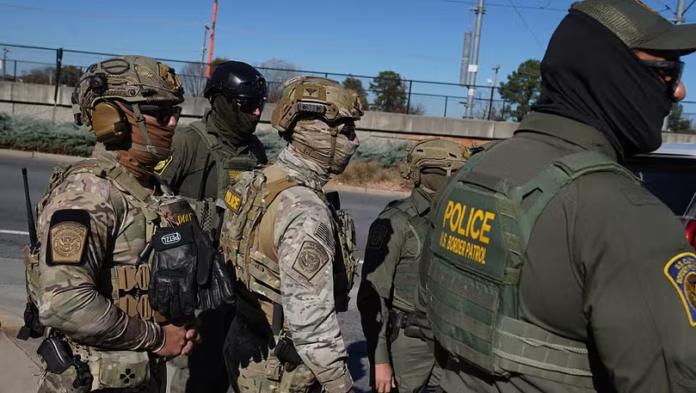
House Speaker Mike Johnson, a Republican from Louisiana, confirmed Monday that he expected the $70 billion immigration enforcement funding bill to pass, though he acknowledged the challenge of securing votes during a day when several of his members are tied up with primary elections in Maine, South Carolina, Nevada, and North Dakota. The House Rules Committee met Monday afternoon to formally advance the legislation for floor consideration, and a vote was placed on the schedule for around 4:30 p.m. Tuesday.
The bill — which funds ICE and Border Patrol through the end of Trump’s term — passed the Senate in the early morning hours of Friday, June 5, on a 52-47 vote. Every Democrat voted against the measure. The sole Republican defector was Senator Lisa Murkowski of Alaska, who criticized the use of the budget reconciliation process, a parliamentary mechanism that allowed Republicans to bypass the 60-vote filibuster threshold typically required to advance legislation in the Senate.
The funding lapse at the Department of Homeland Security began in mid-February, after Democratic lawmakers demanded policy reforms following the fatal shootings of two U.S. citizens, Renee Good and Alex Pretti, by federal immigration agents in Minneapolis in January. Democrats insisted on accountability measures including body camera requirements, rules against masked agents, and guardrails against detaining American citizens — conditions Republicans refused to accept.
The legislation ultimately advanced without any of those Democratic demands. Republicans used the budget reconciliation process throughout, which requires only a simple majority in the Senate. The maneuver drew criticism from Democrats and some Republicans who argued it set a damaging procedural precedent, but party leaders pushed through nonetheless under pressure from President Trump, who had originally set a June 1 deadline for the bill’s passage.
A controversy over a proposed $1.8 billion “anti-weaponization” fund — which would have compensated Trump allies who claimed the federal government had been weaponized against them — threatened to derail the bill for weeks. Acting Attorney General Todd Blanche ultimately told Congress that the administration would “not be moving forward with the fund, period,” defusing the standoff and allowing the Senate to advance the immigration bill to a final vote.
Why It Matters
The vote represents the most consequential piece of domestic legislation the Trump administration has moved through Congress in months, and its outcome has major implications for the administration’s most high-profile policy priority: immigration enforcement. Without renewed funding, ICE and Border Patrol have operated under significant financial constraint since February, limiting staffing, detention capacity, and enforcement operations at a moment when the administration has made mass deportation a central governing promise.
For Republican members, the vote also carries midterm significance. The party has staked considerable political capital on aggressive immigration enforcement, and a failure to fund the agencies carrying out those policies would have been an embarrassing and damaging result heading into the November elections. Johnson’s acknowledgment of a narrow margin of error underscores just how thin the House Republican majority remains.
Democrats are framing the legislation as a dangerous expansion of an already-aggressive enforcement apparatus, one that has operated without the transparency and accountability measures they sought. Congressional Democrats, civil liberties organizations, and immigrant advocacy groups have argued that the bill leaves ICE and Border Patrol with a blank check and no meaningful oversight mechanisms. The absence of body camera requirements, in particular, has drawn sustained criticism.
For ordinary Americans, the funding bill’s passage means the continued and potentially intensified implementation of the Trump administration’s deportation campaign. With $70 billion in guaranteed funding through the end of the term, ICE will have the resources to significantly expand its operations — including in communities that had previously seen less enforcement activity.
Economic and Global Context
The financial scale of the bill is striking. At $70 billion, it represents one of the largest single appropriations for domestic law enforcement in American history. The bulk of the funding flows to ICE and Customs and Border Protection, the two agencies responsible for interior enforcement and border security. Economists and policy analysts have noted that large-scale deportation campaigns carry real economic costs, including labor market disruptions in agriculture, construction, food processing, and hospitality sectors that rely heavily on immigrant workforces.
The U.S. economy added 172,000 jobs in May, according to the most recent jobs report, a sign of continued labor market resilience. But economists have warned that an accelerated deportation campaign could tighten labor supply in key industries, particularly at a moment when the administration is also pursuing tariff policies that have already added inflationary pressure to supply chains. The interplay between immigration enforcement and labor economics will be a significant dynamic to watch in the months ahead.
Internationally, the legislation has drawn attention from governments whose nationals are subject to enforcement actions. Mexico, Guatemala, El Salvador, and Honduras have all been engaged in ongoing diplomatic discussions with Washington over deportation logistics and the treatment of their citizens in U.S. custody.
Implications
If the House passes the bill as expected Tuesday, Trump will sign it and the partial DHS shutdown will officially end. ICE and Border Patrol will receive their full appropriations and resume operations at full capacity, likely leading to a renewed and expanded enforcement push in the weeks that follow. The administration has signaled it views this funding as a mandate to accelerate its deportation agenda.
For Senate Republicans who backed the bill, Tuesday’s outcome will be watched as a test of whether the reconciliation strategy pays off politically. With midterms approaching, members in competitive districts will need to show their constituents that they can both govern effectively and deliver on immigration promises. Members in suburban swing districts may face a different calculation, particularly if enforcement operations in their communities generate local controversy.
For Democratic leaders, the bill’s likely passage marks another legislative setback in a Congress where they hold no chamber. Their strategy of demanding policy guardrails as the price for cooperation failed to gain traction, and the administration moved forward without them. Whether that approach pays off in November, as a mobilizing contrast for their base, remains to be seen.
Sources
“House to vote on ICE funding, ending months-long impasse”