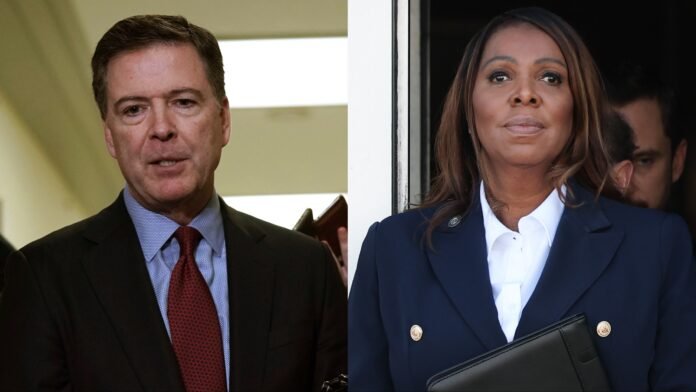
Former FBI Director James Comey faces a federal trial beginning July 15 on charges that a beach photo of seashells constituted a threat against President Donald Trump, marking the Justice Department’s second attempt to criminally prosecute one of the president’s most prominent critics. The case has drawn sharp criticism from legal experts and former prosecutors who question whether the underlying conduct constitutes a crime at all.
Story Highlights
- Comey faces two felony charges over a 2025 Instagram post of seashells arranged to spell “86 47”
- The case marks the second Justice Department attempt to prosecute Comey after an earlier case was dismissed
- U.S. District Judge Louise Flanagan is presiding over the North Carolina trial
- At least six federal prosecutors have reportedly been demoted or removed amid fallout from the case
What Happened
Former FBI Director James Comey is set to stand trial July 15 in North Carolina on two federal charges stemming from a photograph he posted to Instagram in May of last year, showing seashells arranged on a beach to spell out “86 47,” accompanied by the caption “Cool shell formation on my beach walk.” Prosecutors allege the post constituted a threat against President Donald Trump, the nation’s 47th president, interpreting the numerical arrangement as coded language calling for violence against him. The indictment alleges Comey “consciously disregarded a substantial risk that his communication would be viewed as threatening violence.”
The case represents the Justice Department’s second attempt to criminally prosecute Comey since Trump returned to office. An earlier indictment, filed last September in Virginia and centered on allegations that Comey lied to Congress during 2020 Senate testimony regarding media leaks, was dismissed by a federal judge in November after it was determined that the interim U.S. Attorney who secured the indictment, Lindsey Halligan, had not been lawfully appointed to her position. That dismissal left prosecutors facing a five-year statute of limitations that had already expired on the original charges, leading legal analysts to question whether Comey could be prosecuted again on those specific allegations.
The current case, filed in the Eastern District of North Carolina, proceeds on different legal grounds tied to the seashell photograph rather than the earlier congressional testimony allegations. Acting Attorney General Todd Blanche announced the new charges at a press conference, stating that “threatening the life of the president of the United States will never be tolerated by the Department of Justice.” FBI Director Kash Patel similarly characterized the post as Comey encouraging “a threat on President Trump’s life.” Comey removed the post shortly after publishing it, stating at the time that he had not realized some people associated the numerical sequence with violence and that he intended the arrangement as “a political message.”
Comey’s attorney, Patrick Fitzgerald, has stated that his client “vigorously denies” the charges and intends to contest them in court, framing the prosecution as a First Amendment matter. Legal and security experts have publicly questioned the strength of the government’s case, noting the considerable free speech protections that typically apply to political commentary and satire, even when expressed through ambiguous or provocative imagery. The Washington Post has reported that at least six prosecutors within the U.S. Attorney’s Office for the Eastern District of Virginia were demoted or pushed out amid fallout connected to the department’s broader efforts to prosecute Comey.
Why It Matters
The Comey prosecution has become a central flashpoint in broader debates over the Justice Department’s independence and its relationship to the White House under the current administration. Critics, including former career Justice Department attorneys, have characterized the case as part of a broader pattern of using federal law enforcement resources to pursue and punish individuals whom Trump has publicly identified as political adversaries, a dynamic that raises fundamental questions about prosecutorial discretion and equal justice under the law.
The case’s path, from initial dismissal due to an improperly appointed prosecutor to a second indictment on different charges, illustrates the extraordinary lengths to which federal prosecutors have gone in pursuing a Trump critic, drawing scrutiny from legal observers who note that comparable prosecutions of a private citizen’s ambiguous social media post would rarely proceed with this level of institutional resources and attention absent the political dimension involved.
For career Justice Department personnel, the case has reportedly contributed to declining internal morale and growing concern that political considerations are increasingly shaping charging decisions typically insulated from White House influence, according to former department attorneys who have spoken publicly about the institutional strain created by the administration’s approach to politically sensitive prosecutions.
The trial’s outcome will carry significant implications for how courts evaluate the boundaries between protected political speech and prosecutable threats, particularly in cases involving ambiguous imagery or coded language that requires substantial interpretive inference to establish criminal intent, a legal question with ramifications extending well beyond this specific case.
Economic and Global Context
While the Comey case itself carries limited direct economic impact, it exists within a broader pattern of high-profile prosecutions and investigations targeting the administration’s perceived political adversaries that collectively consume substantial federal law enforcement and judicial resources, raising questions among fiscal oversight groups about the allocation of Justice Department budget and personnel toward politically sensitive cases relative to other law enforcement priorities.
The case has also drawn attention from international observers and press freedom organizations that monitor the treatment of political dissent and criticism of government officials in democratic nations, with some foreign commentators noting the unusual nature of prosecuting a former senior law enforcement official over an ambiguous social media post rather than a clear, unambiguous threat.
Legal costs associated with defending against the prosecution have also drawn attention, with Comey’s defense reportedly requiring significant financial resources, a burden that legal experts note could create a chilling effect on political speech among individuals lacking comparable financial means to mount a full legal defense against similar prosecutorial attention.
The broader pattern of prosecutions against Trump critics, including Comey, former New York Attorney General Letitia James, and others, has also drawn commentary from financial and legal analysts regarding the potential long-term costs to institutional trust in the Justice Department’s impartiality, a factor that some argue could affect willingness of career prosecutors to remain in government service.
Implications
The trial beginning July 15 will test whether prosecutors can convince a jury that the ambiguous seashell arrangement meets the legal threshold for a genuine threat against the president, a standard that typically requires demonstrating specific intent to threaten violence rather than mere political commentary open to multiple interpretations.
For the Justice Department, a conviction would represent a significant validation of its renewed prosecutorial approach toward Trump’s political critics, while an acquittal or dismissal would likely intensify existing criticism that the department has misused its charging authority for political purposes rather than legitimate law enforcement objectives.
For Comey personally, the trial carries both immediate legal consequences, given the ten-year maximum sentence associated with each of the two charged counts, and broader implications for his ongoing public role as one of the administration’s most visible critics among former senior law enforcement officials.
Looking beyond this specific case, legal scholars anticipate the trial’s proceedings and ultimate outcome will be closely studied for guidance on how courts navigate prosecutions involving ambiguous political speech, particularly as similar dynamics continue to play out in other cases involving perceived critics of the current administration across multiple jurisdictions.
Sources