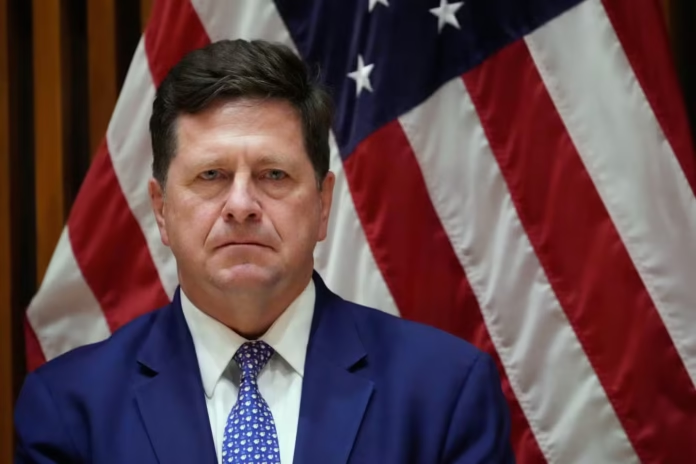
Jay Clayton, President Trump’s nominee to lead the nation’s intelligence apparatus, finally appeared before the Senate Intelligence Committee on Wednesday, nearly a month after Trump personally ordered the hearing canceled at the last minute. The delay left Bill Pulte, a housing official with no intelligence background, serving as acting director of national intelligence and contributed to the lapse of a key surveillance authority. Clayton’s confirmation now carries added weight for lawmakers hoping to resolve both a leadership vacuum at the top of the intelligence community and a stalled national security law.
Story Highlights
- Trump abruptly canceled Clayton’s original June 17 confirmation hearing, saying it should wait until his chosen successor as U.S. attorney was confirmed
- Bill Pulte has served as acting Director of National Intelligence since June 19 despite having no prior intelligence experience
- Section 702 of the Foreign Intelligence Surveillance Act has lapsed as Democrats withhold support pending Pulte’s removal
What Happened
Jay Clayton, the U.S. attorney for the Southern District of New York and a former chair of the Securities and Exchange Commission, testified Wednesday before the Senate Intelligence Committee in his long-delayed confirmation hearing to become director of national intelligence. In his opening statement, Clayton pledged to be “mission-focused and team-oriented” and said he would prioritize “enhancing the trust of the American people” in the Office of the Director of National Intelligence if confirmed.
The hearing had originally been scheduled for June 17 but was scrapped hours beforehand after Trump posted on Truth Social that the process should not continue until James McDonald, his pick to succeed Clayton as U.S. attorney, was confirmed. “In the meantime, Bill Pulte will remain as the Acting Director of National Intelligence,” Trump wrote at the time. Senate Intelligence Committee Chairman Tom Cotton called the cancellation “regrettable,” while ranking Democrat Mark Warner described Trump’s about-face as “an extraordinary display of dysfunction,” suggesting the president might ultimately withdraw Clayton’s nomination altogether.
The vacancy at the top of the intelligence community emerged after Tulsi Gabbard announced her resignation in May, citing her husband’s cancer diagnosis. Trump quickly named Pulte, then serving as director of the Federal Housing Finance Agency, as acting director of national intelligence, a move that immediately drew bipartisan criticism given Pulte’s complete lack of national security experience. Pulte had gained Trump’s favor by using his housing agency post to launch investigations into perceived political adversaries of the president, including Federal Reserve Governor Lisa Cook and New York Attorney General Letitia James.
Democrats responded to the Pulte appointment by refusing to support reauthorization of Section 702 of the Foreign Intelligence Surveillance Act, a warrantless surveillance program used to monitor foreign communications, arguing they would not back an extension while Pulte remained atop the intelligence community. The authorization lapsed in June as a result, and it remains unclear when or whether Congress will restore it. Trump further complicated the standoff by demanding that any FISA reauthorization be paired with the SAVE America Act, a voter identification bill that Democrats have rejected, calling it an attempt to restrict voting access.
Clayton, who is well-regarded by lawmakers in both parties, previously served as SEC chair during Trump’s first term after winning Senate confirmation in a 61-37 vote. Both Cotton and Warner have signaled support for his nomination, viewing him as a stabilizing choice compared to Pulte. During Wednesday’s hearing, Clayton also faced questions about the administration’s decision to issue subpoenas to New York Times journalists following reporting on security concerns involving a Qatari-donated Air Force One, as well as his past comments questioning California’s mail-in voting laws.
Why It Matters
The prolonged vacancy at the helm of American intelligence carries direct consequences for national security operations. The director of national intelligence oversees eighteen separate spy agencies, advises the president on classified matters, and plays a central role in coordinating the country’s intelligence budget. Leaving a housing official without security clearance experience in that role, even temporarily, alarmed lawmakers across the political spectrum who worried about both operational competence and the potential politicization of intelligence functions.
The episode also illustrates how personal presidential interventions can disrupt routine governmental processes. Trump’s decision to personally cancel a scheduled Senate hearing, seemingly to leverage an unrelated nomination, drew criticism even from within his own party as an example of unnecessary disorder inserted into a process that both parties otherwise wanted resolved quickly.
The lapse of Section 702 authority represents a tangible national security cost stemming from the standoff. The program has historically been used to track foreign terrorism suspects and other national security threats, and its expiration removes tools that intelligence officials have said are important for counterterrorism work, even as lawmakers continue to negotiate its restoration.
For voters concerned about the integrity of upcoming midterm elections, Pulte’s tenure atop the intelligence community has taken on additional significance given Democratic concerns that intelligence and law enforcement resources could be directed toward influencing state-level election administration.
Economic and Global Context
While the DNI standoff is primarily a national security and governance story, it carries indirect economic implications tied to the reauthorization of surveillance authorities that affect cybersecurity coordination between government and private-sector partners in critical infrastructure sectors. Delays in reauthorizing Section 702 could complicate information-sharing arrangements that businesses rely on for threat intelligence related to foreign cyberattacks.
Globally, an extended leadership vacuum in the U.S. intelligence community arrives at a sensitive moment, with active military operations against Iran underway and heightened tension in the Persian Gulf. Allied intelligence services that coordinate closely with American counterparts may face uncertainty about continuity of leadership and priorities during an active conflict period.
The broader pattern of political appointees with limited subject-matter expertise assuming sensitive national security roles has also drawn scrutiny from international partners who rely on stable, professionalized U.S. intelligence leadership for coordinated operations and information sharing.
Implications
If Clayton receives a favorable committee vote, Senate leadership has suggested he could be confirmed within roughly a week given the apparent bipartisan support for his nomination. His confirmation would immediately remove Pulte from the acting DNI role, a change Democrats have made a precondition for reauthorizing Section 702.
However, the fate of any FISA reauthorization remains tied to the unresolved dispute over the SAVE America Act, meaning Clayton’s confirmation alone may not fully resolve the surveillance authority lapse. Lawmakers will need to negotiate a path forward on that legislation separately, and it remains unclear whether Trump will continue to condition his support for FISA on the voter identification measure.
For the intelligence community itself, Clayton’s confirmation would end months of uncertainty about permanent leadership, potentially allowing agencies to resume normal budget planning and coordination functions that officials say have been disrupted by the prolonged acting arrangement.
Both parties will also be watching whether Trump attempts further last-minute interventions in the confirmation process, given his history of abruptly altering the timeline for reasons that were not always clearly explained to the committee or the public.
Sources
Trump intel pick Jay Clayton set to face a tough confirmation hearing