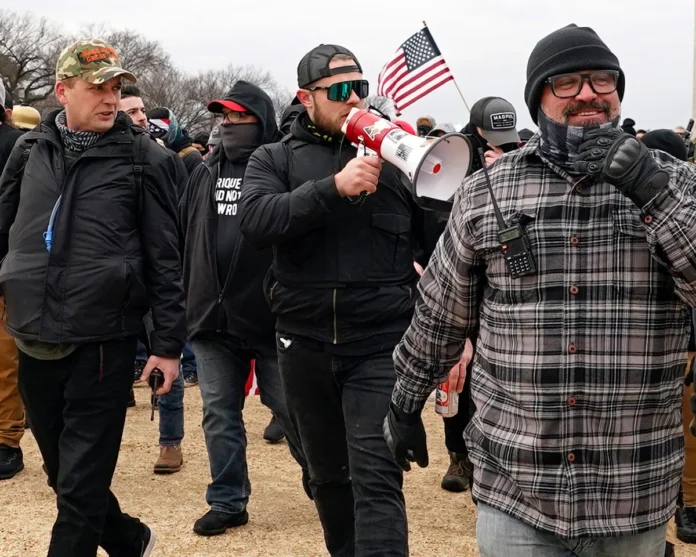
A federal judge granted the Justice Department’s own request to dismiss the seditious conspiracy case against four top Proud Boys leaders this week, but issued a pointed warning about the broader pattern of clemency and prosecutorial retreat that has unwound nearly the entire body of January 6 criminal accountability. The dismissal closes one of the most significant remaining prosecutions connected to the Capitol attack, following the Justice Department’s earlier moves to vacate related convictions and abandon appeals against other Trump allies. The ruling underscores how thoroughly the legal consequences of January 6 have been dismantled through a combination of blanket pardons, commutations, and now direct prosecutorial abandonment.
Story Highlights
- U.S. District Judge Timothy Kelly dismissed seditious conspiracy charges against Proud Boys leaders Ethan Nordean, Joseph Biggs, Zachary Rehl, and Dominic Pezzola
- The four had been excluded from Trump’s original blanket January 6 pardon but saw their case dropped at the Justice Department’s own request
- The Justice Department has separately moved to vacate Steve Bannon’s contempt conviction and stopped defending Peter Navarro’s related case on appeal
What Happened
U.S. District Judge Timothy J. Kelly granted a Justice Department request on Friday, July 10, to dismiss the seditious conspiracy case against four leaders of the Proud Boys extremist group who led a violent mob into the U.S. Capitol on January 6, 2021. The defendants, Ethan Nordean, Joseph Biggs, Zachary Rehl, and Dominic Pezzola, had been convicted or faced charges connected to what prosecutors originally described as a coordinated plan to obstruct the certification of the 2020 presidential election, among the most serious charges brought against any January 6 defendant.
Notably, the four Proud Boys leaders were among the small group of defendants specifically excluded from Trump’s sweeping January 20, 2025 clemency proclamation, which granted pardons to approximately 1,500 individuals connected to the Capitol attack and commuted the sentences of 14 others, including the Proud Boys and Oath Keepers leaders convicted of seditious conspiracy. Rather than including them in the original blanket pardon, Trump commuted their sentences while leaving certain legal proceedings technically unresolved, a distinction that mattered significantly for the roughly 470 cases across the broader January 6 docket that remained in various stages of ongoing litigation at the time of the clemency proclamation, according to figures previously released by the District of Columbia U.S. Attorney’s Office.
Judge Kelly’s dismissal order, while granting the Justice Department’s request, included language expressing concern about the broader pattern underlying the department’s approach to January 6 cases. The dismissal followed a string of related Justice Department actions unwinding accountability measures connected to the Capitol attack, including the department’s move to vacate the criminal contempt of Congress conviction against Steve Bannon, a former senior Trump adviser who had been convicted for defying a congressional subpoena related to the January 6 investigation, and its decision to stop defending a similar contempt conviction against Peter Navarro, a top trade adviser to the president, in his ongoing appeal.
These prosecutorial retreats have unfolded alongside a parallel and now largely defunct effort to financially compensate January 6 defendants through the Trump administration’s proposed $1.776 billion “anti-weaponization fund.” Dozens of January 6 rioters had reportedly signaled intent to apply for payments from the fund before a federal judge blocked its establishment in early June following bipartisan congressional backlash, concerns that centered specifically on the prospect of taxpayer funds compensating individuals convicted of violent offenses, including assaults on police officers who defended the Capitol during the attack.
The Justice Department’s pattern extends beyond the courtroom as well. Trump administration appointees have also fired numerous FBI officials and career prosecutors who investigated the January 6 attack, further reshaping the institutional apparatus that had originally built the cases against the Proud Boys, Oath Keepers, and hundreds of other defendants.
Why It Matters
The dismissal of the Proud Boys case represents the effective conclusion of federal accountability for what the Justice Department itself once described as the largest single criminal investigation in American history, encompassing more than 1,580 defendants charged in connection with the assault on the Capitol. The systematic unwinding of that investigation, through blanket pardons, targeted commutations, vacated convictions, abandoned appeals, and now direct case dismissals, raises fundamental questions about the durability of criminal accountability for political violence when the beneficiaries of that violence subsequently gain control of the prosecutorial apparatus that investigated them.
For law enforcement officers who defended the Capitol during the attack, many of whom testified against the Proud Boys and other defendants at considerable personal and professional risk, the dismissal represents a direct repudiation of the legal process that had validated their experiences and the severity of the violence they confronted. Legal experts and former DOJ officials have previously expressed concern that releasing or clearing violent January 6 offenders creates tangible safety risks for the prosecutors, judges, and witnesses who participated in their original prosecutions, concerns that gain additional weight as each successive case is unwound.
The broader pattern also illustrates a significant separation-of-powers dynamic: while the presidential pardon power is a well-established and largely unreviewable constitutional authority, the Justice Department’s affirmative decision to abandon ongoing prosecutions and stop defending existing convictions on appeal, as occurred with the Navarro case, represents a different and arguably more discretionary form of prosecutorial retreat, one that raises separate questions about whether such decisions reflect genuine legal judgment or political loyalty to defendants connected to the administration.
For future accountability efforts, whether connected to January 6 or other politically sensitive matters, the episode establishes a significant precedent regarding the extent to which an incoming administration can systematically dismantle prosecutions initiated by a prior administration, a pattern that could theoretically be replicated by future presidents of either party seeking to protect allies from legal consequences for actions taken in service of a political cause.
Economic and Global Context
The financial dimensions of the January 6 prosecutorial unwinding extend well beyond the now-abandoned compensation fund. The original investigation and prosecution effort, spanning more than four years and involving thousands of FBI agents, federal prosecutors, and court personnel, represented a substantial ongoing taxpayer investment that has now been rendered largely moot through the combination of pardons, commutations, and case dismissals, raising questions about the ultimate return on that extensive law enforcement investment.
Internationally, the treatment of individuals convicted of participating in an attack on a nation’s legislative body during the certification of a democratic election carries significant symbolic weight for how other democracies assess the strength and independence of American judicial institutions. Comparative democracy researchers have noted that the systematic reversal of criminal accountability for insurrectionary violence represents an unusual pattern among established democracies, where such prosecutions, once concluded, typically remain durable regardless of subsequent changes in political leadership.
The pattern of vacated convictions and abandoned appeals connected to figures like Bannon and Navarro also carries implications for the broader enforcement of congressional subpoena power, a tool Congress relies upon for oversight functions across administrations of both parties. If contempt of Congress convictions can be reliably vacated once allies of the convicted individual gain control of the Justice Department, the practical deterrent value of congressional subpoenas against future witnesses who might otherwise refuse to comply is substantially diminished.
Domestically, the controversy continues to generate significant media and advocacy organization attention, with groups tracking the specific criminal histories of pardoned January 6 defendants documenting that at least 14 pardon recipients have since faced charges or convictions related to child sexual abuse material or sex crimes, and at least six have faced domestic violence charges, findings that have fueled ongoing public debate about the wisdom and scope of the original blanket clemency decision.
Implications
In the near term, the Proud Boys case dismissal likely closes the door on any remaining significant federal criminal accountability connected to January 6, barring unforeseen future legal developments, effectively completing a process that began with Trump’s first-day blanket pardon proclamation and has continued through a steady stream of subsequent prosecutorial retreats.
For law enforcement officers and Capitol Police personnel who testified in the original prosecutions, the dismissal may prompt renewed advocacy for alternative accountability mechanisms, potentially including congressional investigation, civil litigation, or historical documentation efforts, given that the primary federal criminal pathway has now been effectively exhausted.
For congressional oversight committees, particularly House and Senate Judiciary Democrats, the pattern of dismissals and vacated convictions is likely to feature prominently in ongoing oversight hearings and public statements questioning the current Justice Department leadership’s independence, adding to the broader set of controversies already complicating Todd Blanche’s confirmation process.
For future administrations of either party, the episode establishes a consequential precedent regarding the scope of executive authority to unwind prior prosecutorial efforts connected to politically significant events, a precedent legal scholars will likely study closely as they assess the durability of criminal accountability across changes in presidential administration going forward.
Sources