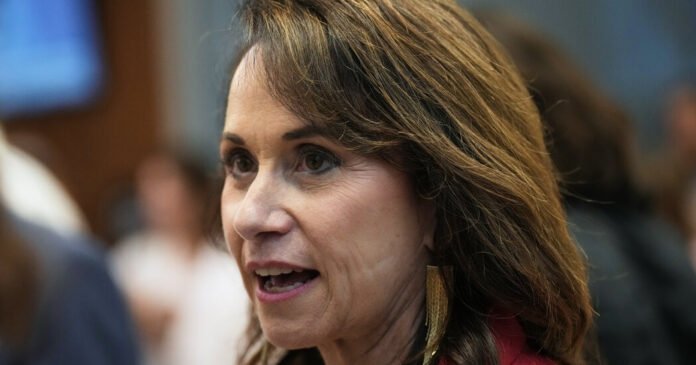
Louisiana Attorney General Liz Murrill, a prominent Trump-aligned state official, was indicted on 16 felony counts by a New Orleans grand jury this week over allegations she intimidated local officials, only to see the state’s highest court stay the proceedings within 24 hours amid claims of serious procedural irregularities. Governor Jeff Landry immediately pledged to pardon Murrill if she is ultimately convicted, setting up a politically charged legal showdown between state and local authorities. The case has become a flashpoint in an escalating power struggle between Louisiana’s Republican leadership and Democratic officials in New Orleans.
Story Highlights
- A New Orleans grand jury indicted Attorney General Liz Murrill on eight counts of malfeasance in office and eight counts of public intimidation.
- The charges stem from letters Murrill allegedly sent warning New Orleans officials their jobs were at risk if they opposed a state law restructuring city court positions.
- The Louisiana Supreme Court stayed the indictment less than 24 hours later, citing potential conflicts of interest and procedural irregularities in the grand jury process.
- Governor Jeff Landry pledged to pardon Murrill if she is convicted and ordered a state police investigation into the grand jury proceedings.
What Happened
Louisiana Attorney General Liz Murrill, a Republican and prominent ally of the Trump administration on immigration and election-related legal matters, was indicted on July 2 by an Orleans Parish grand jury on 16 felony counts, including eight counts of malfeasance in office and eight counts of public intimidation. Special prosecutor Laurie White, a former judge appointed to oversee the investigation, confirmed the indictment at a press conference outside the courthouse, stating simply that “the grand jury has returned an indictment, it is now a criminal matter.” An Orleans Criminal District judge subsequently issued a warrant for Murrill’s arrest and set her bond at $25,000 per charge, totaling $400,000.
The charges stem from letters Murrill allegedly sent in May to several New Orleans officials, including Mayor Helena Moreno, District Attorney Jason Williams, who recused himself from the matter, and five city council members. Prosecutors allege the letters warned these officials that their jobs could be at risk if they continued opposing a new state law that eliminated a position within the city’s court clerk system, a position that would have been held by newly elected official Calvin Duncan. The law consolidating the city’s criminal and civil clerk positions was pushed by Governor Jeff Landry, and the New Orleans City Council had pushed back against the change by voting to appoint an interim clerk and call a special election, setting up a direct confrontation between state and local authority over control of city institutions.
Murrill responded forcefully to the indictment, calling the underlying investigation “corrupt” and characterizing the charges themselves as “retaliatory, meritless, and unconstitutional.” In a statement, she connected the prosecution directly to her broader law enforcement record, stating, “After taking on violent crime and entrenched corruption in New Orleans, it’s no surprise the status quo is looking for ways to stop me.” Governor Landry offered immediate and vocal public support, writing on social media that Murrill would not need to worry about her reputation being tarnished by what he called a “kangaroo grand jury” and pledging to pardon her “as fast as the law allows” should she ultimately be convicted. Landry further ordered the Louisiana State Police to investigate alleged improprieties in the grand jury proceedings themselves.
The case took a dramatic turn less than 24 hours after the indictment was issued, when the Louisiana Supreme Court granted Murrill’s emergency motion for a stay, remanding the case back to district court and allowing her to pursue formal defensive motions, including a motion to quash the indictment entirely. In its ruling, the state’s highest court cited what it described as “considerable support” for the argument that Murrill was likely to succeed on the merits of such a motion, pointing specifically to potential conflicts of interest involving special prosecutor Laurie White, who had previously represented Duncan in an unrelated matter, as well as reports that journalists were reportedly “handcuffed and removed” from grand jury proceedings that Louisiana law requires to occur in open court.
Why It Matters
This case represents a significant test of institutional accountability mechanisms at the state level, illustrating the complex and sometimes contentious relationship between elected law enforcement officials and the judicial processes meant to hold them accountable when allegations of misconduct arise. The rapid sequence of events, an indictment followed within a day by a state supreme court stay citing serious procedural concerns, raises important questions about the integrity of the grand jury process itself, regardless of the ultimate merits of the underlying allegations against Murrill.
The case also highlights a broader pattern of escalating tension between Republican-controlled state governments and Democratic-led major cities over control of local institutions, a dynamic playing out not only in Louisiana but in various forms across the country. The underlying dispute, over control of a New Orleans court clerk position, reflects genuine disagreement about the appropriate balance between state legislative authority and local self-governance, a tension with implications well beyond this single case for how state governments interact with cities that hold different political orientations than the state government as a whole.
Governor Landry’s immediate pledge to pardon Murrill, offered even before any trial or conviction occurred, raises additional questions about the appropriate use of gubernatorial pardon power and whether such early commitments undermine public confidence in the independence of ongoing legal proceedings. While governors retain broad constitutional authority to issue pardons, the timing and framing of Landry’s commitment, effectively signaling the outcome he expects and desires before any evidence has been formally tested in court, illustrates the complex interplay between executive clemency power and the perceived integrity of the judicial process.
Economic and Global Context
While this case is primarily a matter of state-level governance and accountability, it carries broader implications for how legal and political disputes between different levels of government are resolved, particularly in politically significant cities like New Orleans that play substantial roles in state and regional economic activity through tourism, shipping, and cultural industries. Prolonged legal and political conflict over control of city institutions carries the potential to create governance uncertainty that could affect municipal bond markets, business investment decisions, and public confidence in local government stability.
The case also intersects with Murrill’s broader national profile as a Trump-aligned state attorney general who has been active on numerous high-profile legal matters, including supporting Trump’s 2024 presidential immunity arguments before the Supreme Court and pursuing aggressive legal positions on abortion enforcement and immigration cooperation with federal authorities. Her national visibility on these issues means the outcome of this state-level prosecution carries reputational stakes that extend beyond Louisiana’s borders, potentially affecting how other conservative state attorneys general approach similar high-profile legal and political confrontations with Democratic-led municipalities.
Legal experts quoted in coverage of the case have noted the unusual complexity of prosecuting a state’s chief law enforcement officer, given the inherent conflicts of interest such a prosecution can create throughout the judicial system, from special prosecutor selection to potential appellate review. This structural challenge illustrates broader questions about how legal systems can effectively hold the most senior law enforcement officials accountable when allegations of misconduct arise, given that those same officials often maintain extensive relationships throughout the very judicial apparatus responsible for evaluating such allegations.
Implications
For Louisiana’s legal and political establishment, the case is likely to generate continued litigation over the coming months as Murrill pursues motions to dismiss the charges entirely, with the state supreme court’s initial stay suggesting a reasonably strong likelihood that the underlying indictment could ultimately be quashed on procedural grounds even before the substantive merits of the intimidation allegations are fully litigated.
For New Orleans city officials, including Mayor Moreno and the city council members named in the original complaint, the case represents a continuation of an already tense relationship with state government over control of local institutions, a conflict likely to persist regardless of the ultimate outcome of the criminal case against Murrill specifically.
For voters and observers of Louisiana politics more broadly, the case offers a vivid illustration of how partisan and institutional conflicts between state and local government can escalate into high-stakes legal confrontations, with the eventual resolution likely to shape how similar disputes between state officials and municipal governments are approached in Louisiana and potentially in other states experiencing similar state-local political tensions.
Sources