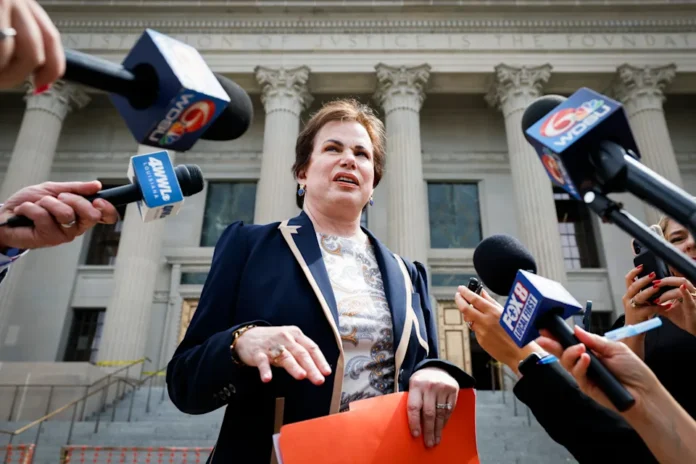
Louisiana’s highest court moved swiftly to stay a 16-count criminal indictment against Republican Attorney General Liz Murrill just hours after a New Orleans grand jury handed up the charges, in a case that has exposed deep fractures between the state’s Republican leadership and Democratic officials in New Orleans. The court’s intervention, unusual in its speed and scope, cited serious procedural irregularities in how the grand jury proceedings were conducted. The dispute traces back to a Trump-era Supreme Court redistricting ruling that reshaped Louisiana’s congressional map and ignited the underlying political conflict.
Story Highlights
- The Louisiana Supreme Court stayed a 16-count indictment against Attorney General Liz Murrill less than 24 hours after a New Orleans grand jury issued the charges.
- The court later voted 4-3 to recall Murrill’s arrest warrant entirely, citing conflicts of interest and grand jury secrecy violations.
- The underlying dispute stems from a state law consolidating New Orleans clerk of court positions, enacted after the Supreme Court’s Callais v. Louisiana redistricting decision.
What Happened
A New Orleans grand jury indicted Louisiana Attorney General Liz Murrill, a Republican, on 16 felony counts of malfeasance in office and intimidation on July 2, related to letters she sent in May to seven elected officials in New Orleans. Special prosecutor Laurie White confirmed the charges, which stemmed from allegations that Murrill’s letters threatened Mayor Helena Moreno, District Attorney Jason Williams, and five city council members with removal from office if they defied a new state law consolidating the city’s criminal and civil clerk of court positions into one office.
The underlying political conflict traces back to the U.S. Supreme Court’s ruling in Callais v. Louisiana, a redistricting case that set in motion a Republican plan to eliminate one of the state’s two majority-Black congressional districts. Louisiana Governor Jeff Landry, a Republican, subsequently postponed U.S. House primaries and pushed through legislation consolidating the Orleans Parish clerk positions, which would have eliminated a role that newly elected Democrat Calvin Duncan was set to hold. New Orleans officials responded by installing an interim clerk and calling a special election, actions Murrill’s letters warned could result in their removal from office.
Murrill filed an emergency motion with the Louisiana Supreme Court within hours of her indictment, asking the court to either quash the charges or stay the proceedings entirely. The court granted the stay early the following morning in an unsigned opinion joined by a five-member majority, finding “considerable support for the view that the Attorney General is likely to succeed on the merits of a motion to quash this indictment on either a legal basis or due to apparent procedural irregularities.” The court specifically flagged concerns that special prosecutor White had a potential conflict of interest, since Murrill’s office was representing White as a defendant through appointed counsel in an unrelated sexual harassment case, and that White had improperly contacted the attorney general’s office to discuss the pending indictment, allegedly violating grand jury secrecy rules.
The court also cited reports that journalists and an attorney for a television station had been “handcuffed and removed” from what state law requires be open grand jury proceedings. Chief Justice John Weimer and Justice John Michael Guidry dissented from the stay order. Later that same night, after Murrill said the special prosecutor’s office refused to remove the active arrest warrant despite the stay, the Louisiana Supreme Court issued an additional order recalling the warrant entirely by a 4-3 vote, with Weimer, Guidry, and Justice Piper Griffin dissenting from that specific action, even though Griffin had supported the initial stay.
Murrill, who was never taken into custody during the legal proceedings, characterized the prosecution as a “political witch hunt” in a public statement, saying, “Neither the grand jury investigation law nor the public intimidation law was intended to be used as a political weapon by a rogue, biased, vindictive special prosecutor, judge, and grand jury.” She indicated she would file additional motions seeking to have the charges dismissed entirely and vowed to continue performing her official duties without interruption.
Why It Matters
The case represents an extraordinary escalation in the use of criminal prosecution as a tool in state-level political disputes, raising fundamental questions about the boundaries between legitimate law enforcement and politically motivated prosecution of sitting officials. When a sitting attorney general can be indicted and have an arrest warrant issued within hours based on letters sent in the course of official policy disagreements, it raises significant concerns about the potential weaponization of the criminal justice system against political opponents, regardless of which party initiates such actions.
The speed and scope of the Louisiana Supreme Court’s intervention, which one dissenting justice noted would rarely, if ever, occur for a typical criminal defendant, also raises important questions about equal treatment under the law and whether elected officials receive judicial consideration unavailable to ordinary citizens facing similar criminal charges.
The dispute’s roots in the Callais v. Louisiana redistricting case connect this state-level political conflict directly to the broader national battle over congressional district maps following recent Supreme Court rulings, illustrating how federal judicial decisions on voting rights and redistricting can generate significant downstream political and legal conflicts at the state and local level.
For Louisiana voters and residents, the unresolved conflict between state Republican leadership and New Orleans Democratic officials over control of court administration positions represents a broader test of how effectively local democratic institutions can function amid intense partisan conflict over redistricting and representation.
Economic and Global Context
While primarily a state-level political and legal dispute, the case underscores broader national trends in how redistricting battles following major Supreme Court rulings continue to generate significant secondary political conflicts at the state and local level nationwide, as states navigate the practical implementation of new congressional maps and related administrative changes.
The prosecution and its swift judicial reversal have drawn attention from national legal observers and government accountability organizations interested in how state judicial systems handle politically charged prosecutions of sitting officials, particularly regarding the procedural safeguards, or lack thereof, that govern grand jury proceedings and prosecutorial conduct in politically sensitive cases.
The case also highlights ongoing tensions between Louisiana’s Republican state government and Democratic-led New Orleans that extend beyond this specific dispute, reflecting a broader pattern of state-local political conflict seen in various forms across multiple states where state government control and major urban centers are held by opposing political parties.
Implications
For Louisiana’s legal and political landscape, Murrill’s planned motions to dismiss the charges entirely will likely keep the case in the public eye for months, with her ability to continue serving as attorney general largely unaffected in the near term given the stay and warrant recall.
For special prosecutor Laurie White and the New Orleans grand jury process, the Supreme Court’s pointed criticism of procedural irregularities may prompt broader scrutiny of how grand jury proceedings are conducted in Orleans Parish, particularly regarding transparency requirements and conflict-of-interest safeguards for special prosecutors.
For national observers watching the aftermath of Callais v. Louisiana, the case serves as an early illustration of how redistricting-driven political conflicts can escalate into criminal prosecutions of sitting officials, a dynamic that may recur in other states navigating similar post-redistricting administrative and political disputes in the months ahead.
Sources
“Louisiana Supreme Court issues stay in indictment of AG Liz Murrill.”