Story Highlights
- Maduro and Flores appeared for a March 26 pretrial hearing and are set to return to court June 30
- The Trump administration revoked permission for Venezuela to fund Maduro’s legal fees hours after granting it, triggering a Sixth Amendment challenge
- Federal Judge Alvin Hellerstein declined to dismiss the case over the funding dispute but signaled the issue may require further review
What Happened
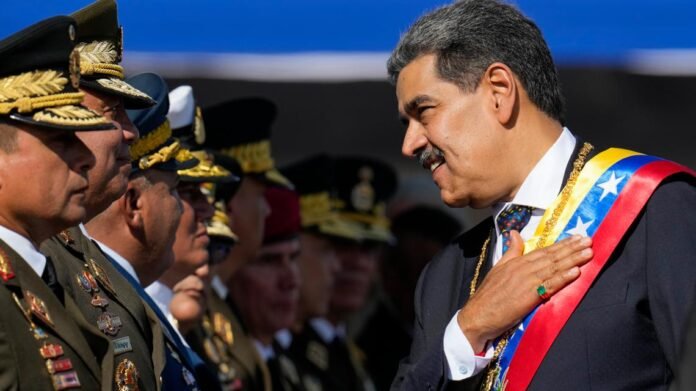
Nicolás Maduro and his wife Cilia Flores appeared before U.S. District Judge Alvin Hellerstein in the Southern District of New York on March 26 for a pretrial status conference — their second court appearance since being captured and brought to the United States in January. The hearing lasted approximately one hour and addressed procedural matters including discovery timelines, potential motions, and the ongoing dispute over legal fee payment.
Both defendants are charged with narco-terrorism conspiracy, cocaine-importation conspiracy, and weapons charges under a superseding indictment unsealed January 3, 2026. The original case, filed in 2011 and unsealed in 2020, alleged that Maduro and his associates conspired with Colombian guerrilla organizations including FARC to traffic cocaine into the United States. The January 2026 indictment expanded the charges and added multiple co-defendants including Maduro’s son, Interior Minister Diosdado Cabello, and other senior Venezuelan officials.
The most contentious issue at the March hearing was the funding of Maduro’s legal defense. His attorney, Barry Pollack — who previously represented WikiLeaks founder Julian Assange — has argued that the Venezuelan government has a legal obligation to fund Maduro’s defense and that blocking those funds violates the Sixth Amendment right to counsel of choice. The U.S. Treasury’s Office of Foreign Assets Control granted permission for Venezuelan government funds to cover the fees on January 9, then revoked it without explanation within three hours.
Judge Hellerstein declined to dismiss the case on those grounds at this time but indicated the issue remained live and that he would issue a written decision soon. Hellerstein observed that in a case of this complexity — involving classified evidence, international law questions, and extensive discovery — it is unrealistic to expect adequate representation without the funding Maduro’s lawyers require.
Why It Matters
The Maduro prosecution is the most legally novel criminal case before a U.S. federal court in decades. It combines questions of international law, executive authority, criminal jurisdiction, and constitutional rights in a single proceeding that has no clear precedent in the American legal system. The closest analogue is the prosecution of former Panamanian leader Manuel Noriega, who was captured during the 1989 U.S. military intervention and tried in Miami.
In the Noriega case, courts found that the United States had not recognized Noriega as Panama’s head of state at the time of his seizure, which supported jurisdiction. The January 2026 indictment against Maduro acknowledges that he was Venezuela’s president and “now de facto ruler” at the time of his capture — a characterization that his defense team argues entitles him to head-of-state immunity under international law.
The administration’s decision to block Venezuelan government funding for Maduro’s defense is an additional layer of legal complexity. If the court ultimately rules that the Treasury’s revocation of the funding license violated Maduro’s Sixth Amendment rights, the case could face dismissal or at minimum a significant setback. That outcome would be politically embarrassing for an administration that framed the capture of Maduro as a signature law enforcement achievement.
President Trump signaled at a Cabinet meeting shortly before the March hearing that additional charges against Maduro are forthcoming. “Other cases are going to be brought as you probably know,” Trump said. If proven, the charges outlined in the 2026 indictment alone carry the potential for life imprisonment, making this one of the most consequential federal prosecutions in modern history.
Economic and Global Context
Venezuela’s oil resources remain central to the broader political and economic calculus of the intervention. Venezuela holds the world’s largest proven oil reserves — estimated at 17 percent of the global total, or approximately 300 billion barrels. The Trump administration has made clear that U.S. oil companies are expected to re-enter Venezuela to rebuild infrastructure that was nationalized under Hugo Chávez and allowed to deteriorate under Maduro.
The intervention has displaced Venezuelan oil from global markets in the short term, contributing to the energy price disruption already driven by the Iran war and the closure of the Strait of Hormuz. U.S. sanctions continue to apply to Venezuelan oil exports under the acting government of Delcy Rodríguez, though the political transition underway in Caracas remains deeply uncertain.
Opposition leader María Corina Machado, who won the 2024 Venezuelan presidential election by the opposition’s count and has received the Nobel Peace Prize, met privately with Trump in January. She has publicly supported the operation while criticizing the administration for not immediately empowering the democratic opposition. The question of who ultimately governs Venezuela — and under what framework — remains unresolved more than four months after the operation.
Implications
The June 30 hearing is expected to produce a clearer picture of the trial timeline. Legal experts have consistently said that a trial is unlikely in 2026, given the case’s complexity, the volume of potentially classified evidence, and the unresolved legal fee dispute. A more realistic projection places the trial in 2027 at the earliest, meaning the political and legal dimensions of the case will continue to unfold through and beyond the midterm elections.
For the Trump administration, the case is both a political asset and a legal liability. As a symbol of decisive executive action against a foreign adversary, it appeals to the administration’s political base. As a legal proceeding that highlights constitutional tensions and the limits of executive authority, it may produce setbacks that undercut the narrative.
For Venezuela, the country remains in a political limbo — formally governed by the Maduro-aligned Rodríguez government, subject to ongoing U.S. sanctions, and without a clear pathway to the democratic transition that both Washington and the opposition have said they want.
Sources
“Nicolás Maduro and his wife appear in federal court again for pretrial hearing”