Story Highlights
- Project costs have grown from an initial $200 million estimate to $600 million
- Records show roughly $307 million in taxpayer funds covering portions of the project
- Funds were drawn from the Secret Service, White House Military Office, and Executive Residence accounts
What Happened
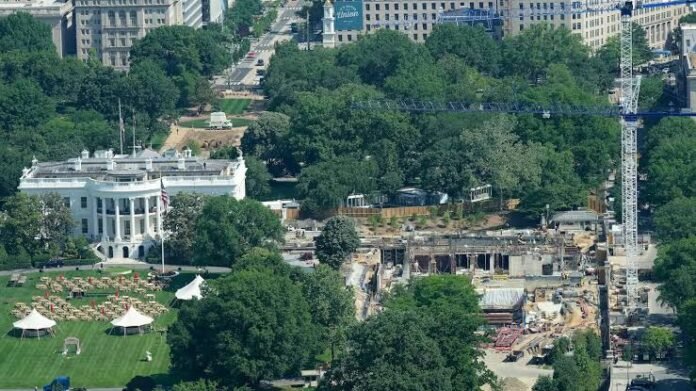
President Donald Trump’s White House ballroom project, first announced in July 2025, has seen its publicly stated cost estimate climb dramatically over the past year, from an initial $200 million figure to $300 million, then $400 million, and ultimately to a documented $600 million according to internal contractor records reviewed by The Washington Post. Throughout this escalation, Trump repeatedly and publicly insisted the project would be funded entirely by private donors, telling reporters at various points that “not one penny is being used from the federal government” and that the structure would come at “zero cost to the American Taxpayer.”
However, a project summary dated March 5 and obtained by The Washington Post showed that of the $600 million total, approximately $293 million was expected to come from private donors, while the remainder would be drawn from taxpayer-funded government accounts. Specifically, reporting indicates roughly $155 million was pooled from Secret Service funds, $149 million from the White House Military Office, and an additional $3 million from the Executive Residence budget, totaling more than $307 million in public money supporting a project Trump has consistently described as privately financed.
The ballroom, now rebranded by the White House as the “Great National Security Facility and Ballroom,” replaces the East Wing of the White House, which was demolished last year to clear space for construction. Trump has described the underground component of the project in increasingly elaborate terms, telling reporters in May that the structure would extend approximately six stories deep and include a military hospital, research facilities, and a drone-capable rooftop system he has called a “DronePort.” The shift in framing, from a purely ceremonial event space to a facility justified primarily on national security grounds, has drawn skepticism from lawmakers and architectural historians alike.
Republican lawmakers separately proposed up to $1 billion in additional federal funding for security upgrades tied to the project, a request that ran into resistance on Capitol Hill from members of both parties concerned about the cost and the precedent of linking the ballroom to broader spending legislation. The Senate ultimately rejected a $1 billion payment request from the administration, explicitly citing Trump’s earlier promises that taxpayer dollars would not be involved.
The project has also faced sustained legal challenges. The National Trust for Historic Preservation sued the administration in December over the East Wing’s demolition, arguing it occurred without proper historical review. A federal judge separately ruled that congressional approval was required for aspects of the project, a ruling the administration has continued to contest while construction proceeds.
Why It Matters
The gap between Trump’s public statements and the project’s actual funding structure raises fundamental questions about transparency and accountability in how the executive branch manages public resources. For American taxpayers, the redirection of Secret Service and military funding toward a ceremonial and now reframed “security” structure represents a use of public money that was never explicitly authorized by Congress through the normal appropriations process, a point that has drawn objections from lawmakers across the political spectrum.
The controversy also illustrates a broader pattern of executive branch spending decisions occurring outside traditional congressional oversight mechanisms. Senator John Curtis, a Utah Republican, has publicly noted that if taxpayers are footing part of the bill, “we have to have a totally different conversation” about how the project was approved and funded, reflecting bipartisan unease about the precedent being set.
For government accountability advocates, the episode underscores ongoing concerns about the use of historically protected federal properties and the redirection of agency-specific funding streams, such as Secret Service and military accounts, toward presidential pet projects without explicit congressional authorization. Critics argue this approach circumvents the checks and balances designed to ensure taxpayer money is spent according to congressionally approved priorities.
The shifting justification for the project, from an event space to a national security facility, also raises questions about whether the security framing is being used retroactively to justify costs and design elements that were originally intended for ceremonial purposes, complicating efforts by Congress and watchdog groups to assess whether the spending is appropriate or proportionate to genuine security needs.
Economic and Global Context
The $600 million ballroom project represents a significant capital expenditure that has drawn comparisons to historical White House renovation efforts, though its scale substantially exceeds prior projects. By comparison, the Lincoln Memorial Reflecting Pool’s most recent major renovation, completed between 2010 and 2012, cost approximately $34 million using funds from the American Recovery and Reinvestment Act.
The project’s private fundraising component has drawn participation from major U.S. corporations, including technology firms and defense contractors, raising separate questions about potential conflicts of interest given that several of these companies maintain extensive business relationships with the federal government. Reporting has also identified instances where private donations of materials, such as a $37 million steel donation from Luxembourg-based ArcelorMittal, coincided with subsequent tariff relief benefiting the donor’s Canadian manufacturing operations, though the White House has not acknowledged any direct connection between the two.
Globally, the project has drawn attention as part of a broader pattern of monument and infrastructure projects undertaken during Trump’s second term, including the Lincoln Memorial Reflecting Pool resurfacing and a proposed triumphal arch, which together reflect a significant reshaping of Washington’s federal landscape and have prompted commentary from international observers about the symbolism and cost of these initiatives during a period of broader fiscal constraint.
Construction contractor Clark Construction has continued work on the project despite the ongoing legal challenges, with above-ground construction permitted to continue through at least June 2026 under current court orders, though the underlying legal disputes over congressional authorization remain unresolved.
Implications
The Trump administration is expected to continue defending the project’s funding structure, with White House officials maintaining that security-related expenditures from the Secret Service and military budgets fall within existing agency authority rather than requiring new congressional appropriation. This interpretation is likely to face continued legal and legislative challenges in the coming months.
For congressional appropriators, the revelation is likely to fuel further oversight hearings and information requests, particularly from lawmakers seeking clarity on the legal basis for redirecting Secret Service and military funds toward the project without explicit authorization.
For the National Trust for Historic Preservation and other plaintiffs in ongoing litigation, the funding revelations may provide additional grounds for legal challenges, particularly regarding whether the project’s true scope and purpose were accurately represented during the public comment and approval process.
For voters, the episode adds to a broader national conversation about executive branch spending transparency heading into the 2026 midterm elections, with both parties likely to continue citing the project as either an example of presidential overreach or, alternatively, necessary security modernization, depending on political perspective.
Sources
“Records reveal $600M estimate for Trump’s ballroom project, with half from taxpayers”