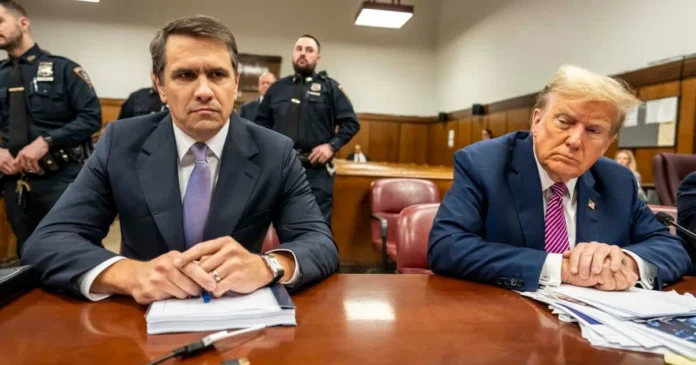
A stunning intra-party rebellion erupted on Capitol Hill last week when Senate Republicans refused to advance a major immigration enforcement spending bill after the Trump administration quietly attached a $1.8 billion fund to compensate individuals it claims were targeted by the Biden-era Justice Department. The confrontation forced Senate Majority Leader John Thune to abandon a scheduled vote and send lawmakers home for the Memorial Day recess empty-handed, blowing past Trump’s self-imposed June 1 deadline. The episode has laid bare the growing fractures between the White House and Republican legislators who fear the fund will become an electoral liability in November.
Story Highlights
- Senate Republicans walked out of a closed-door briefing with Acting Attorney General Todd Blanche more agitated than when they entered, with roughly half of the 45 senators present openly criticizing the fund.
- The proposed fund could potentially compensate January 6 Capitol rioters convicted of assaulting police officers, a prospect that senior Republicans described as indefensible.
- The legislative impasse stalled a $72 billion immigration enforcement package that Trump had demanded be delivered to his desk before June 1.
What Happened
Senate Republicans departed for recess without passing President Donald Trump’s immigration enforcement package after the Justice Department’s controversial “anti-weaponization” fund sparked a revolt within the GOP. Senators said they were blindsided by the $1.8 billion fund for individuals claiming they had been unfairly treated by past Justice Departments, and the controversy threatened to derail the immigration enforcement package entirely.
The fund was created through a settlement of Trump’s lawsuit against the IRS. Trump defended it publicly, writing that he was helping others “who were so badly abused by an evil, corrupt, and weaponized Biden Administration receive, at long last, JUSTICE.” The announcement landed without warning while Republican leaders were working to build final consensus on the broader spending package, catching the caucus off guard.
Hours before senators were scheduled to vote, they instead refused to advance the key bill. Acting Attorney General Todd Blanche made an unplanned trip to the Capitol to personally argue the case for the fund. After a two-and-a-half-hour meeting that participants described as tense, Republican senators decided they would go home and pass nothing, unconvinced by Blanche’s arguments.
Senator Ted Cruz of Texas reported that at least half of the 45 senators in the room were “blasting the attorney general.” Senator Thom Tillis said the prospect that the fund could potentially compensate someone who had assaulted a police officer was “absurd.” Senator Mitch McConnell described a fund that could serve as “a slush fund to pay people who assault cops” as “utterly stupid” and “morally wrong.”
The Senate impasse ultimately prompted the White House to scrap a planned meeting between Trump and House Speaker Mike Johnson about the funding package, and the House canceled its Friday votes as well.
Why It Matters
The revolt is significant not merely because it stalled one piece of legislation, but because it represents one of the most organized acts of congressional Republican defiance since Trump returned to the White House. In a caucus that has consistently deferred to presidential preferences, the willingness of sitting senators — including some of Trump’s most reliable allies — to openly confront his Justice Department is a meaningful indicator of changing political calculus.
The controversy quickly became one of the most politically sensitive issues facing Republicans in Congress, with some lawmakers warning that supporting the proposal could damage the party’s chances in competitive races across the country. With Democrats already polling ahead on the generic congressional ballot and midterm enthusiasm running higher among Democratic voters, Republican legislators are acutely aware that any association with January 6 defendants and government slush funds could prove damaging in swing districts.
The result left in shambles, for now, the GOP’s top priority of passing a roughly $70 billion budget package that would fuel Trump’s immigration and deportation operations for the remainder of his presidential term through 2029. The vote was postponed until Congress resumes next month, blowing Trump’s June 1 deadline.
The episode also reflects a broader exhaustion within the Republican caucus. Trump spent the same week endorsing primary challengers against sitting Republican legislators, including backing Paxton over Cornyn in Texas, a maneuver that strained relationships further. Senators asked to absorb political risk on behalf of an administration that is simultaneously threatening their own colleagues are finding the ask increasingly difficult to fulfill.
Economic and Global Context
The stalled immigration enforcement package carries real fiscal and operational stakes. The $72 billion bill was designed to fund Immigration and Customs Enforcement and Border Patrol operations through the end of Trump’s term in 2029, providing long-term budget certainty for the agencies at the center of the administration’s signature domestic policy agenda. Delays in passage create uncertainty about operational capacity and potentially force the administration to seek emergency supplemental funding through a less predictable congressional process.
The dispute over the fund intensified as Republican senators pushed back against the broader immigration enforcement spending package, exposing deep divisions among congressional Republicans just months before critical midterm elections. The timing compounds the difficulty, as Congress now returns to a compressed calendar with multiple high-priority legislative items competing for floor time.
The anti-weaponization fund itself has drawn legal challenges. Officers who defended the Capitol on January 6 filed suit to block payouts from the $1.8 billion fund. That lawsuit adds a judicial dimension to what is already a politically explosive issue, increasing the likelihood that the fund’s ultimate fate will be determined in court rather than Congress.
Economists and budget analysts have also flagged the unprecedented nature of the fund’s creation through a legal settlement rather than an appropriations process, raising questions about whether the mechanism bypasses the constitutional requirement that Congress control federal spending.
Implications
When Congress returns from recess, Republican leaders in both chambers face the task of reconciling fundamentally different positions on the fund. While many Senate Republicans were furious with the Trump administration, many House Republicans welcomed the idea of compensating what they termed victims of “lawfare.” Their anger was directed instead at their Senate colleagues for leaving town before the immigration package was passed.
That House-Senate divide will need to be bridged before any final bill can reach the president’s desk, and the competing political pressures in each chamber make a clean resolution difficult. Senate Republicans in competitive states will resist including the fund; House Republicans in safe MAGA districts will resist stripping it out.
For Trump, the episode creates a reputational problem on two fronts. He failed to deliver a legislative priority by his own stated deadline, and he did so because members of his own party refused to follow his lead. That image of presidential weakness in Congress, while recoverable, is not the narrative the White House wants circulating as midterm campaigns intensify.
For American taxpayers, the fundamental question raised by the fund — whether public money should be used to compensate political allies of the sitting president through a legal settlement the president negotiated with agencies he controls — will not be easily resolved and is likely to remain a point of partisan contention well into the fall election season.
Source
Republicans revolt over Trump’s $1.8 billion ‘anti-weaponization’ fund