Story Highlights
- A War Powers Resolution to halt the Iran war failed 50-49 on Wednesday, the closest vote yet, with Republican Sen. Lisa Murkowski of Alaska voting with Democrats for the first time
- Sens. Susan Collins of Maine and Rand Paul of Kentucky also voted with Democrats; the deciding vote against the measure was cast by Democratic Sen. John Fetterman of Pennsylvania
- Trump passed the 60-day statutory deadline under the War Powers Act on May 1 without seeking congressional authorization, and Defense Secretary Pete Hegseth told Congress this week the administration believes it has “all the authorities necessary” to continue
What Happened
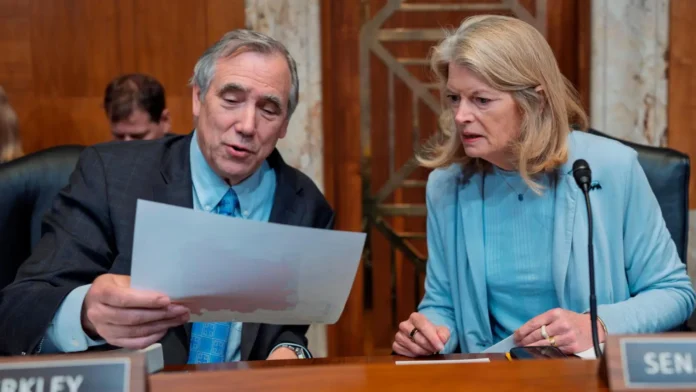
Sen. Jeff Merkley, the Oregon Democrat who has spearheaded his party’s repeated war powers efforts, brought the seventh such resolution to the Senate floor on Wednesday under the 1973 War Powers Resolution, which gives Congress the authority to compel the withdrawal of American forces from unauthorized hostilities. The measure failed to advance, 50-49, falling one vote short of the simple majority needed.
The arithmetic, however, was more significant than the outcome. Sen. Lisa Murkowski, the Alaska Republican who had voted with her party on all six previous Iran war powers resolutions, switched her vote to support the measure. She was joined by fellow Republicans Sen. Susan Collins of Maine, who had previously broken ranks, and Sen. Rand Paul of Kentucky, a consistent war powers skeptic who has backed all seven attempts. On the other side of the partisan divide, Sen. John Fetterman of Pennsylvania — a Democrat and fervent Israel supporter — again voted against the resolution, providing the decisive margin that preserved the Republican position.
Murkowski explained her vote in direct terms. She cited two specific changes since her previous votes: the Trump administration had passed the statutory 60-day deadline under the War Powers Act on May 1 without seeking congressional authorization, and Defense Secretary Pete Hegseth had told her during a Tuesday hearing that the administration believes it has “all the authorities necessary” to resume attacks on Iran without returning to Congress. “You’ve got a timeline that has taken us beyond the 60 days,” Murkowski told reporters after the vote. “I thought that perhaps we would get more clarity from the administration in terms of where we are, and I haven’t received it.”
Republican leadership responded to the vote by defending the president’s authority and questioning Democratic motives. Sen. John Barrasso, the No. 2 Republican in the Senate, declared on the floor that “Iran’s economy is on life support” and its leadership is “eliminated,” arguing the stalemate in the Strait of Hormuz is working in America’s favor. He also dismissed the Democratic effort as fundamentally about undermining Trump rather than genuine constitutional concern. The White House had publicly urged Republicans to block the measure, with Trump warning that limiting his authority would embolden Iran.
Why It Matters
The 1973 War Powers Resolution exists for one precise constitutional purpose: to preserve Congress’s role in the decision to commit American lives and resources to sustained military conflict. The Constitution vests the power to declare war in Congress, not the president. The War Powers Resolution was passed in the aftermath of Vietnam to prevent exactly the kind of open-ended, undeclared military engagement that the United States has been conducting against Iran since February 28, 2026. The 60-day clock that Murkowski referenced is not a technicality — it is the core enforcement mechanism of the law.
The Trump administration’s position — articulated explicitly by Hegseth — that it has “all the authorities necessary” to resume attacks on Iran without further congressional action represents one of the broadest claims of unilateral executive war-making power in American history. It goes beyond the legal theories advanced by previous administrations and asserts, in effect, that the War Powers Resolution does not bind the president in this context. That assertion has not been tested in court, and several legal scholars argue it is flatly unconstitutional.
For the men and women of the American military deployed to the region, the legal ambiguity has real consequences. They are conducting operations under orders that an increasing number of senators — now including three from the president’s own party — believe lack the legal authorization that the Constitution requires. That is not an abstract concern: the legal basis for military orders matters for accountability, for command authority, and for the treatment of service members under international law.
The political trajectory is also significant. Each successive vote that comes closer to passing puts more pressure on Republican senators who are facing competitive reelection environments in 2026. A majority of Americans — according to an April poll of 2,560 adults — now say the Iran war was a mistake. That includes 71 percent of independents and 91 percent of Democrats. While 79 percent of Republican voters still support the war, support drops to 50 percent among “non-MAGA Republicans,” a demographic that matters in general elections.
Economic and Global Context
The economic costs of the Iran war continue to accumulate. The U.S. military campaign has cost approximately $29 billion as of the most recent Pentagon estimate to Congress, a figure that has risen faster than initial projections. Oil prices have increased more than 40 percent since the war began, a supply shock that is flowing through the entire American economy. The Strait of Hormuz remains effectively closed to most commercial shipping, disrupting global trade flows and energy markets in ways that are contributing directly to the 3.8 percent annual inflation rate reported this week by the Labor Department.
The war’s cost to American military readiness is also being scrutinized by Congress. Significant quantities of THAAD and Patriot interceptor missiles have been deployed to the Iranian theater, reducing available inventory for other contingencies including the Taiwan Strait and NATO’s eastern flank. Lawmakers on the Armed Services committees have raised concerns about whether the drawdown of precision munitions and interceptors has created vulnerability windows elsewhere that adversaries could exploit.
Diplomatically, the war continues to strain alliances and relationships that American foreign policy has built over decades. Spain refused to allow the United States to use its air bases, prompting trade threats from Trump. Multiple European governments have expressed concerns through formal diplomatic channels. The U.S.-China summit now underway in Beijing is partly about managing the energy and economic disruptions the war has caused, a dimension of the conflict that has received less coverage than the military operations themselves.
Implications
The arithmetic in the Senate is moving. One more Republican switching sides would produce a tied 50-50 vote, which fails under Senate rules but would be an extraordinary public rebuke of a sitting president from within his own party. Several senators who have not yet voted against the war have signaled privately that they want more information and more consultation from the administration about the war’s objectives, timeline, and exit strategy. If that consultation does not materialize, additional defections become more likely.
The May 31 deadline is the next constitutional milestone. Under the War Powers Act, once the 60-day window has expired, the president has 30 days to disengage forces after Congress demands it. If a resolution were to pass both chambers after May 31, Trump would be legally required to begin withdrawal. Even in the current political environment, where a veto remains virtually certain, passing the resolution would force an override vote and create the clearest possible constitutional confrontation between the branches over war-making power.
For Trump, the political calculation has been that the war powers votes are a nuisance that Republican unity can manage. Murkowski’s defection changes that calculation. She is not a fringe voice in the Republican caucus — she chairs the Interior Appropriations Subcommittee, has a durable political base in Alaska, and survived a primary challenge backed by Trump himself in 2022. Her vote is a signal that institutional concerns about unchecked executive war-making are reaching Republicans who are not ideologically motivated to oppose Trump.
The constitutional stakes could not be higher. If Congress ultimately acquiesces to an open-ended war conducted without authorization — despite a clear statutory deadline, multiple court battles, and now bipartisan dissent in the Senate — it will have established a precedent that future presidents of both parties will invoke to bypass the war powers framework entirely. That outcome would represent a fundamental and potentially irreversible shift in the balance of power between the legislative and executive branches.
Sources
“3 Republicans Join Democrats in Closest Senate Vote Yet to Halt Iran War”