Story Highlights
- It was the 10th time the Senate tried to stop the Iran war; the vote was a stunning turnaround from past efforts, all of which had fallen short of a majority.
- The four Republicans who crossed party lines were Bill Cassidy of Louisiana, Susan Collins of Maine, Rand Paul of Kentucky, and Lisa Murkowski of Alaska.
- A Reuters/Ipsos poll released Tuesday found that only 24 percent of Americans felt the war had been worth the cost.
What Happened
The Senate approved a war powers resolution Tuesday seeking to block U.S. military action against Iran, as lawmakers warily watched President Donald Trump‘s efforts to resolve a conflict that the administration launched on its own and now needs Congress to fund. The resolution directs the president to remove U.S. armed forces from hostilities with Iran unless Congress explicitly authorizes continued military engagement through a formal declaration of war or an authorization for the use of military force.
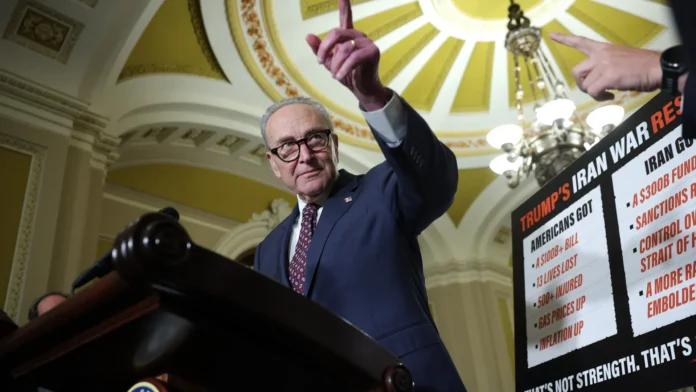
Senate Minority Leader Chuck Schumer and Democrats have repeatedly forced votes to limit Trump’s war powers in both chambers — a campaign that has gradually picked up more GOP support in recent weeks, drawing the president’s ire. The effort finally crossed the threshold needed for passage when the absences of two Republican senators changed the math.
The absences of Republican Sens. Mitch McConnell of Kentucky, who was admitted to the hospital recently for an undisclosed matter, and Dave McCormick of Pennsylvania contributed to the measure’s adoption. The final tally was 50-48. One Democrat, Sen. John Fetterman of Pennsylvania, voted against the measure.
The U.S. and Israel launched large-scale strikes on Iran on February 28, marking the start of the 2026 Iran war. The attacks included the assassination of Supreme Leader Ayatollah Ali Khamenei, as well as Ali Larijani, a key figure in earlier negotiations. Congress had been pushing back against the administration’s military posture almost since the first strikes were launched.
Trump responded with characteristic force. He criticized the resolution after it passed, writing on Truth Social that the senators had “made my job more difficult” and called the vote “poorly timed and meaningless,” insisting he will still reach a deal “one way or the other, because I always get it done.”
Why It Matters
This is the first time both chambers of Congress have passed a concurrent resolution directing a president to remove U.S. armed forces from a warzone under the War Powers Act of 1973. That law was passed in the wake of the Vietnam War to prevent any future president from unilaterally committing the country to prolonged military conflict. Reaching both chambers constitutes a historically significant assertion of legislative authority, even if the resolution is nonbinding.
Concurrent resolutions do not require the president’s signature and do not have the force of law. However, the War Powers Resolution of 1973 states that the president must withdraw U.S. armed forces from hostilities in the absence of congressional authorization. Legal scholars and congressional leaders are now debating whether the resolution carries any binding legal weight.
Before the vote, Sen. James Risch of Idaho argued that passing the resolution would weaken Trump’s standing in negotiations in Switzerland, warning that Iran could simply walk away from the table. That concern highlights the real tension between congressional oversight and diplomatic leverage in an ongoing conflict.
The vote also signals that cracks in Republican Party unity are widening. The fact that four GOP senators were willing to side with Democrats on a high-profile national security vote — just as Trump was preparing to meet with Senate Republicans at the Capitol — underscores the degree to which the Iran war has become a liability for the president and his party.
Economic and Global Context
Prices for essential supplies like oil, natural gas, and fertilizer have spiked since the war began, as a result of the Iranian blockade in the Strait of Hormuz and the U.S. response. Those cost increases have filtered directly into household budgets, making the war one of the most tangible economic events affecting American consumers in the current political cycle.
The Pentagon is seeking $80 billion from Congress mostly for the Iran war as it backfills munitions and restores stockpiles. That funding request will require another round of congressional votes, giving lawmakers fresh opportunities to extract concessions or conditions from the administration before approving the spending.
The evacuation of more than 11,000 sailors stranded in the Persian Gulf because of the war will take a few weeks, according to the head of the International Maritime Organization, with approximately 600 ships stuck since the start of the conflict. The disruption to global shipping routes continues to ripple through supply chains worldwide, affecting everything from energy markets to food prices.
Implications
Technically, the Trump administration should now seek explicit congressional approval for further strikes on Iran. However, previous administrations have found routes around war powers constraints by securing more limited authorizations for the use of military force. The administration is expected to continue its current course while challenging the resolution’s legal standing.
Rep. Gregory Meeks of New York, the ranking member of the House Foreign Affairs Committee, said he will explore all legal avenues to ensure the administration complies with the will of Congress, arguing that the measure is binding under the War Powers Resolution.
Republicans are also facing pressure from voters ahead of November’s midterm elections, which will decide whether the party maintains its control over both the House and Senate. With only 24 percent of Americans saying the war has been worth it, any further military escalation carries enormous political risk for incumbents seeking reelection.
For the constitutional balance of power, the most enduring implication may be the precedent itself. Congress has now demonstrated it can muster enough votes to pass a war powers resolution — and if the political winds shift further, future resolutions may carry even more weight.
Sources
“Senate for first time approves a war powers resolution in a rebuke to Trump over Iran conflict”