Story Highlights
- The Niskanen Center found National Guard deployment in D.C. reduced property crimes by 24% but had no measurable effect on violent crime
- Each Guard member costs taxpayers an average of $607 per day compared to $384 for an MPD officer
- The administration is requesting an additional 1,500 troops for a “summer surge,” bringing total deployment toward 5,000
What Happened
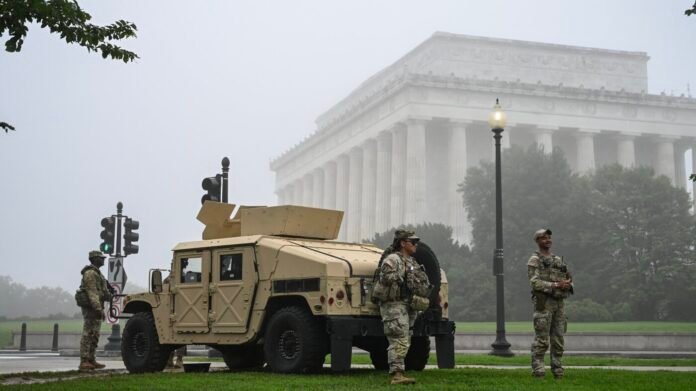
The nonpartisan Niskanen Center released a detailed analysis this month examining the effects of President Donald Trump‘s deployment of National Guard troops to Washington, D.C., which began in August 2025 following Trump’s declaration of a crime emergency in the nation’s capital. The findings, which received renewed attention Wednesday as Trump referenced the D.C. deployment at his Secure America Act signing, directly contradict the administration’s public narrative about the program’s success.
The analysis found that the presence of uniformed military personnel on city streets did produce a 24 percent drop in opportunistic property crimes — such as vehicle break-ins and theft — by creating a visible deterrent. However, the researchers found no measurable effect on violent crime, the category Trump has most prominently cited when justifying the deployment. The study described the Guard as “an expensive tool used in the wrong places for the wrong types of crime.”
Researchers also raised significant cost efficiency questions. The average daily cost per National Guard member in Washington is $607, compared to $384 for a Metropolitan Police Department officer performing similar duties. The study concluded that a more targeted, data-driven MPD mobilization could have produced comparable or better outcomes at substantially lower expense to American taxpayers.
The White House dismissed the analysis, with spokesperson Abigail Jackson calling it an “out-of-touch” assessment by “keyboard warriors” seeking to undermine Trump’s agenda. Trump himself has repeatedly cited the D.C. deployment as evidence of his administration’s public safety credentials, telling supporters that the capital has been transformed from “a crime-ridden city into a safe and beautiful haven.” At the Oval Office ceremony Wednesday, Trump again claimed restaurants in Washington are “reopening” because of his safety measures.
Despite the study’s conclusions, federal officials have announced plans for a “summer surge” that will add approximately 1,500 additional Guard members to the capital ahead of the America250 events commemorating the nation’s 250th birthday, bringing total troop presence toward 5,000.
Why It Matters
The Niskanen Center’s findings represent a significant accountability data point because they directly test the empirical claims the Trump administration has used to justify an unprecedented military deployment on American civilian streets. The question of whether the deployment reduces crime is not a partisan one — it is measurable. When a nonpartisan institution applies standard social science methodology and finds no effect on the crime category most prominently cited by the White House, that finding deserves serious policy consideration regardless of ideological perspective.
The constitutional and governance dimensions of the deployment also warrant attention. Deploying military personnel to patrol civilian streets in a major American city is an extraordinary action with historical precedent in only the most severe domestic emergencies. Trump’s use of the National Guard in Washington builds on his earlier deployment of approximately 4,000 Guard members and 700 Marines to Los Angeles during immigration protests, establishing a pattern of using military assets in contexts that most previous administrations handled through civilian law enforcement.
Washington’s civilian government has strongly objected throughout the deployment. The D.C. Council has argued that the Guard presence intrudes on local officials’ lawful authority to direct law enforcement in the District. A federal judge agreed, ruling at one point that the deployment illegally infringed on local governance authority, before an appeals court allowed it to continue pending further proceedings.
The cost discrepancy between Guard and MPD personnel also raises direct questions about fiscal accountability. At a time when the administration is signing $70 billion enforcement packages and pressing Congress for budget discipline, maintaining a Guard deployment that costs $607 per person per day — when $384-per-day MPD officers would produce comparable or superior results — is difficult to justify on efficiency grounds.
Economic and Global Context
The cumulative cost of the Washington National Guard deployment is substantial. With more than 2,000 troops deployed at an average of $607 per day since August 2025 — a period of approximately 10 months — the total cost of the D.C. deployment alone approaches hundreds of millions of dollars. The administration’s plans to expand to nearly 5,000 troops for the summer will significantly accelerate that expenditure during a period when budget pressures are acute.
The America250 celebrations, which are the stated justification for the summer troop surge, are a high-visibility national event with legitimate security requirements. However, the Niskanen study’s findings suggest the Guard’s operational role in crime reduction does not justify the scale of ongoing deployment, separating the legitimate security rationale for the celebration from the broader law enforcement justification the White House has used throughout.
More broadly, Trump’s D.C. deployment has been cited internationally as an example of military force being used for domestic political signaling. Foreign governments and press freedom organizations have noted that the visible presence of armed military personnel in the capital city of the world’s leading democracy sends a message about civilian-military relations that complicates American diplomatic positions on rule of law and democratic governance elsewhere.
The White House’s announcement of 12,000 arrests by the combined federal task force since operations began — including 62 known gang members and thousands of seized firearms — provides some evidence of enforcement activity, though independent researchers have noted that the ratio of Guard deployment to high-priority arrests remains extremely unfavorable from a cost-effectiveness standpoint.
Implications
The summer surge announcement, coming alongside the Niskanen Center’s findings, sets up a direct evidentiary test. If violent crime in Washington does not decline meaningfully during the period of heightened deployment, the administration’s claims about the Guard’s public safety impact will be further undermined by concrete data. Conversely, if America250 events pass without major incident, the White House will use security outcomes to validate the entire deployment — even if everyday crime patterns remain unchanged.
For D.C. residents and businesses, the doubling of troop presence will create an even more visible military footprint in a city that has not experienced a declared state of emergency comparable to what the administration has described. Primary elections are approaching in the District, and residents’ attitudes toward the Guard presence are likely to influence local political outcomes.
The broader precedent being established matters enormously for governance. If National Guard deployments in civilian cities become a normalized response to crime levels that are historically average or declining, future administrations will inherit a template for using military presence as a political communication tool regardless of empirical justification.
Sources
“National Guard has done little to reduce violent crime in D.C., a new study finds”