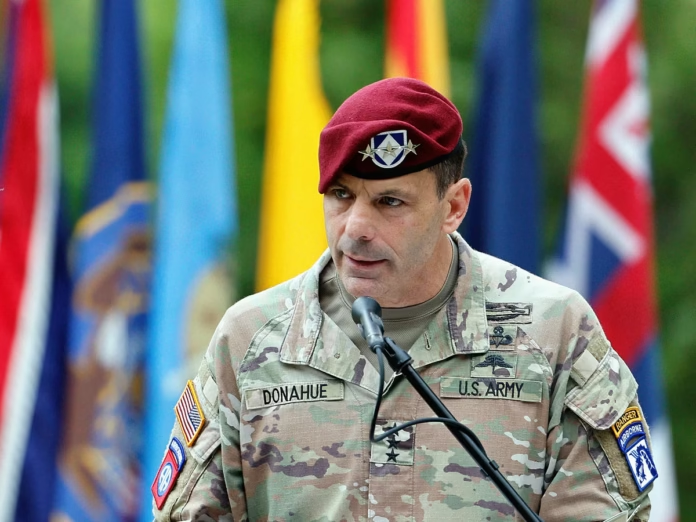
General Christopher Donahue, one of the U.S. Army’s most decorated and widely respected officers, formally relinquished command of U.S. Army Europe and Africa this week after being unexpectedly forced out by Defense Secretary Pete Hegseth. Donahue’s abrupt departure after just 18 months in the role has drawn rare bipartisan criticism in Congress and adds to a growing pattern of senior military leadership changes under Hegseth’s tenure. The episode raises broader questions about civilian-military relations and the criteria driving major personnel decisions at the Pentagon.
Story Highlights
- General Christopher Donahue relinquished command of U.S. Army Europe and Africa in Wiesbaden, Germany, after being ousted by Defense Secretary Pete Hegseth.
- Donahue, widely regarded as the last American service member to leave Afghanistan during the 2021 withdrawal, held the command for only 18 months.
- His departure follows Hegseth’s earlier removal of Army Chief of Staff Gen. Randy George, part of a broader shake-up of senior Pentagon leadership.
- The four-star command Donahue led is reportedly being downgraded to a three-star position as part of Hegseth’s effort to reduce the number of generals across the force.
What Happened
Army General Christopher Donahue formally relinquished command of U.S. Army Europe and Africa during a ceremony held Thursday at Clay Kaserne in Wiesbaden, Germany, marking the end of an unexpectedly brief 18-month tenure in one of the Army’s most significant overseas commands. Donahue’s departure comes after Defense Secretary Pete Hegseth unexpectedly ousted him from the position last month, a move the Army and Pentagon have not publicly explained. Major General Christopher Norrie, Donahue’s deputy, will serve as acting commander until a permanent successor is nominated by the president and confirmed by the Senate.
Donahue, 56, is one of the most recognizable and respected figures within the modern U.S. Army, having spent decades in elite special operations units, including service as an Army Ranger and member of Delta Force, before eventually rising to command that elite unit itself. He later commanded the Army’s 82nd Airborne Division, during which he played a central role in the chaotic 2021 evacuation of American citizens, Afghan allies, and Special Immigrant Visa applicants from Kabul’s international airport. Donahue became a defining visual symbol of that withdrawal when a night-vision photograph captured him boarding the final C-17 aircraft to leave Afghanistan, making him, by widespread public understanding, the last American service member to depart the country during that mission.
At the ceremony marking his departure, Donahue struck a gracious tone despite the abrupt nature of his removal. “I love this team, it has been the honor of a lifetime to be a part of it. I’m proud of what we built and I have absolute confidence in what you will build next,” he told those assembled. In addition to his role overseeing U.S. Army operations across Europe and Africa, Donahue also served as commander of NATO’s Allied Land Forces Command in Izmir, Turkey, a position he is set to relinquish separately on July 9, further underscoring the breadth of his responsibilities at the time of his ouster.
Donahue’s removal followed closely on the heels of Hegseth’s earlier decision to oust Army Chief of Staff Gen. Randy George, and Army Secretary Dan Driscoll had reportedly advocated for Donahue to fill that vacant chief of staff role, or alternatively to serve as the Army’s vice chief of staff, according to a U.S. official who spoke on condition of anonymity. Instead, Donahue was pushed out of his own command entirely. Compounding the significance of the personnel change, U.S. officials indicate that the four-star command Donahue held is set to be downgraded to a three-star position, part of a broader Hegseth initiative aimed at reducing the overall number of general officers across the armed forces.
Why It Matters
Donahue’s removal has generated unusually bipartisan concern in Congress, reflecting broader unease about the pattern and rationale behind Hegseth’s ongoing reshaping of the Pentagon’s senior officer corps. Republican lawmakers themselves have been notably divided in their public response, with some directly criticizing Hegseth’s handling of the matter while others have withheld judgment pending fuller information. Senator Thom Tillis of North Carolina was particularly pointed in his criticism, accusing Hegseth of committing another “unforced” error and of leading the Pentagon with what Tillis characterized as “bro-culture bravado” rather than the deliberate, merit-based personnel processes traditionally associated with senior military leadership decisions.
The episode matters significantly for civil-military relations more broadly. Donahue was widely regarded within the Army as a strong candidate for future service as Army Chief of Staff, and his removal, following the earlier ouster of the sitting chief of staff, represents a striking disruption to a career trajectory that appeared to reflect strong institutional consensus about his qualifications and performance. When senior military leaders with this level of demonstrated competence and cross-partisan congressional support are removed without clear public explanation, it raises legitimate questions about whether personnel decisions at the Pentagon’s highest levels are being driven by professional merit and strategic considerations or by other factors not fully disclosed to Congress or the public.
The broader pattern of senior leadership turnover under Hegseth also carries implications for military readiness and institutional continuity, particularly regarding critical alliance relationships. Donahue’s NATO-affiliated role commanding Allied Land Forces Command placed him at the center of coordination with European allies at a moment of significant strategic tension involving Russia’s ongoing war in Ukraine, and the disruption to that continuity, layered atop the broader downgrading of the overall Army Europe and Africa command structure, raises questions about how allied partners will interpret America’s institutional commitment to the region during a period of heightened security concern.
Economic and Global Context
The downgrading of U.S. Army Europe and Africa from a four-star to a three-star command carries symbolic and practical significance for how NATO allies and regional partners perceive the priority Washington places on European and African security cooperation. Four-star commands traditionally signal the highest level of institutional priority and resourcing within the U.S. military structure, and a reduction in that designation, occurring amid ongoing Russian aggression in Ukraine and continued instability across parts of Africa, could be read by allied governments as a signal of shifting American strategic priorities, regardless of the internal Pentagon budgetary or organizational rationale behind the change.
Hegseth’s broader initiative to reduce the overall number of general officers across the armed forces reflects a stated policy goal of streamlining Pentagon leadership structures, though critics argue that the manner in which this goal has been pursued, through the abrupt removal of specific well-regarded officers rather than through a more systematic and transparent restructuring process, has generated unnecessary institutional disruption and eroded morale among career officers who might otherwise view such reforms as legitimate management improvements.
Internationally, NATO allies closely monitor changes in U.S. military command structures given the direct operational implications for joint planning and coordinated response capabilities. Donahue’s departure from his NATO-affiliated Allied Land Forces Command role, occurring in tandem with his U.S. Army Europe and Africa departure, means allied military planners must simultaneously adjust to leadership transitions across multiple coordinated command structures during an active period of regional security tension.
Implications
For Congress, the bipartisan concern expressed over Donahue’s removal is likely to fuel continued oversight scrutiny of Hegseth’s broader personnel decisions at the Pentagon, particularly regarding the criteria and process used to determine which senior officers are retained, promoted, or removed from key positions.
For NATO allies, the leadership transition adds a layer of uncertainty to ongoing security coordination efforts at a moment when consistent, predictable American military engagement in the European theater remains a central concern for regional partners assessing collective defense commitments amid continued instability in Ukraine.
For the broader U.S. military officer corps, the pattern of senior leadership changes under Hegseth, including the removal of officers widely regarded as top performers and future institutional leaders, may generate lasting effects on morale and career planning among ambitious officers assessing whether merit-based advancement remains a reliable pathway to senior command under the current Pentagon leadership.
Sources