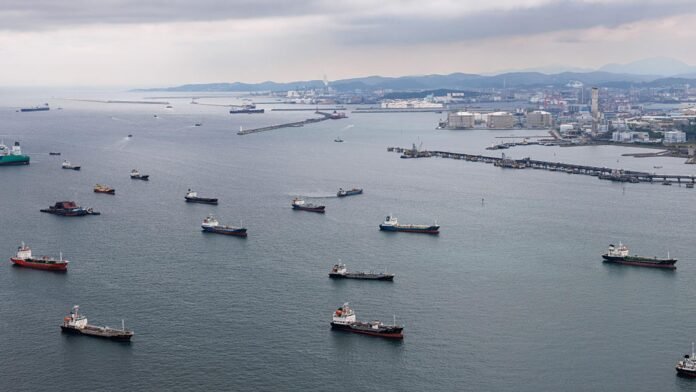
President Trump reversed course this week on a proposed 20 percent transit fee for ships passing through the Strait of Hormuz, opting instead for investment pledges from Gulf allies, even as the United States reimposed a naval blockade on Iran and launched a fourth round of airstrikes. The whiplash policy reversal came amid a rapidly deteriorating security situation in the Persian Gulf, where a collapsed ceasefire has reignited direct military exchanges between Washington and Tehran. The stakes extend far beyond the region, threatening global oil markets, shipping lanes, and a fragile diplomatic framework that had briefly reopened the world’s most critical energy corridor.
Story Highlights
- Trump dropped a proposed 20 percent fee on ships transiting the Strait of Hormuz roughly 24 hours after announcing it, citing investment offers from Gulf states
- The U.S. Central Command reimposed a naval blockade on Iranian ports and carried out a fourth consecutive night of strikes
- Iran retaliated by striking tankers in the strait and launching missiles at U.S. assets in Bahrain and Jordan, killing and wounding civilians and mariners
What Happened
Donald Trump announced Monday that the United States would impose a 20 percent “reimbursement fee” on cargo vessels transiting the Strait of Hormuz, describing it on Truth Social as compensation for American efforts to secure the waterway. By Tuesday, he had abandoned the idea entirely, telling reporters that Gulf allies had instead offered to make substantial direct investments in the United States. “We’d love to invest in the United States with billions and billions of dollars,” Trump said, describing conversations with regional leaders he called “kings and emirs.” He added that he did not “like the concept of a fee,” a notable shift from his rhetoric just a day earlier.
The reversal came as the U.S. military moved forward with a naval blockade on Iranian ports, which took effect Tuesday afternoon at 4 p.m. Eastern time. U.S. Central Command said forces would enforce the blockade against vessels transiting to or from Iranian ports and coastal areas, while allowing humanitarian aid shipments to pass. The blockade replaced an earlier one lifted in June after Washington and Tehran signed a memorandum of understanding intended to end hostilities and reopen the strait. That agreement has since fallen apart, with both sides disputing who controls maritime traffic through the corridor.
Overnight strikes continued into Wednesday morning, with U.S. forces hitting an Iranian army barracks and additional military targets. Iranian officials reported at least seven troops killed and 260 people wounded nationwide. Central Command said the operations were designed to “continue imposing a heavy cost on Iranian forces” and to degrade Tehran’s capacity to strike commercial shipping. Trump has also floated targeting Iranian power plants and bridges in the coming days, according to officials familiar with internal deliberations.
Iran responded with a wave of retaliatory strikes. The country’s Revolutionary Guard claimed responsibility for attacks on two supertankers in the strait, and Iranian forces launched missiles and drones at U.S. military infrastructure in Bahrain and outposts in Jordan. The International Maritime Organization reported that strikes on the tankers Mombasa and Al Bahiyah killed two mariners and wounded fourteen others. A Dutch-flagged vessel, the Stolt Magnesium, also came under attack near Oman, sparking an engine-room fire, though the crew was reported safe. The United Arab Emirates, whose vessels were targeted, threatened retaliation of its own.
Secretary of State Marco Rubio had previously rejected the idea that any single nation could unilaterally charge tolls on an international waterway, arguing it would undermine established maritime law. Trump’s brief embrace of a similar fee-based approach before abandoning it underscored the administration’s shifting posture toward a conflict that has proven difficult to contain diplomatically.
Why It Matters
The Strait of Hormuz carries roughly a fifth of the world’s traded crude oil and natural gas, making any disruption to its operation a matter of direct consequence for American consumers and the broader global economy. Trump’s flirtation with a transit fee, however brief, signaled a willingness to test unprecedented and legally contentious approaches to controlling international waters, raising questions among allies and legal scholars about American commitments to freedom of navigation principles it has long championed.
The rapid reversal also highlights the volatility surrounding U.S. Iran policy under the current administration. A ceasefire and memorandum of understanding reached in June had briefly restored calm and reopened the strait to unrestricted traffic. Its collapse within weeks, followed by a return to nightly strikes and blockade conditions, suggests that the underlying disputes between Washington and Tehran over control of the waterway remain fundamentally unresolved despite diplomatic efforts.
For American voters, the renewed hostilities carry tangible economic consequences. Energy price volatility tends to translate quickly into higher costs at the pump and increased shipping expenses that ripple through supply chains. The administration’s approach of pairing military escalation with informal investment arrangements from Gulf states, rather than a clear diplomatic resolution, leaves the durability of any calm uncertain and subject to further reversal.
Members of Congress and foreign policy officials will also be watching closely to see whether the administration seeks any formal authorization for continued military operations against Iran, given the scale and duration of the current strikes compared to earlier, more limited engagements.
Economic and Global Context
Oil prices climbed to a one-month high this week as the renewed conflict unfolded, with European markets falling in response to the uncertainty. Analysts have long warned that any sustained disruption to Hormuz traffic could send crude prices sharply higher, given the volume of global energy supply that transits the corridor daily. The initial fee proposal, even though short-lived, contributed to market anxiety by suggesting that U.S. policy toward the strait could shift unpredictably.
Gulf state investment pledges cited by Trump as the alternative to the transit fee remain unspecified in scope. The president did not identify a dollar figure or name which countries would participate, leaving markets and economists without clear data to assess the substance of the arrangement. This lack of specificity contrasts with the concrete and immediate market impact of renewed hostilities, including tanker strikes and blockade enforcement.
The broader regional picture remains fluid. A truce in Lebanon between Israel and Hezbollah has held for now, but officials have cautioned that its stability could be jeopardized if the U.S.-Iran conflict escalates further. Kuwait reported engaging aerial targets amid the exchange of strikes, indicating that the conflict’s reach extends beyond direct U.S.-Iran engagement to other Gulf states caught in the crossfire.
Shipping insurers and commercial carriers are likely to reassess risk premiums for vessels transiting the strait, a dynamic that could raise costs for goods reliant on Gulf shipping lanes regardless of whether Trump’s fee proposal is formally revived in some other form.
Implications
In the near term, the durability of the naval blockade and continued strikes will determine whether oil markets stabilize or continue climbing. Should Iran continue targeting tankers and Gulf state infrastructure, further escalation appears likely, potentially drawing in additional regional actors such as the UAE, which has already threatened retaliation for attacks on its vessels.
For Gulf allies, the vague investment pledges Trump cited will require follow-through to be meaningful. Regional governments will need to clarify the scale and terms of any proposed U.S. investments, and Washington will face pressure to specify how it intends to secure the strait without either directly controlling it or imposing fees that many international law experts view as legally dubious.
Congressional oversight of the conflict may intensify given the scope of ongoing strikes and the blockade’s economic implications. Lawmakers from both parties have previously scrutinized the administration’s rapid policy shifts on Iran, and the current volatility is likely to prompt renewed calls for clarity on the administration’s long-term strategy and legal authority for continued military action.
For everyday Americans, the practical impact will likely show up first at gas pumps and in shipping-dependent industries, reinforcing affordability concerns that have already dogged the administration amid broader economic headwinds.
Sources