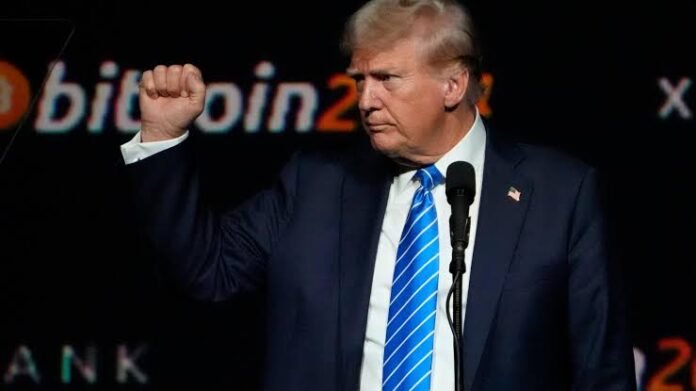
President Trump and his family earned more than $1 billion last year through cryptocurrency ventures and other businesses, according to a newly released 927-page financial disclosure filed with the Office of Government Ethics. The staggering figures, which show crypto now dwarfing Trump’s traditional real estate income, have reignited concerns among ethics experts about conflicts of interest at the highest level of government. Trump has dismissed the criticism, insisting there is nothing illegal or improper about his family’s financial arrangements.
Story Highlights
- Trump’s 2025 financial disclosure shows more than $1 billion in income from cryptocurrency ventures, with total earnings exceeding $2 billion for the year.
- More than $500 million came from World Liberty Financial, a crypto venture co-founded by Trump family members, while Trump-branded meme coin sales generated over $600 million.
- Nearly a million investors in the $TRUMP meme coin have collectively lost $3.8 billion, according to New York Times reporting, even as the Trump family and its partners profited substantially from trading fees.
What Happened
A financial disclosure report filed with the U.S. Office of Government Ethics and released this week reveals that President Donald Trump and his family earned more than $1 billion last year through cryptocurrency ventures alone, with total income across all business interests exceeding $2 billion for 2025. The 927-page filing shows that cryptocurrency has become the single largest source of Trump’s personal income, surpassing his longstanding real estate empire and legal settlement proceeds combined.
The disclosure breaks down the earnings in significant detail. More than $500 million came from World Liberty Financial, a cryptocurrency venture co-founded by members of the Trump family, while sales of Trump-branded “meme” coins featuring the president’s image generated more than $600 million in additional revenue. The filing also documented more than $50 million in income from settlements with media companies, along with millions more in profits from Trump-branded consumer products including Bibles, sneakers, and watches.
Trump’s assets are held in a trust overseen by his son, Donald Trump Jr., while the broader Trump Organization business empire is managed by two of his sons. Because the trust is revocable, Trump retains the legal authority to amend or revoke it and to appoint or remove trustees at will. Notably, while the president and vice president are legally required to disclose their income and assets, they are not subject to the same conflict-of-interest laws that govern most other executive branch employees, a legal distinction that has become central to the ongoing debate over the propriety of Trump’s business dealings while in office.
When pressed on the scale of his earnings, Trump defended the arrangement directly, telling reporters, “You know why I’m profiting, because the stock market’s going up, everybody’s profiting.” He separately told CNBC there is “nothing illegal” and “nothing wrong” with his crypto investments, while also acknowledging some discomfort with his children’s business activities: “I tell my kids: stay away from as much as you can stay away from. But they also have a life. You know, they were doing business long before I ever thought of running for president.” The White House, through spokesperson Anna Kelly, issued a statement denying any conflicts of interest and crediting Trump with making the United States “the crypto capital of the world.”
Separately, New York Times reporting published around the same time revealed that nearly a million investors in the $TRUMP meme coin have collectively lost approximately $3.8 billion since the coin’s launch, even as the president’s affiliated companies and partners profited substantially from trading fees generated by the token’s volatile trading activity. A forensic analysis commissioned by the Times previously found that more than 813,000 individual wallets lost a combined $2 billion trading the coin, while entities connected to Trump and his partners earned roughly $100 million from associated trading fees.
Why It Matters
The scale of Trump’s crypto earnings while serving as president raises fundamental questions about the separation between the machinery of federal governance and the personal financial interests of the nation’s chief executive. Because presidents are exempt from standard executive branch conflict-of-interest statutes, the primary check on presidential financial impropriety rests on public disclosure and political accountability rather than legal enforcement mechanisms available for other federal officials.
Ethics experts have specifically flagged the potential for the Constitution’s foreign emoluments clause to be implicated, given that cryptocurrency transactions can obscure the identity of purchasers, raising the possibility that foreign governments or foreign nationals could acquire Trump-branded tokens as a means of currying favor with the administration without public knowledge. This concern is compounded by the fact that Trump’s administration has simultaneously eased federal crypto regulation, including through the Securities and Exchange Commission and Justice Department scaling back Biden-era enforcement priorities, creating what critics describe as a direct financial incentive for the president to favor deregulation in an industry from which he and his family profit enormously.
For the nearly one million ordinary investors who have lost money purchasing Trump-affiliated cryptocurrency products, the disclosure underscores a troubling asymmetry: those closest to the coin’s creation and promotion have profited substantially through trading fees and coin sales, while the broader investing public, drawn in partly by the association with a sitting president, has absorbed the bulk of the financial losses.
The controversy also touches on longstanding congressional efforts to legislate around presidential financial conflicts. Senators including Jeff Merkley and Chuck Schumer have introduced legislation that would bar senior executive branch officials and their families from profiting off cryptocurrency ventures while in office, though such measures face an uncertain path in a Republican-controlled Congress.
Economic and Global Context
Trump’s embrace of cryptocurrency as a business venture followed years of public skepticism toward the asset class before his 2024 campaign, during which he pivoted to aggressively courting the crypto industry. Since taking office, his administration has signed the GENIUS Act, the first major federal regulatory framework establishing standards for payment stablecoins, while simultaneously easing broader enforcement scrutiny of the crypto sector across multiple federal agencies.
Reuters has separately reported that the Trump family made at least $2.3 billion from crypto-related ventures during Trump’s second term, a figure that reflects the broader financial ecosystem the family has built around presidential-adjacent branding, including a widely criticized dinner event held for top investors in the $TRUMP coin at Trump National Golf Club, which drew formal investigation requests from the Senate Homeland Security Permanent Subcommittee on Investigations and an inquiry from House Judiciary Committee ranking member Jamie Raskin.
The broader deregulatory trend has coincided with Trump’s use of presidential pardon power to benefit prominent figures within the cryptocurrency industry, including Silk Road founder Ross Ulbricht, the founders of BitMEX, and Binance founder Changpeng Zhao, further illustrating the interconnection between the administration’s regulatory posture and the personal and political relationships tied to the industry.
Implications
For Congress, the scale of the disclosed earnings will likely fuel renewed legislative pushes to close the conflict-of-interest exemptions that currently shield the presidency from the ethics rules governing other federal officials, though passage of such measures remains unlikely without significant bipartisan pressure.
For the cryptocurrency industry, Trump’s high-profile financial success, contrasted against the substantial losses experienced by everyday token purchasers, may continue to generate reputational tension within an industry still working to establish broader public trust and legitimacy.
For voters and watchdog organizations, the disclosure will likely remain a significant point of scrutiny heading into the midterm elections, with government accountability groups continuing to press for greater transparency around the intersection of Trump’s personal business interests and his administration’s regulatory decision-making.
Sources
“Former ethics lawyer says Trump’s crypto poses ‘clear conflict of interest'”