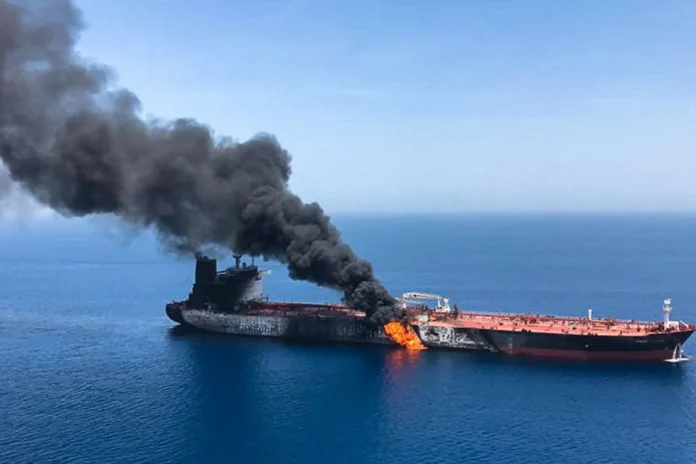
The United States fired on two Iranian-flagged oil tankers attempting to bypass the American naval blockade in the Persian Gulf on May 9, even as the Trump administration awaited a critical peace proposal from Tehran. Secretary of State Marco Rubio, speaking from Rome, said the U.S. had not yet received Iran’s response and expressed hope that it would represent a serious offer. The simultaneous military action and diplomatic outreach encapsulate the razor-thin line the Trump administration is walking in the most significant U.S. military engagement since the Iraq War.
Story Highlights
- U.S. forces fired on two Iranian-flagged oil tankers on May 9 attempting to bypass the naval blockade of Iranian ports
- Secretary of State Marco Rubio said he hopes Iran’s pending response is “a serious offer” that can restart negotiations
- President Trump said the U.S. may resume “Project Freedom” — the operation to guide vessels through the Strait of Hormuz — citing progress in talks
What Happened
The United States expected a response from Iran on a war-ending proposal on May 9, with President Donald Trump saying he anticipated hearing from Tehran “supposedly tonight.” Secretary of State Marco Rubio, speaking to reporters in Rome, said he had not yet received the Iranian response as of his last available update and expressed hope that it would constitute a “serious offer” capable of moving both sides toward formal negotiations. CNN
Despite the ongoing ceasefire framework, U.S. Central Command confirmed that American forces fired on Iranian military facilities responsible for attacking American warships earlier in the week as Navy destroyers transited the Strait of Hormuz. On May 9, the U.S. military reported it had fired on two Iranian-flagged oil tankers that were attempting to bypass the active naval blockade of Iranian ports, which the United States has maintained since April 13. Fox News
Trump described earlier U.S. strikes on Iranian targets as a “love tap,” telling ABC News that “the ceasefire is going” and confirmed it remained in effect. He urged Iran to sign the new U.S. proposal while simultaneously signaling willingness to escalate further if Tehran failed to engage constructively. Fox News
Trump also indicated he was considering resuming “Project Freedom,” the U.S.-led operation to guide stranded commercial vessels out of the Strait of Hormuz, which he paused earlier in the week citing progress in the negotiations with Iran. The American forces’ blockade of Iranian ports, however, remained firmly in place throughout the pause. NPR
Talks between the U.S. and Iran continue to be mediated by Pakistan, with key issues under discussion including freedom of navigation through the Strait of Hormuz, Iran’s nuclear and ballistic missile programs, reconstruction, sanctions relief, and the framework for a long-term peace agreement. House of Commons Library
Why It Matters
The ongoing conflict between the United States and Iran represents the most consequential military and diplomatic challenge of Trump’s second term. What began in late February 2026 with coordinated U.S.-Israeli strikes on Iranian targets has evolved into an extended standoff that has upended global energy markets, tested American alliances in the Gulf, and raised urgent questions about the constitutional framework governing presidential war powers.
The Trump administration has cited the April 8 ceasefire in asserting that the president does not have to provide a formal update to Congress on the war under the War Powers Resolution — a legal argument that has drawn growing scrutiny from lawmakers on both sides of the aisle who believe Congress must have greater oversight over an engagement of this scale. NPR
Many Iranians within the country have urged Trump not to engage in negotiations with the Iranian government, calling instead for U.S. support of a nationwide struggle for freedom and democracy. This complicates the administration’s diplomatic calculus, as any deal that legitimizes the current Iranian government may provoke backlash from Iranian dissidents and their American advocates, even if it produces a formal ceasefire. Wikipedia
For American families, the stakes are immediate. Energy prices have surged well above $100 per barrel, gasoline costs have climbed sharply, and the broader economic disruption caused by the Strait of Hormuz closure is feeding into domestic inflation at a sensitive political moment ahead of the 2026 midterms. The administration is under mounting pressure to produce a credible diplomatic resolution.
Economic and Global Context
Until the U.S.-Israeli war against Iran, approximately 25% of the world’s seaborne oil trade and 20% of the world’s liquefied natural gas passed through the Strait of Hormuz each day. That flow has been largely disrupted since late February 2026, with cascading consequences for energy markets worldwide. Wikipedia
Oil futures have climbed above $100 a barrel, and gasoline futures have also jumped, signaling continued pain at the pump for American consumers. Analysts at Kpler estimate that approximately 170 million barrels of crude oil, jet fuel, diesel, and other refined products are currently stranded aboard 166 tankers in the Middle East. The firm estimates it could take up to three months to clear the backlog once the Strait of Hormuz is fully reopened. CNN
Treasury Secretary Scott Bessent noted that some of the larger oil tankers trapped in the strait carry approximately two million barrels each and expressed optimism that Project Freedom would get that oil to market. He also pointed to OPEC’s recent promise to increase production, though analysts note the hundreds of thousands of additional OPEC barrels are a fraction of the estimated 14 million barrels per day lost due to the conflict. CNN
Global food security is also at risk. The UN Food and Agriculture Organization has said uncertainty persists over next year’s wheat output as the closure of the Strait of Hormuz drives up energy and fertilizer costs worldwide. Nations dependent on affordable fuel for agricultural production face compounding risks as the standoff drags on. CNN
Implications
If Iran delivers a substantive peace proposal that the Trump administration finds workable, it could mark a turning point toward a negotiated resolution. However, both sides have repeatedly accused each other of ceasefire violations, and trust remains extremely low. Any agreement would require verification mechanisms that Iran has historically resisted, making the path to a durable peace long and uncertain.
Iranian parliament speaker Mohammad Bagher Ghalibaf previously stated that Iran would not agree to extend the ceasefire unless it included Iranian control of the Strait of Hormuz — a condition the United States has firmly rejected. That gap illustrates how far apart the two sides remain on fundamental questions of sovereignty and navigation rights. House of Commons Library
For American businesses and consumers, the sooner a deal is reached, the faster energy prices can begin to normalize. Every additional week of disruption adds to inflationary pressure across supply chains, particularly in transportation, agriculture, and manufacturing. The political consequences for Republicans heading into the midterms are significant, as voters increasingly associate economic pain with the administration’s foreign policy decisions.
The administration’s dual posture — striking Iranian assets while simultaneously seeking peace — reflects the difficult balance of projecting strength without foreclosing negotiations. Whether Tehran reads this as leverage or aggression will likely determine whether the next 72 hours produce a breakthrough or another escalation.
Source
“U.S. says it struck two Iran-flagged oil tankers trying to skirt blockade”