Story Highlights
- Trump told reporters after attending the NBA Finals in New York that the deal would “not in any way allow nuclear weapons”
- A top Iranian official told CNN that Tehran sees no “serious will” from the U.S. to finalize a framework agreement
- Sky News Arabia reported a draft agreement has been sent to Washington and is “preliminarily acceptable” to the White House
What Happened
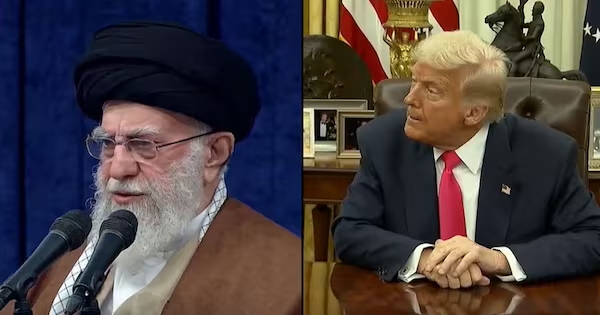
Speaking to reporters on Monday night after attending Game 3 of the NBA Finals at Madison Square Garden in New York, President Donald Trump again declared that a final peace deal with Iran was within reach, predicting that both countries were in the “final stages” of a comprehensive agreement. Trump said the deal would include a prohibition on nuclear weapons and that the strategically vital Strait of Hormuz would reopen “immediately” upon signing.
The statement came just hours after Israeli Prime Minister Benjamin Netanyahu said publicly that the conflict with Iran and Hezbollah “has not yet ended,” stopping short of acknowledging the informal ceasefire that Trump has repeatedly promoted. Iran also paused its operations but warned it would resume them if Israeli strikes in Lebanon continued.
The weekend saw the fragile ceasefire fractured for the first time since it came into effect in mid-April. Israel launched airstrikes on Lebanon, striking the southern city of Tyre and issuing an evacuation warning that, for the first time, included the port’s Christian quarter. Iran retaliated by firing missiles at Israel, prompting Trump on Monday morning to call for attacks to “immediately stop” in a Truth Social post.
Despite the renewed hostilities, the White House maintained an optimistic public posture. A statement issued by the administration credited pressure from U.S.-led operations — dubbed “Operation Epic Fury” and “Operation Economic Fury” — along with a naval blockade of Iran, saying Tehran was “desperate” to reach an agreement. Sky News Arabia reported that a draft framework had been sent to Washington and was “preliminarily acceptable” to the White House.
A senior Iranian official, however, struck a more guarded tone in comments to CNN, saying Tehran sees no “serious will” from the American side to finalize a deal structure. The official added that Iran had “no problem” engaging in peace talks, provided it could trust the sincerity of the U.S. negotiating position.
Why It Matters
The gap between Trump’s repeated optimism and the reality on the ground has become a defining tension of his foreign policy. A CNN analysis published Tuesday found Trump has publicly predicted an imminent Iran deal roughly three dozen times since late March, and none of those timelines has produced a signed agreement. The pattern has raised questions among allies, analysts, and lawmakers about whether the administration’s public statements reflect genuine diplomatic progress or serve primarily as a messaging strategy.
For American voters, the Iran conflict looms large as the 2026 midterm elections approach. The war has split Trump’s coalition, most notably fueling a sustained public feud between Trump and conservative media figure Tucker Carlson, who broke with the president over the joint U.S.-Israeli military campaign that began in February 2026. Some America First voices have framed the conflict as a betrayal of Trump’s original non-interventionist instincts.
Beyond domestic politics, the stakes for a negotiated settlement are substantial. The nuclear dimension is the most urgent: Vice President J.D. Vance has acknowledged the administration’s goal is to “substantially set back” Iran’s nuclear program rather than eliminate it entirely, a framing that has already generated pushback from hawks who want a more definitive prohibition. Any deal that falls short of full denuclearization will face intense scrutiny in both Congress and allied capitals.
There is also a broader humanitarian and diplomatic dimension. Iran has insisted that any final agreement must include a halt to Israeli military operations against Hezbollah in Lebanon — a condition that complicates the diplomatic architecture considerably. The weekend’s renewed strikes suggest the gap between Israeli military objectives and the terms Iran would accept remains wide.
Economic and Global Context
The Strait of Hormuz, which Trump has promised will reopen “immediately” after a deal, is among the most commercially consequential waterways on Earth. Roughly 20 percent of global oil supply passes through the strait, and its continued restricted access has contributed to elevated energy prices since the conflict escalated in early 2026. Futures markets have reflected ongoing uncertainty, with oil prices volatile as diplomatic signals shift week to week.
Polymarket, the prediction market platform, had priced a permanent U.S.-Iran peace deal by June 30 at approximately 18 percent as of Monday, reflecting broad market skepticism. The U.S. Treasury Department also imposed fresh sanctions on Iran’s military oil-sales arm this week, a move that many analysts interpreted as mixed signaling — maintaining economic pressure even while diplomats speak of imminent progress.
Global shipping companies have been managing around the blockade and elevated risk for months, adding costs that ripple through supply chains. Insurance premiums for vessels operating in the Gulf region remain at elevated war-risk levels, and several major carriers have continued to divert ships from the region entirely.
Allied governments in Europe, the Gulf states, and Asia are watching closely. Saudi Arabia and the United Arab Emirates have a direct stake in Hormuz access and have been quietly facilitating back-channel communications. European capitals have been pressing for a diplomatic resolution but have been largely sidelined in the U.S.-led negotiations.
Implications
If a deal is reached in the coming days as Trump predicts, the geopolitical and economic consequences would be significant and immediate. Hormuz reopening would relieve considerable pressure on global energy markets, potentially driving oil prices lower and offering relief to American consumers at the pump heading into the summer. It would also represent a major diplomatic achievement that Trump would likely amplify heading into midterm season.
If no deal materializes — the outcome that has followed each of the previous three dozen predictions — the credibility cost will continue to compound. Lawmakers in both parties are watching the negotiations closely. The ceasefire’s fragility, demonstrated by the weekend exchanges, suggests that the window for a deal could close rapidly if either side miscalculates.
For Iran, the calculus is a negotiation between economic devastation from the blockade and sanctions and the domestic political cost of appearing to capitulate to U.S. and Israeli demands. The supreme leader’s approval of any framework remains the decisive variable, and Tehran has shown little inclination to rush a settlement it views as disadvantageous.
For the region, a failed peace process could reignite full-scale hostilities with consequences extending well beyond Iran and Israel. Hezbollah’s posture in Lebanon, Iraqi proxy groups, and Houthi activity in the Red Sea are all interlinked variables. Trump’s repeated optimism, however genuine, has not yet been matched by a durable diplomatic outcome.
Sources