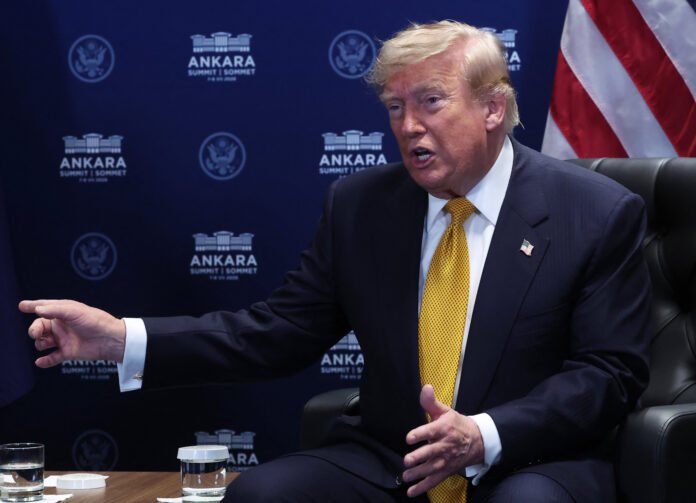
President Donald Trump declared the ceasefire with Iran finished on Wednesday, threatening to strike the country “very hard” again after Iranian forces attacked merchant vessels in the Strait of Hormuz and launched retaliatory strikes on U.S.-allied nations in the Persian Gulf. The rapid escalation, unfolding as Trump attended the NATO summit in Turkey, sent oil prices soaring and stocks tumbling in early trading, underscoring how quickly the fragile truce has unraveled.
Story Highlights
- Trump said the ceasefire with Iran is “over” after Iran’s Revolutionary Guard attacked tankers in the Strait of Hormuz, prompting fresh U.S. strikes.
- Iran retaliated with strikes on U.S. military-linked sites in Bahrain and Kuwait, killing eight Iranian air force and navy personnel in the initial exchange.
- Brent crude jumped nearly 8 percent to above $80 a barrel as markets reacted to fears of renewed regional conflict.
What Happened
Speaking at the NATO summit in Ankara, President Trump told reporters that the ceasefire agreement reached with Iran last month is finished, declaring “it’s over” and calling further dealings with Tehran’s government “a waste of time.” His comments followed a fast-moving sequence of events that began when Iran’s Islamic Revolutionary Guard Corps attacked three merchant tankers transiting the Strait of Hormuz, a vital global shipping corridor through which roughly a fifth of the world’s oil supply passes.
The United States responded with strikes against Iranian targets, which Trump said were carried out overnight and described as forceful. Iran, in turn, launched retaliatory strikes early Wednesday against military sites in Bahrain and Kuwait, both close U.S. security partners in the Persian Gulf, according to the Revolutionary Guard. Iranian officials confirmed that eight members of the country’s air force and navy were killed in the exchange, with state media reporting the deaths occurred in the coastal cities of Bandar Abbas and Bushehr.
Trump told reporters the U.S. would “very probably hit” Iran again Wednesday night and raised the possibility of reinstating a naval blockade against the country. He also accused Iranian leaders of duplicity, saying they had agreed to terms privately only to reverse course publicly, and used blunt language to describe what he characterized as erratic behavior from Tehran’s government. Despite the aggressive rhetoric, Trump also said he did not believe the broader war would fully restart, leaving the administration’s next steps somewhat ambiguous even as military options were actively being weighed.
NATO Secretary General Mark Rutte, appearing alongside Trump at the summit, backed the American response, telling reporters that a forceful reaction was necessary once Iran violated the ceasefire. Trump separately met with Ukrainian President Volodymyr Zelensky on the summit sidelines, where he indicated the U.S. would discuss helping Ukraine develop its own capability to manufacture Patriot missile defense systems, tying the Iran escalation to broader alliance discussions on security commitments.
Why It Matters
The collapse of the ceasefire represents a significant setback for an administration that had touted the truce, brokered after the February strikes that killed Iran’s former supreme leader, as a diplomatic accomplishment. The rapid return to direct military exchanges raises the prospect of a prolonged, open-ended conflict at a moment when Iran’s government is still absorbing the loss of its top leadership and navigating an uncertain succession.
For American policymakers, the strikes on Bahrain and Kuwait, both hosts to significant U.S. military infrastructure, demonstrate that the conflict’s reach extends well beyond Iranian and American territory, drawing in Gulf allies whose security has become directly entangled in the broader confrontation. This raises the stakes for U.S. force posture across the region and could prompt renewed congressional scrutiny over the scope of military authorization being relied upon for continued operations.
The renewed hostilities also test the durability of the coalition Trump has sought to build among NATO allies for supporting American action against Iran. Rutte’s public endorsement suggests continued alliance backing, though Trump has separately criticized other member states, including Spain, for insufficient support during earlier phases of the conflict.
Economic and Global Context
The market reaction was immediate and sharp. Brent crude, the international oil benchmark, jumped nearly 8 percent to trade above $80 a barrel, reflecting acute concern that renewed hostilities could disrupt the flow of oil through the Strait of Hormuz, a chokepoint that carries a substantial share of global crude and liquefied natural gas shipments. U.S. equity markets slumped in early trading as investors priced in the risk of a broader, sustained conflict.
Any prolonged disruption to Hormuz shipping carries outsized consequences for global energy markets, given that alternative routes for Gulf oil exports remain limited. Sustained higher oil prices would likely filter through to gasoline prices for American consumers and add new inflationary pressure at a time when the Federal Reserve has been closely monitoring price stability. Gulf allies Bahrain and Kuwait, both major hosts of American naval and air assets, now face direct exposure to Iranian retaliation, complicating their economic and security calculations.
Globally, the escalation places pressure on other regional and international actors, including European allies, who had welcomed the earlier ceasefire as a stabilizing development following months of conflict. Renewed hostilities could also affect ongoing indirect diplomatic channels involving Qatari and Pakistani mediators.
Implications
For the Trump administration, the coming days will determine whether Wednesday’s exchange marks an isolated escalation or the beginning of a sustained new phase of conflict. Trump’s ambiguous signals, threatening further strikes while also suggesting he does not expect a full resumption of war, leave open significant uncertainty about the administration’s actual strategy.
For global energy markets and American consumers, continued volatility in oil prices is likely in the near term, with the degree of disruption tied directly to whether shipping through the Strait of Hormuz remains viable. Businesses reliant on global shipping and energy-intensive industries will be watching closely for signs of further escalation.
For Gulf allies and NATO partners, the strikes on Bahrain and Kuwait raise urgent questions about collective security commitments and whether additional U.S. military resources will be deployed to protect partner nations now directly targeted by Iranian retaliation.
Sources
Trump threatens to hit Iran ‘very hard,’ strike infrastructure