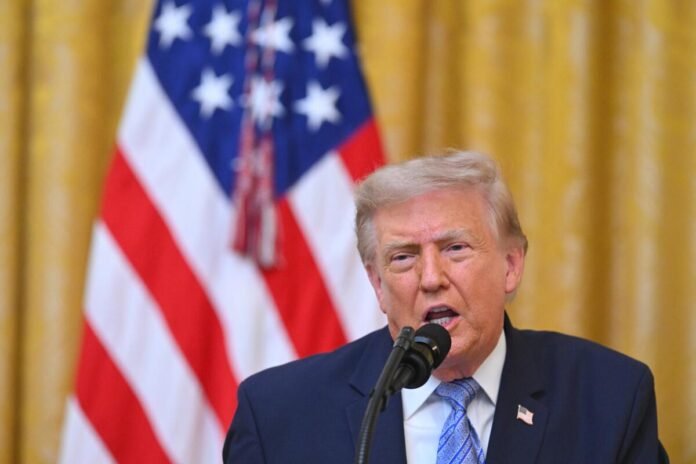
President Donald Trump used a rare primetime address from the White House on Thursday night to allege sweeping government failures in election security, claiming Chinese actors accessed American voter data and that “deep state” officials suppressed the information from him while in office. The speech, delivered less than four months before the 2026 midterm elections, drew immediate pushback from Democrats and independent election experts who said Trump presented no conclusive evidence of past election manipulation. The address has reignited a long-running national debate over the integrity of U.S. elections and the role of federal power in overseeing how states run them.
Story Highlights
- Trump alleged China acquired 220 million U.S. voter files and claimed government officials covered up the intrusion
- Declassified documents released alongside the speech did not substantiate claims of a coordinated cover-up or election manipulation
- Trump called on Congress to pass the SAVE America Act, which would impose stricter voter ID and citizenship documentation requirements
- Several major broadcasters, including ABC, NBC, and CNN, declined to air the full speech on their main channels
What Happened
President Trump addressed the nation Thursday evening from the East Room of the White House in a speech his press secretary, Karoline Leavitt, had promised would deliver “really big news.” Instead, the address largely revisited familiar grievances Trump has aired since his 2020 election loss to former President Joe Biden. Trump alleged that the People’s Republic of China carried out what he called the largest compromise of election data in history, claiming Beijing acquired 220 million voter files, including names, addresses, and party affiliations, across 18 states. A spokesperson for the Chinese embassy denied the allegations, stating that China has never interfered in U.S. presidential elections.
Critics quickly noted that much of the voter data Trump referenced is already publicly available, with some states selling such files for prices ranging from free to as much as $37,000, according to a 2020 U.S. Election Assistance Commission report. The declassified intelligence documents released by the White House alongside the speech appeared to confirm that at least some of the information China accessed was drawn from publicly downloadable voter rolls, rather than a hidden or illicit breach.
Trump also revived his long-standing claims of a “deep state” conspiracy, alleging that rogue bureaucrats in the intelligence community concealed information about Chinese interest in the 2020 election from his daily presidential briefings. “These were briefings I would get almost every day. Everything was kept out that was of importance,” Trump said. However, a previously declassified January 2021 intelligence assessment found with high confidence that China had considered, but ultimately declined to pursue, an influence campaign that year. That earlier disclosure appears to contradict Trump’s cover-up narrative.
The president also called for broadcasters who declined to air his address to lose their licenses, criticized California’s governance, and revived a years-old Michigan voter registration case that state and federal investigators previously found showed no evidence of successful fraud. Trump closed his remarks by urging Congress to pass the SAVE America Act, legislation he has championed that would require voters to present documents such as birth certificates or passports to prove citizenship before casting ballots.
Democratic lawmakers responded swiftly. Representative Jason Crow said Trump was attempting to sow doubt and suppress turnout ahead of the midterms, while House Minority Leader Hakeem Jeffries dismissed the speech as a distraction from economic concerns. Political analysts noted the address fits a broader pattern of Trump seeking greater federal control over election administration, a power traditionally reserved for states.
Why It Matters
The speech arrives at a politically consequential moment, with control of Congress at stake in the November midterms and Trump’s Republican Party facing headwinds in several competitive districts. Renewed doubts about election security, even when not substantiated by hard evidence, can shape voter confidence and turnout in ways that ripple through close races. Election law experts have long warned that unsubstantiated claims of systemic fraud, regardless of their evidentiary basis, can erode public trust in democratic institutions over time.
The push for the SAVE America Act also carries direct policy consequences. Voting rights organizations argue that stricter documentary citizenship requirements could disenfranchise eligible voters, particularly women who have changed their names through marriage and lower-income Americans who lack ready access to passports or certified birth certificates. Supporters counter that the measure would strengthen public confidence in the integrity of federal elections.
The speech also underscores an ongoing tension between the federal government and the media. Trump’s call to strip broadcast licenses from networks that declined to air his address raises First Amendment concerns among press freedom advocates, who view it as an attempt to pressure private news organizations into carrying presidential messaging regardless of newsworthiness.
Finally, the renewed focus on 2020 continues to keep alive a political fault line that has defined much of Trump’s public life since that election. For his base, the speech reinforces long-held beliefs about institutional betrayal. For his critics, it signals a continued unwillingness to accept settled outcomes, a dynamic that could again shape how both parties campaign heading into November.
Economic and Global Context
While the speech centered on domestic election administration, it landed amid a broader geopolitical backdrop involving China, a country already at the center of trade tensions with the Trump administration. Allegations of Chinese interference in U.S. elections could further complicate an already strained economic relationship, potentially influencing ongoing negotiations over tariffs, technology restrictions, and export controls between Washington and Beijing.
Globally, the speech drew attention from foreign governments and media watching how the U.S. Departments of Justice and Homeland Security respond to Trump’s directive to reopen the Michigan investigation and pursue potential criminal charges against officials he accuses of covering up intelligence. Any formal prosecutorial action could invite international scrutiny of how the U.S. balances executive authority with judicial independence.
Domestically, financial markets showed little immediate reaction to the speech itself, as investors have grown accustomed to Trump’s rhetoric on election integrity without corresponding policy shifts. However, any legislative momentum behind the SAVE America Act could draw attention from voting-rights litigation groups and civil liberties organizations likely to challenge the law in federal court if it advances.
Implications
In the near term, expect Democrats to use the speech as a rallying point heading into the midterms, framing it as evidence that Trump intends to contest results unfavorable to Republicans later this year. Republican leadership in Congress will likely face pressure to bring the SAVE America Act to a vote, testing party unity on an issue that has divided some moderate members concerned about voter access.
For federal law enforcement, Trump’s directive to reopen the Michigan case and pursue possible charges against officials involved in the alleged cover-up will be closely watched. Legal experts note that absent new evidence beyond what was already reviewed and dismissed by state and federal investigators, any prosecution would face significant hurdles.
Media organizations must also weigh how to cover future presidential addresses given Trump’s explicit threat regarding broadcast licenses, a decision with implications for how networks balance journalistic independence against regulatory risk. State election officials, who administer the vast majority of election infrastructure, will likely face renewed federal pressure and scrutiny as the midterms approach, even though decentralization remains a core safeguard against large-scale manipulation, according to longstanding U.S. intelligence assessments.
Sources
“Key takeaways from Donald Trump’s controversial speech on election security”