Story Highlights
- Trump directed DNI nominee Jay Clayton not to appear at his Senate confirmation hearing; Intelligence Committee Chair Tom Cotton initially defied the order before reversing course within hours
- FISA Section 702, which authorizes warrantless intelligence collection on foreign nationals, lapsed on June 12 and remains expired
- Trump demanded that his SAVE America Act — requiring documentary proof of citizenship for federal voter registration — be attached to any FISA renewal, despite the bill lacking 60 votes in the Senate
What Happened
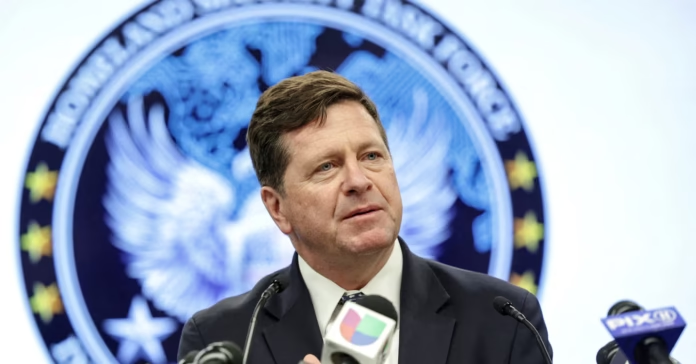
Just before 4 a.m. EDT on Wednesday, President Donald Trump published a Truth Social post declaring the Senate confirmation hearing for Jay Clayton, his nominee to lead the U.S. intelligence community, was canceled. In an early-morning Truth Social post, Trump accused the Senate of moving too fast to hold a confirmation hearing with Clayton, citing his frustration over a lapsed surveillance tool and a voter ID bill that lacks the votes to pass. Trump also threatened not to sign a bill to revive the expired Foreign Intelligence Surveillance Act Section 702 program unless it was attached to his SAVE America Act election overhaul.
Despite the president’s demand, Sen. Tom Cotton of Arkansas, the chairman of the Senate Intelligence Committee, initially said the panel planned to proceed with the confirmation hearing “unless the president directs him not to appear or withdraws his nomination.” But a couple of hours later, Cotton said the hearing was “now unfortunately postponed.” “It’s regrettable that the president has directed Jay Clayton not to appear at his confirmation hearing today. Mr. Clayton is a patriot and a highly qualified nominee, as the president has said repeatedly,” Cotton wrote on X.
Clayton, a chairman of the Securities and Exchange Commission during Trump’s first term, has spent the last 14 months as the top federal prosecutor in Manhattan, one of the Justice Department’s premier posts. The intelligence director position became available after Tulsi Gabbard, who had held the job, announced last month that she was resigning to spend time with her husband as he fights cancer. Trump subsequently announced that Bill Pulte — a Trump bulldog with no national security or intelligence experience — would serve as acting DNI, a move that sparked outrage from both Republicans and Democrats.
The SAVE America Act would require Americans to provide documentary proof of citizenship — such as a passport or birth certificate — when registering to vote in federal elections. Supporters say the measure would prevent noncitizens from voting and strengthen election integrity. Critics argue Trump’s proposal could make voter registration harder for potentially millions of eligible Americans. Senate Majority Leader John Thune told CBS News that he hadn’t received clarity from the White House.
Why It Matters
FISA Section 702 is among the most consequential surveillance authorities in the U.S. national security toolkit. It permits intelligence agencies to collect, without a warrant, communications of foreign nationals located outside the United States when those communications transit American infrastructure. National security officials across administrations have described it as critical for detecting terrorism, espionage, and foreign electoral interference. The nation’s foremost national security tool, which allows the government to spy on foreigners overseas, has expired, while the Senate is back to square one on confirming a top intelligence chief.
Senate Intelligence Committee ranking member Mark Warner of Virginia called the president’s post an “extraordinary display of dysfunction.” “The biggest obstacle to resolving these issues has not been Senate Democrats or Senate Republicans,” Warner said. “It has been the chaos and confusion coming from the White House itself.” Republican senators who celebrated Clayton’s nomination as a stabilizing choice now face the prospect that the political dynamics around the DNI seat have grown more complicated than before Trump intervened.
Democratic leaders say Trump is harming his own objectives. Senate Minority Leader Chuck Schumer said on the floor, “Trump is twisting himself up in knots and jumping through hoops to make it impossible to reauthorize FISA right now, and he is embarrassing his Republican colleagues in the process.” The SAVE America Act’s failure to reach 60 votes was known to Republican leadership well before Trump’s overnight escalation, making the demand for its attachment to FISA a strategic choice unlikely to produce the legislative outcome Trump seeks.
Economic and Global Context
The DNI disruption occurs at a moment of acute foreign intelligence need. With the U.S. emerging from the Iran conflict, monitoring Iranian compliance with the newly signed peace framework, tracking Hezbollah activities in Lebanon, and maintaining situational awareness across the broader Middle East all require robust signals intelligence. Negotiations over Section 702 were already delicate even before Trump inflamed the issue by announcing Bill Pulte as acting director of national intelligence, with Democrats refusing to pass FISA’s Section 702 if Pulte was in office. An expired Section 702 weakens the legal architecture for new collection activities at precisely the moment active monitoring of Iranian compliance is most critical.
Sen. Kevin Cramer of North Dakota gently pushed back against Trump’s calls to tie the SAVE America Act to FISA. “No, it doesn’t go together naturally,” Cramer said. “I think the thought process is he wants to attach to something that’s going to pass. The problem is must-pass legislation is only must-pass until Democrats decide they don’t want to pass it.” The senator’s warning reflects a broader congressional concern that Trump’s leverage strategy may produce the opposite of its intended outcome — killing FISA reauthorization rather than advancing his voting bill.
The Pulte controversy carries its own institutional dimensions. His designation as acting DNI placed a politically controversial figure with no intelligence background in nominal command of the intelligence community, undermining confidence among career professionals and allied intelligence services. Foreign partners — particularly the Five Eyes nations that share sensitive signals intelligence with Washington — closely monitor stability and leadership at the senior levels of the American intelligence apparatus. Extended instability at the DNI level complicates those relationships at a moment when allied cooperation on Iranian compliance monitoring is essential.
Implications
Senate Intelligence Committee Chair Tom Cotton postponed a Wednesday confirmation hearing for Clayton at Trump’s behest, leaving the Senate’s path forward unclear. Republicans face a narrow set of options: advance FISA without the SAVE America Act and risk a presidential veto; attempt to pass the SAVE Act knowing Democrats will likely filibuster it; or wait for further guidance from a White House that Senate Majority Leader Thune described as offering no clarity. Each option involves accepting either a substantive policy failure or a public confrontation with the president.
For the intelligence community, extended leadership uncertainty at the DNI level creates operational and morale challenges during an active transition from wartime operations to peacetime monitoring obligations. Career officials who manage the daily functions of intelligence collection, analysis, and dissemination must navigate an environment in which their civilian chain of command is unsettled and the legal authority undergirding their most sensitive foreign collection activities has lapsed. The longer the impasse persists, the greater the cumulative institutional cost.
For voters and governance observers, the episode is another illustration of how Trump uses legislative urgency as leverage for unrelated political demands — a pattern seen in previous fights over government funding and the debt ceiling. Trump keeps searching for new leverage to force the Senate to pass the SAVE America Act, despite repeated warnings that the votes aren’t there. Each escalation frays Senate Republican cohesion and tests the capacity of institutional norms to contain executive pressure on a co-equal branch of government.
Sources
“Senate delays Jay Clayton’s nomination for intel director after Trump post”