Story Highlights
- Trump claimed Pope Leo supports Iran obtaining nuclear weapons — a characterization the Vatican has explicitly rejected as false
- A Washington Post-ABC News-Ipsos poll found that Pope Leo has a 25-point net favorable margin among Americans, while nearly 60 percent reacted negatively to Trump’s comments
- Italian Foreign Minister Antonio Tajani and Italian PM Giorgia Meloni, longtime Trump allies, both distanced themselves from Trump’s attacks on the pontiff
What Happened
In an interview recorded Monday with conservative radio host Hugh Hewitt, President Donald Trump said that Pope Leo XIV “would rather talk about the fact that it’s OK for Iran to have a nuclear weapon,” and declared the pope was “endangering a lot of Catholics and a lot of people.” The comments represented an escalation of a weeks-long dispute between the White House and the Vatican, one that began when the pontiff publicly criticized U.S. military action in Iran and called for a negotiated peace.
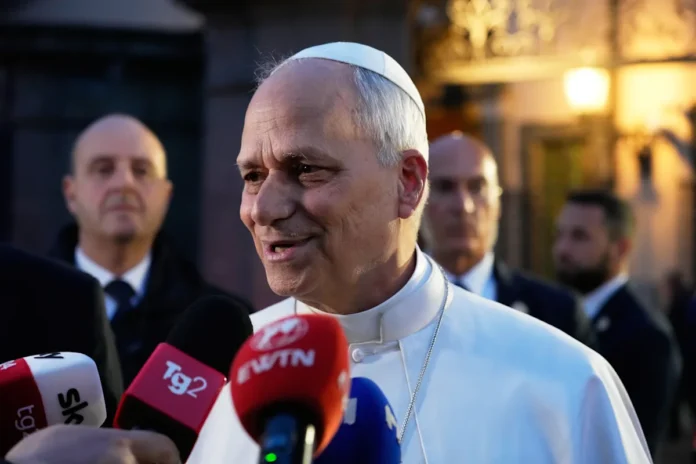
The accusation is factually inaccurate. Pope Leo has never stated that Iran should have nuclear weapons. The Catholic Church has long opposed all nuclear weapons on doctrinal grounds, and the pope himself reiterated that position when asked by reporters Tuesday. “The Catholic Church for years has spoken out against all nuclear weapons, so there is no doubt there,” Leo said. He added that his calls for peace and dialogue in the Iran conflict are rooted in scripture and Church teaching, not political rivalry with the American president.
The feud has been building for weeks. Trump previously attacked Leo on social media, claiming the pope was soft on crime and immigration, and labeling him sympathetic to the radical left. The dispute intensified after Trump posted and then deleted an AI-generated image that appeared to depict himself as Jesus Christ. He has refused to apologize to the pope for that image and later claimed he believed it showed him dressed as a doctor.
Secretary of State Marco Rubio, a practicing Catholic who has visited Italy and the Vatican at least three times in the past year, is scheduled to meet with the pope on Thursday in what the State Department described as an effort to maintain communication. Rubio attempted Wednesday to reframe Trump’s comments as a defense against Iranian nuclear weapons, saying no one should want Iran to acquire such capabilities. Whether that framing can repair the relationship with the Holy See before Rubio’s arrival remains deeply uncertain.
Why It Matters
The rift between a sitting American president and the first U.S.-born pope is unprecedented in modern political history. Pope Leo XIV carries unusual moral authority not only among the world’s 1.3 billion Catholics but among a broader global audience that views the papacy as an independent voice for peace and human dignity. Trump’s decision to attack that authority — and to repeat demonstrably false claims about the pope’s positions — has created a political and diplomatic liability that is difficult to contain.
Domestically, the politics are similarly unfavorable for Trump. The Washington Post-ABC News-Ipsos poll conducted April 24 to 28 found that Americans rate Pope Leo with a 25-point net favorable margin: 41 percent favorable, 16 percent unfavorable, with 43 percent having no opinion. By contrast, nearly 60 percent of Americans reacted negatively to Trump’s attacks on Leo. A separate question found 76 percent disapproval of Trump’s social media post suggesting he resembled Jesus Christ.
For Catholic voters in particular, the feud carries risks in an election year. Catholics represent a significant and closely contested bloc in key swing states, including Pennsylvania, Wisconsin, Michigan, and Arizona. Catholic bishops in the United States have defended the pope’s just-war arguments, citing the Church’s catechism. Any perception that Trump is at war with the Church’s spiritual leadership could accelerate erosion of Catholic support, a demographic the Republican Party depends on.
The episode also reflects a pattern of Trump treating allies and institutions as adversaries the moment they offer any criticism. Italian Prime Minister Giorgia Meloni, perhaps Trump’s closest European ally, has distanced herself from his attacks on the pope. Trump responded by criticizing Meloni publicly, further straining a relationship that had been seen as a stabilizing factor in U.S.-European ties.
Economic and Global Context
The Vatican feud adds another layer of diplomatic friction to a U.S.-Europe relationship already under significant strain. Trump’s tariff policies, his troop withdrawal announcement from Germany, and his approach to the Iran war have collectively generated a level of transatlantic tension not seen in decades. The Catholic Church’s global network of aid organizations, educational institutions, and hospitals makes it a significant soft-power presence in regions where U.S. foreign policy depends on local cooperation.
Italian Foreign Minister Antonio Tajani said in a social media post that Trump’s comments were “neither acceptable nor helpful to the cause of peace.” Italy is a NATO ally and a key partner in Mediterranean security operations, including the ongoing effort to manage shipping disruptions stemming from the Iran conflict. Italian Prime Minister Meloni’s criticism of Trump, however mild, signals that even the most Trump-aligned European governments have limits.
The optics of the dispute also complicate the administration’s stated goal of positioning the Iran war as a moral and strategic necessity. The pope’s consistent framing of the conflict as unjust, amplified by the global reach of the Catholic Church, creates a counter-narrative that resonates with audiences the administration cannot simply dismiss. Rubio’s planned Vatican meeting is a tacit acknowledgment of that challenge, even as Trump continues to publicly inflame the dispute.
Implications
The immediate question is whether Rubio’s visit to the Vatican on Thursday can achieve any meaningful stabilization. Given that Trump renewed his attacks days before the scheduled meeting, Rubio will arrive in a weaker negotiating position than the State Department had hoped. Diplomats who deal with the Holy See note that the Vatican is highly attuned to the sincerity of overtures and unlikely to paper over public insults with private courtesy.
For the Republican Party heading into November’s midterms, the pope feud is another front in an increasingly difficult environment. Polling consistently shows Trump’s approval sinking, and the combination of an unpopular war, rising costs, and now a public quarrel with one of the world’s most admired figures adds to the party’s challenges in competitive districts.
For the American public, the episode raises questions about the standards of factual accuracy the president applies to religious and moral debates. The repeated claim that Pope Leo supports Iranian nuclear weapons — despite there being no evidence for the assertion — reflects the same willingness to misrepresent opponents’ positions that critics have documented across other policy disputes.
Sources
“Trump lashes out at Pope Leo again ahead of Rubio trip to Rome”