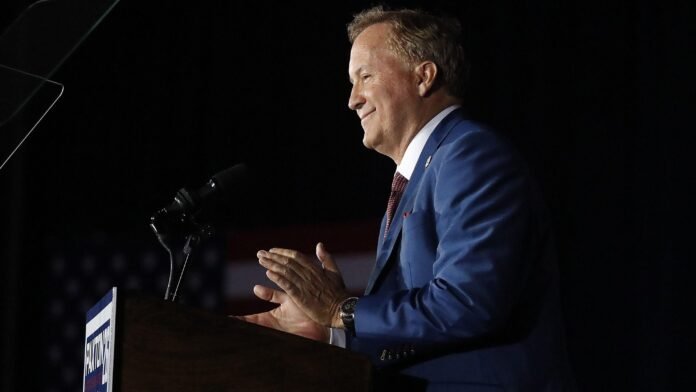
A seismic shift in Texas Republican politics unfolded Tuesday night when Trump-backed Attorney General Ken Paxton defeated longtime incumbent Senator John Cornyn in the GOP Senate primary runoff, ending a 24-year congressional career with a single presidential endorsement. The result cemented Donald Trump’s dominance over Republican primary politics even as his national approval ratings hit record lows. Paxton will now face Democratic nominee James Talarico in a November general election that Republicans privately fear could prove competitive.
Story Highlights
- Ken Paxton defeated John Cornyn after Trump issued a late endorsement just one week before the runoff vote closed.
- Cornyn’s loss ends a 24-year Senate career and removes one of the chamber’s most experienced institutionalists from the Republican caucus.
- Democrats have not won a Texas Senate race since 1988, but Talarico’s nomination and low Republican turnout have shifted the general election outlook.
What Happened
Trump-backed Texas Attorney General Ken Paxton won the Senate primary runoff for the GOP nomination, CBS News projected, unseating longtime incumbent Senator John Cornyn in a seismic shift for Republicans in the Senate. The victory closed a contentious race that had divided the party establishment from the MAGA base for months.
Trump endorsed Paxton over incumbent Cornyn in the runoff just one week before voting closed, a decision that defied months of Senate leadership lobbying for the president to back Cornyn or stay out of the race entirely. Political analysts noted the timing was classic Trump: he waited until Paxton had established a slight polling lead before committing, maximizing his association with a likely winner.
Republican senators and top operatives had believed Cornyn was a reliable pick for reelection if he survived the primary, and that Paxton was a weaker general election candidate. But Trump decided to ignore that political calculation, issuing a last-minute endorsement and demonstrating that his influence over the Republican base remains intact even as his broader approval numbers have declined.
Trump’s stamp was all over Tuesday’s results. His pick for Republican Senate nominee toppled the incumbent, and his endorsed candidates proceeded toward the general election, reinforcing his continued grip on the primary process.
On the Democratic side, Talarico immediately framed the fall matchup in stark terms. Talarico characterized Paxton as corrupt and branded the fall contest as “the people versus Ken Paxton,” attempting to cast the former attorney general’s legal controversies as a liability in the general electorate.
Why It Matters
Cornyn’s defeat represents the most significant scalp Trump has claimed in the 2026 primary cycle. As one of the Senate’s most senior Republicans and a former Majority Whip, Cornyn symbolized the old GOP establishment — a figure whose loss sends a clear message that ideological alignment with Trump now outweighs institutional longevity in Republican primaries.
The result also exposes the limits of traditional Republican infrastructure. Cornyn reportedly held enormous advantages in fundraising, establishment support, and name recognition, yet none of it insulated him from a single Truth Social post. The power asymmetry between official party machinery and a presidential endorsement has rarely been displayed so starkly.
Trump’s run of endorsements in May shows he retains power over the Republican base even as his national approval ratings have slipped. That dynamic creates a durable political paradox: Trump can still dictate Republican primary outcomes while simultaneously dragging the party toward a difficult midterm environment in competitive general elections.
For the Senate Republican caucus, the loss of Cornyn removes a skilled legislative operator who had navigated relationships across the aisle. His departure, effective January, creates a leadership vacuum that will need to be filled as the chamber confronts a packed legislative agenda and looming budget battles.
Economic and Global Context
Texas holds enormous strategic importance to the national economy as the country’s leading energy producer and a major hub for technology, defense, and agriculture. Senate representation shapes federal policy on energy permitting, tax treatment of the oil and gas sector, and infrastructure investment across the Gulf Coast.
Paxton’s record as attorney general has been defined in large part by aggressive litigation against federal environmental and regulatory actions. His entry into the Senate would add another reliable conservative vote on energy and financial deregulation at a time when those issues are central to economic policy debates in Washington.
Republicans have seen lackluster primary turnout across the country in 2026 despite high-profile races. Meanwhile, Democrats have been showing up in large numbers, starting in Texas. That enthusiasm gap, if it persists into November, creates genuine uncertainty about whether Texas remains reliably Republican in what was once assumed to be a safe statewide contest.
The outcome also has national implications for Senate math. Democrats have a serious chance of flipping Republican-held seats in North Carolina, Maine, Alaska, and Ohio, while Iowa and Texas are no longer regarded as sure bets for Republicans. A Paxton candidacy, carrying the baggage of his prior impeachment acquittal and multiple ongoing legal controversies, could make Texas more competitive than it has been in a generation.
Implications
Paxton enters the general election as a well-known figure in Texas politics — but known primarily through controversy. His 2021 impeachment by the Texas House, subsequent acquittal by the Senate, and federal securities fraud indictment that was eventually dropped have given Democrats a rich archive of attack material. The Talarico campaign has already signaled it intends to use all of it.
For Senate Republican leadership, the Cornyn loss makes the task of maintaining the majority more complicated. Every seat that shifts from safe to competitive increases the burden on leadership and national fundraising committees, which are already stretched heading into a challenging midterm environment.
For Trump, the win reinforces his strategy of using primary endorsements as a loyalty enforcement mechanism. Senators who cross the administration now have fresh evidence that presidential opposition can be terminal, which is likely to sharpen compliance on contentious votes in the months ahead.
For Texas voters, the general election sets up a genuine choice between two candidates with starkly different profiles, introducing competitive stakes to a Senate race that has rarely attracted serious Democratic investment. The outcome in November will signal whether Trump’s primary dominance can survive a general election environment defined by his own declining popularity.