Story Highlights
- Trump said the “typical family” received tax refunds close to $5,000, but IRS data placed the average refund in the low-$3,000 range.
- The administration reported zero Border Patrol releases, but that is different from saying zero people crossed the border illegally.
- Trump’s drug-pricing remarks mixed real policy action with inflated percentage language that does not match standard price-reduction math.
What Happened
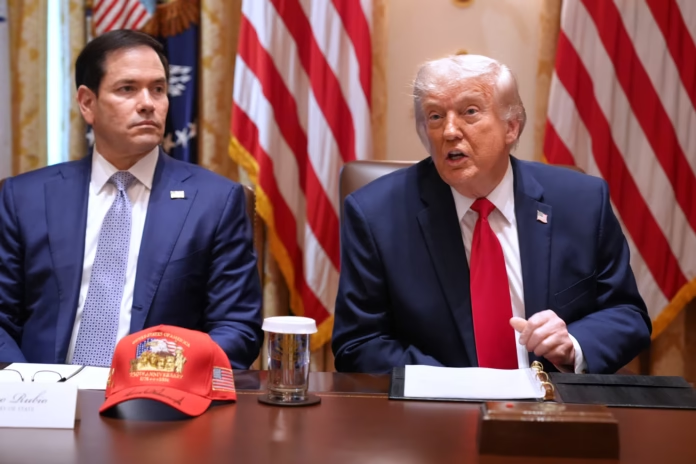
President Donald Trump used a May 27 Cabinet meeting to present a broad defense of his second-term record, touching on the economy, immigration, prescription drug prices, Iran, and government fraud investigations. The meeting gave the administration a chance to highlight policy achievements, but several of Trump’s most specific claims immediately drew scrutiny because they appeared to stretch or misstate the underlying data.
One of the clearest examples involved tax refunds. Trump claimed the “typical family” received refunds of nearly, or close to, $5,000. IRS filing-season statistics, however, showed the average refund was closer to the low-$3,000 range in early May. That gap matters because refunds are something millions of Americans can compare directly against their own tax documents.
- The IRS reported average refunds in the low-$3,000 range, not close to $5,000.
- The refund increase was real, but the scale Trump described was significantly overstated.
- The claim raised questions about whether the administration’s public messaging matched the official data.
Trump also said that “zero” people had entered the country illegally over the past year, a claim that appears to conflate two separate border metrics. The administration has reported a major shift in border enforcement, including zero releases of apprehended migrants into the U.S. interior for consecutive months. But zero releases does not mean zero illegal crossings.
That distinction is important. The administration can credibly point to a major change in catch-and-release policy, but describing the border as having zero illegal entries gives the public a different impression from what the official records actually show.
Why It Matters
The issue is not simply whether the administration has policy wins to point to. It is whether public claims from the highest levels of government match the records citizens, journalists, and oversight officials can verify. When a president cites precise numbers — refunds, border figures, drug-price reductions — those numbers become part of the public record.
The refund claim is especially significant because it touches household finances at a time when voters are judging whether economic policy is improving their daily lives. A refund increase in the low-$3,000 range is a real development, but turning that figure into something close to $5,000 changes the scale of the story.
- Accurate numbers help voters evaluate whether economic gains are reaching households.
- Inflated claims can create expectations that official data does not support.
- Contradictions in public messaging can weaken confidence in government communications.
The same accountability issue applies to the border. If the administration says it has ended releases at the border, that is a specific claim that can be measured. If it says no one entered illegally, that is a broader claim requiring a different standard of proof. Mixing the two allows a real enforcement change to be communicated in a way that risks overstating the result.
On prescription drugs, Trump pointed to his Most Favored Nation pricing policy and described reductions of “400, 500, and even 600 percent.” The policy itself is real, and the administration has pursued lower prices through executive action and pressure on drugmakers. But the percentage language is misleading. A drug falling from $130 to $20 is a major reduction, but it is not a 500 percent reduction in price.
Oversight and Accountability Context
The Cabinet meeting came as Trump’s team sought to project control over several high-pressure policy fronts. On Iran, Trump said Tehran would not be allowed to obtain a nuclear weapon and pointed to continued U.S. pressure. Those remarks came as questions remained over diplomacy, military posture, and the next stage of U.S. policy toward Tehran.
That makes the Iran remarks part of a broader credibility test. When national security claims are made during an open Cabinet meeting, the public often receives only a limited version of the underlying intelligence or diplomatic record. That places more importance on consistency, precision, and follow-up from the White House, State Department, and defense officials.
- Economic claims can be checked against IRS and Treasury data.
- Border claims can be checked against CBP and DHS figures.
- Drug-pricing claims can be checked through standard percentage math and policy implementation records.
- Iran claims require careful tracking of official statements, diplomatic developments, and congressional oversight.
The administration also highlighted its anti-fraud campaign, with senior officials describing hundreds of enforcement actions and tens of billions of dollars in alleged stolen taxpayer funds. Those claims may become another major oversight area if Congress or watchdog groups demand a clearer breakdown of cases, recoveries, prosecutions, and verified savings.
For an administration that frequently emphasizes strength, speed, and results, the risk is that exaggerated language can weaken the credibility of genuine accomplishments. Ending large-scale releases at the border, pursuing drug-price reductions, and increasing average refunds are all politically useful points. But each becomes easier for critics to challenge when the public framing goes beyond the documented record.
What Happens Next
The next test will be whether the White House clarifies or repeats the disputed claims. If officials continue using the $5,000 refund figure, the “zero illegal entries” line, or exaggerated drug-price percentages, those statements are likely to receive additional scrutiny from fact-checkers, congressional critics, and policy analysts.
Congressional oversight could also become more relevant. Lawmakers may seek more detail on the administration’s border metrics, the actual scale of drug-price savings, and the status of Iran negotiations. If the anti-fraud campaign remains a central talking point, committees may also ask for case-level evidence showing how much money was identified, recovered, or prevented from being lost.
- Watch for updated IRS refund statistics as the filing season continues.
- Track whether CBP distinguishes between border encounters, apprehensions, and releases in future statements.
- Monitor whether drug manufacturers publicly confirm the administration’s claimed savings.
- Follow congressional reaction to Trump’s Iran remarks and any demand for classified briefings.
For voters, the larger question is straightforward: can the administration’s biggest claims survive comparison with official data? The Cabinet meeting showed that Trump’s political message remains aggressive and confident. But it also showed that some of the most attention-grabbing claims require careful checking before they can be accepted as fact.
In a midterm year, that gap between message and measurement could matter. Strong numbers help any president. But numbers that do not hold up can quickly become an accountability problem — especially when they involve household finances, border security, national security, and health care costs.
Sources
- CNN: Fact check: Trump makes false claims about Iran war, the economy and the reflecting pool at Cabinet meeting
- IRS: Filing Season Statistics for Week Ending May 1, 2026
- IRS: Filing Season Statistics for Week Ending May 8, 2026
- CBP: Trump Administration Delivers a Full Year of Zero Releases at the Border
- AP: The Latest: Trump convened his Cabinet as talks to end Iran war remain in flux