Story Highlights
- Trump announced the nomination at a White House dinner event, declaring he would make Blanche the “permanent attorney general”
- Blanche has served as acting AG since April 2026, following the firing of Pam Bondi
- As acting AG, Blanche accelerated investigations into Trump’s political opponents and announced the now-scrapped $1.776 billion anti-weaponization fund
What Happened
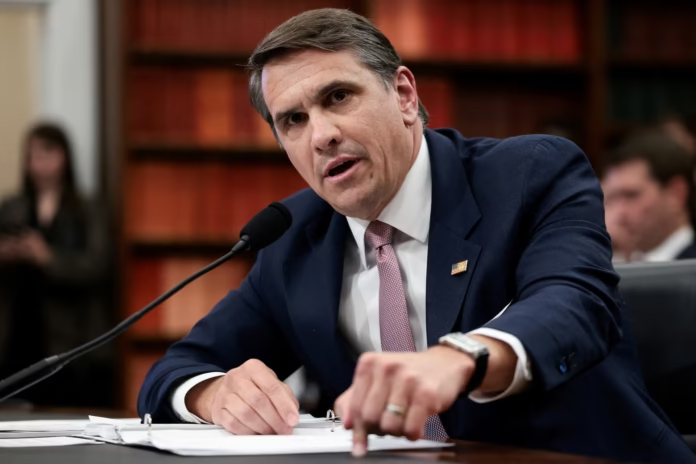
President Donald Trump surprised attendees at a White House Rose Garden event Wednesday evening by announcing he intended to nominate acting Attorney General Todd Blanche to permanently lead the Department of Justice. Deputy White House Chief of Staff Dan Scavino posted a video of the announcement to X, in which Trump told the assembled crowd, “We are going to make him permanent attorney general.” The formal paperwork was expected to be submitted to the Senate on Thursday, June 4.
Blanche, 51, has served as acting attorney general since April 2026, after Trump removed Pam Bondi from the post following a tenure marked by controversy and internal friction. Prior to that, Blanche served as deputy attorney general beginning in March 2025, following Senate confirmation. He is a graduate of Brooklyn Law School and a former federal prosecutor who built his reputation as a defense attorney for high-profile clients in New York.
Blanche’s most significant prior role, beyond his current position, was as Trump’s personal criminal defense attorney during the former president’s 2024 New York trial on 34 counts of falsifying business records to conceal hush money payments. Trump was found guilty on all counts before going on to win the presidency. Their attorney-client relationship makes Blanche’s nomination among the most personally intertwined appointments in modern Justice Department history.
Since assuming the acting role, Blanche moved quickly to establish himself as a loyal executor of the president’s agenda. He accelerated investigations targeting individuals Trump has long viewed as adversaries, including former FBI Director James Comey, who was indicted during Blanche’s tenure. He also announced — and then saw scrapped — a nearly $1.8 billion anti-weaponization fund intended to compensate individuals who claimed they were politically targeted by prior administrations.
Senate confirmation will require a majority vote. Republicans hold a 53-47 seat advantage in the chamber, but several GOP senators have signaled unease with the Justice Department’s recent direction under Blanche, particularly around the settlement fund and the indictment of political opponents. The confirmation hearing is expected to be contentious.
Why It Matters
The nomination of a sitting president’s personal criminal defense lawyer to serve as the nation’s top law enforcement officer is without modern precedent. If confirmed, Blanche would occupy a position that is constitutionally designed to operate with a degree of independence from the White House, regardless of which party holds power. Critics, including legal scholars and Democratic lawmakers, argue that Blanche’s personal loyalty to Trump fundamentally undermines that independence.
The Justice Department under Blanche has already taken a series of steps that have alarmed legal observers across the political spectrum. Prosecutors involved in the January 6 investigations were fired. The contempt-of-Congress case against former Trump adviser Steve Bannon was dismissed. And career DOJ officials have described an environment in which prosecutorial decisions increasingly reflect the president’s political interests rather than the rule of law.
Beyond the immediate political controversy, the nomination raises long-term institutional questions. The DOJ is responsible for enforcing federal law impartially, overseeing the FBI, pursuing public corruption cases, and representing the United States in federal litigation. A permanent attorney general whose rise is directly tied to personal loyalty to the sitting president sets a template that legal experts warn could outlast the Trump administration itself.
For Republicans on the Senate Judiciary Committee, the confirmation hearing will present an awkward balancing act. Many have expressed concerns about Blanche’s handling of the anti-weaponization fund and the targeting of Trump’s political critics. But opposing a Trump nominee carries its own political risks in a midterm election year where Republican base enthusiasm remains closely tied to the president.
Economic and Global Context
The Justice Department plays a central role in the enforcement of federal financial laws, including securities fraud, antitrust violations, and foreign corrupt practices. A DOJ led by a figure widely perceived as a partisan loyalist could affect confidence among international business partners and foreign governments who depend on the predictability of U.S. legal institutions.
The department’s credibility also matters to capital markets. Major corporations, particularly in the financial sector, rely on DOJ guidance and enforcement consistency to structure transactions, plan compliance programs, and manage regulatory risk. Uncertainty about enforcement priorities under a politically oriented attorney general can lead to strategic ambiguity that raises costs for businesses operating in heavily regulated industries.
Internationally, the United States regularly uses the threat of DOJ prosecution — through the Foreign Corrupt Practices Act and related statutes — as a diplomatic lever with allies and adversaries. A weakened perception of DOJ independence diminishes that leverage, particularly with European partners who have already grown wary of American institutional reliability during the current administration.
Domestically, the anti-weaponization fund episode illustrated how the DOJ’s decisions under Blanche can have direct budget implications. The $1.776 billion fund, which a federal judge temporarily blocked and which Blanche eventually abandoned under congressional pressure, was drawn from a settlement in a Trump civil lawsuit against his own government — an arrangement that critics called a constitutional violation of the appropriations process.
Implications
If confirmed, Blanche would be the permanent head of the Justice Department through at least January 2029. His tenure would cover the final years of Trump’s second term, including any post-presidency accountability questions that might arise. Legal experts note that a loyalist attorney general could shape prosecutorial decisions not only in the present but also in how cases are or are not preserved for future administrations.
For Democratic lawmakers, the nomination consolidates their central argument heading into the November 2026 midterms: that the Trump administration has systematically dismantled the independence of the institutions designed to hold it accountable. Senate Democrats are expected to use the confirmation hearings as a high-visibility platform to press Blanche on the fund, the Comey indictment, and the firings of career DOJ officials.
Republican senators who have already expressed reservations will face a decision about whether to vote against or demand concessions from the nomination. Senators like Thom Tillis of North Carolina have been outspoken about the anti-weaponization fund. Whether those concerns translate into confirmation opposition will test how much institutional resistance remains within the Republican Senate caucus.
For ordinary Americans, the question is whether they will have a federal law enforcement apparatus that pursues wrongdoing regardless of political affiliation. Polls consistently show that confidence in governmental institutions is near historic lows. A confirmation fight over a nominee with Blanche’s profile will do little to restore that confidence, regardless of the outcome.
Sources