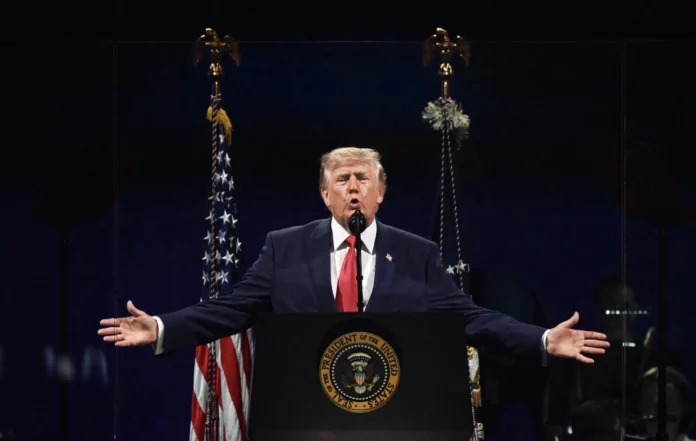
President Trump revealed that he personally overrode a recommendation to cancel the “Salute to America” celebration on the National Mall after severe storms forced a mass evacuation of the crowd Saturday. The decision led to a dramatic scene in which tens of thousands of attendees were cleared from the Mall before being allowed back in for fireworks and a presidential address. The episode has drawn attention both for the logistical scramble it triggered and for what it reveals about how Trump is managing the administration’s marquee events during the nation’s 250th anniversary year.
Story Highlights
- Trump said he personally overruled a recommendation to cancel the National Mall event after storms prompted evacuations
- The president said roughly 150,000 people who had been evacuated returned for his remarks after the storms passed
- The event capped a holiday weekend that included a Mount Rushmore speech warning of communism as a “mortal threat”
- Trump also used the platform to renew his push for the SAVE America Act, a voter ID and citizenship-verification bill stalled in Congress
What Happened
The “Salute to America” event on the National Mall was billed as a historically massive celebration marking the 250th anniversary of the Declaration of Independence. As severe thunderstorms swept through the Washington, D.C. area Saturday evening, organizers moved to evacuate the crowd for safety reasons. According to President Trump, he was presented with a recommendation to cancel the remainder of the event outright rather than attempt to reconvene it. Trump said he rejected that advice and insisted the celebration continue once the weather cleared.
In social media posts following the event, Trump praised the response of the Secret Service and law enforcement personnel for managing the evacuation and subsequent reentry of the crowd, saying at least 150,000 people who had left the Mall returned for his remarks and the fireworks display. He described the night as “even more spectacular” than it would have been without the interruption, framing the storm and recovery as evidence of the event’s resilience rather than a logistical failure.
The Mall event followed a Friday evening address at Mount Rushmore, where Trump delivered remarks that began with celebratory language about American exceptionalism before shifting into warnings about communism, which he called a greater threat to the country than World War I, World War II, Pearl Harbor, or the September 11 attacks. That rhetoric, delivered from a national park most associated with commemorating past presidents, drew comparisons from observers to Cold War-era political messaging.
During his National Mall remarks, Trump also cited recent U.S. military actions in Venezuela and Iran, comparing them to historic American naval victories, and renewed his call for Congress to pass the SAVE America Act, legislation that would require proof of citizenship to register to vote and photo identification to cast a ballot. The bill has not secured sufficient support in Congress to advance, though Trump has continued to promote it at high-profile public events.
The celebration took place against the backdrop of a brutal heat wave gripping much of the eastern United States, which forced the cancellation of some related festivities, including Philadelphia’s Salute to Independence parade, and prompted health officials to issue warnings urging attendees to stay hydrated. New York City Mayor Zohran Mamdani, a democratic socialist, delivered his own Independence Day address that offered a contrasting vision of the country’s founding ideals, an implicit rebuttal to some of Trump’s rhetoric over the weekend.
Why It Matters
The decision to push forward with a major public event despite a weather-related evacuation, and to publicize that decision afterward, reflects a broader pattern in how the Trump White House manages its signature moments: as opportunities for personal narrative-building as much as public commemoration. By emphasizing his own role in overruling event organizers, Trump positioned himself as the decisive figure behind a celebration that could easily have been remembered as a washout.
The substance of Trump’s remarks, particularly the anti-communism rhetoric delivered at Mount Rushmore and reiterated in Washington, carries political significance beyond the holiday itself. With midterm elections approaching, characterizing ideological opponents in the language of a “mortal threat” is widely understood as an attempt to frame the political battle lines for November, even though the term was not applied to any specific party or candidate by name.
The renewed push for the SAVE America Act also signals that voting procedures will remain a central and contested issue heading into the midterms. Supporters argue that citizenship verification and stricter identification requirements are necessary safeguards for election integrity. Critics counter that such measures could disenfranchise eligible voters who face barriers to obtaining the required documentation, an argument that has stalled the legislation in Congress despite repeated presidential endorsement.
Economic and Global Context
Independence Day events of this scale carry substantial public costs, encompassing security operations, infrastructure for large crowds, and coordination among the Secret Service, National Park Service, and local law enforcement. The 250th anniversary celebrations this year were organized in part by Freedom 250, a White House-aligned organization that has taken on a larger role in Washington programming, operating alongside America250, the bipartisan congressional group founded a decade ago to plan anniversary events nationwide.
The dueling organizational structures reflect a broader tension in how the anniversary has been marketed and executed across the country, with Freedom 250 driving much of the Washington activity, including the Great American State Fair, while America250 has organized ball-drop events in cities such as New York and a concert in Los Angeles. Public sentiment around the anniversary itself remains mixed. A survey conducted earlier this year by the Associated Press-NORC Center for Public Affairs Research found that only about four in ten American adults reported feeling “proud” of the country’s 250th anniversary, underscoring a polarized national mood even as official commemorations proceeded at full scale.
Internationally, the timing of Trump’s remarks referencing military actions against Iran and Venezuela adds a foreign policy dimension to what was ostensibly a domestic celebration, reinforcing his administration’s narrative of assertive American power abroad as part of the broader “golden age” framing he has used throughout the anniversary events.
Implications
For the administration, the successful, if chaotic, execution of the Mall event will likely be cited as evidence of Trump’s hands-on management style and his ability to turn a potential public relations setback into a triumphant moment. Expect the storm-and-recovery narrative to feature in future campaign messaging ahead of the midterms.
For congressional Republicans, the renewed spotlight on the SAVE America Act creates pressure to revisit the legislation, even though it has not gained sufficient votes to pass. Democrats are likely to continue framing the bill as a voter suppression risk, ensuring the debate remains a flashpoint through the fall.
For the broader public, the anniversary season will continue to serve as a proxy battleground for competing visions of American identity, as seen in the contrast between Trump’s Mount Rushmore rhetoric and Mayor Mamdani’s Independence Day remarks in New York. That contrast is likely to intensify as the midterm campaign season accelerates in the coming months.
Sources
“In Mount Rushmore speech, Trump veers from U.S. exceptionalism to warnings about communism”