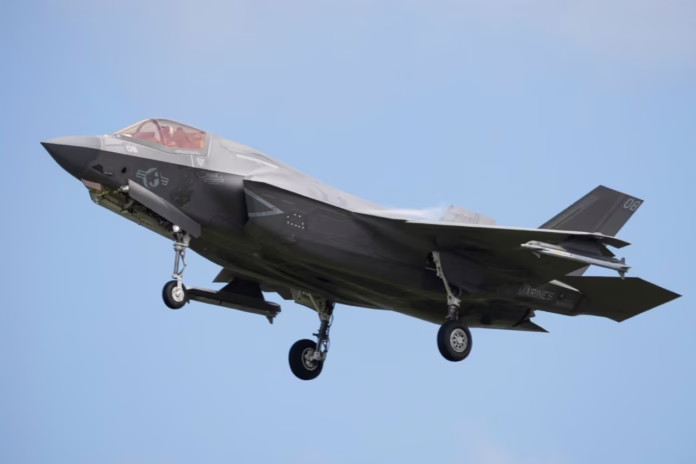
President Donald Trump used the opening day of the NATO summit in Turkey to reassert his interest in acquiring Greenland while advancing a controversial plan to sell F-35 fighter jets to Ankara, a move that has drawn sharp public objections from Israel. The announcement came as the alliance grapples with Russia’s escalating attacks on Ukrainian civilian infrastructure and mounting American pressure on European allies to increase defense spending. The developments underscore how personal diplomacy and unresolved disputes are reshaping alliance dynamics even as the war in Ukraine intensifies.
Story Highlights
- Trump reiterated he wants the United States to control Greenland, acknowledging the position could strain ties with NATO ally Denmark
- The president said he would soon decide on selling F-35 jets to Turkey and lifting sanctions tied to Turkey’s purchase of a Russian air defense system
- Israeli Prime Minister Benjamin Netanyahu has lobbied against the sale, warning it could erode Israel’s military edge in the region
What Happened
President Trump arrived in Turkey on Tuesday for the NATO summit in Ankara, an alliance meeting complicated by Russia’s continued bombardment of Ukraine and long-standing American frustration over European defense contributions. During remarks to reporters, Trump reiterated his desire for the United States to take control of Greenland, a territory belonging to NATO member Denmark, while acknowledging that pursuing the idea would likely damage what he described as an already strained relationship with the alliance. He declined to say whether he intends to announce further reductions of American troops stationed in Europe, telling reporters the administration would wait and see.
In a bilateral meeting with Turkish President Recep Tayyip Erdoğan, Trump said he would decide soon whether to move forward with selling F-35 stealth fighter jets to Turkey, a transaction currently blocked by a congressional ban tied to Turkey’s earlier purchase of Russia’s S-400 air defense system. Trump also indicated he would lift the sanctions imposed on Turkey over that purchase. Erdoğan responded by saying he believed a deal was close, telling reporters that Ankara has been promised five jets and that Trump had made separate assurances regarding American-made engines for Turkey’s domestically built KAAN fighter program.
The proposed sale has become a point of friction between Washington and Jerusalem. Netanyahu made his opposition public in a television interview, warning that arming a government he characterized as influenced by hardline Islamist currents would upset the regional military balance that has long been underwritten by Israeli air superiority and American backing. An Israeli source told reporters that Netanyahu has also raised the matter privately with Trump, arguing that the transfer could compromise Israel’s qualitative military edge, a longstanding principle in U.S. arms sales policy toward the Middle East. According to that source, the administration signaled that even if the sale proceeds, implementation would take considerable time.
The summit unfolds against the backdrop of Russia’s intensifying campaign against Ukraine’s civilian infrastructure. Fuel depots, postal facilities and residential buildings have come under repeated attack in recent weeks, with more than 150 gas stations destroyed in the past two months according to the head of one of Ukraine’s largest fuel retailers. Ukrainian President Volodymyr Zelensky is attending the summit and has urged European allies to prioritize production of anti-ballistic missile systems as the alliance debates its collective response.
Why It Matters
The Greenland comments, paired with the F-35 negotiations, illustrate how Trump’s second term has repeatedly tested the cohesion of NATO even as the alliance confronts what it has itself labeled the gravest threat to European security in decades. Raising the Greenland issue again, even briefly, signals that a dispute many allies believed was settled remains a live point of contention that could complicate coordination on Ukraine and broader defense planning.
The F-35 sale carries significant weight for the regional balance of power. Turkey has sought the aircraft for years, and its acquisition would mark a major shift after Ankara’s removal from the F-35 program in 2019 following its purchase of the Russian S-400 system. Restoring Turkey to the program would represent a significant diplomatic and financial win for Erdoğan and could reshape defense relationships across the eastern Mediterranean.
For American policymakers, the episode highlights the tension between rewarding an increasingly assertive Turkey and preserving the security guarantees historically extended to Israel. Congress previously imposed sanctions and a jet-sale ban specifically to penalize Turkey’s Russian arms purchase, and any move by the administration to reverse that policy would require navigating both congressional resistance and allied concerns.
Economic and Global Context
The F-35 program represents one of the most valuable defense export businesses in American history, with each aircraft costing in the neighborhood of 80 to 100 million dollars depending on configuration and support packages. A Turkish order, potentially numbering dozens of jets, would represent a substantial infusion for Lockheed Martin and its supply chain, which spans hundreds of subcontractors across dozens of states.
Turkey’s KAAN fighter program, meanwhile, has struggled to secure reliable engine suppliers, making American cooperation on propulsion technology a critical variable in Ankara’s broader defense industrial ambitions. Access to American engines would accelerate a program Turkey views as central to reducing its reliance on foreign arms suppliers.
The broader NATO summit takes place as European governments face continued pressure to raise defense spending toward the higher targets pushed by Washington in recent years. Russia’s ongoing strikes on Ukrainian energy and civilian infrastructure have added urgency to those spending debates, with allies weighing additional military aid packages against domestic budget constraints.
Implications
For Turkey, a completed F-35 sale would be a major diplomatic victory and could accelerate broader defense cooperation with Washington after years of strained relations. For Israel, the outcome will be closely watched as a test of how much influence Jerusalem retains over American arms sales decisions in a region it considers vital to its security.
For NATO allies, Trump’s renewed Greenland remarks add another layer of uncertainty to a summit already focused on Ukraine and defense spending commitments. European leaders will likely seek clarity on whether the comments reflect a serious policy push or rhetorical pressure tied to other negotiations.
For Congress, any administration effort to unwind the existing ban on F-35 sales to Turkey would likely reignite debate over the 2019 sanctions law and could prompt renewed legislative pushback, particularly from lawmakers aligned with pro-Israel advocacy groups.
Sources
Trump says US should control Greenland and reiterates disappointment with NATO as summit kicks off