Story Highlights
- The U.S. military conducted new strikes in southern Iran targeting drone operations; Iran retaliated by claiming it struck a U.S. airbase
- Trump told his Cabinet he would not agree to a “crummy agreement” and left open the option of resuming offensive operations
- Kuwait’s air defense intercepted an Iranian missile; no U.S. base was confirmed hit
What Happened
The United States and Iran traded strikes overnight after President Donald Trump insisted he would not agree to a “crummy agreement” in the negotiations to end the three-month-old war. The exchange of fire took place even as diplomatic channels remained technically open, with the White House describing negotiations as proceeding “nicely” on the same day the military action occurred.
Trump announced major combat operations against Iran on February 28, with massive joint U.S.-Israeli strikes targeting military, government, and infrastructure sites. Following a two-week ceasefire, initial U.S.-Iran talks held in Pakistan in April failed to reach a peace deal. Trump later announced an open-ended extension of the ceasefire and the continuation of a U.S. blockade until negotiations conclude “one way or the other.”
Iran accused the U.S. on Thursday of another ceasefire violation and said it retaliated by targeting an American base after a second round of what the Pentagon calls “purely defensive” strikes against drone operations. U.S. Central Command said Kuwait intercepted an incoming Iranian missile, and there were no reports of a U.S. base being hit.
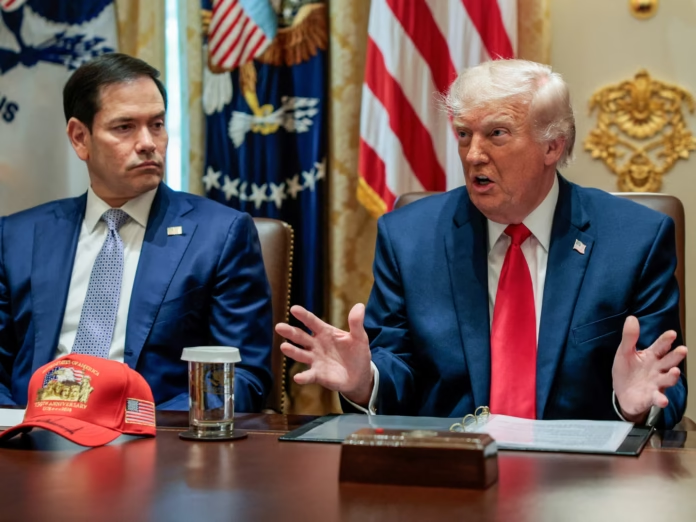
At a Cabinet meeting on May 27, Trump said Iran had been trying to “outwait” him ahead of the 2026 midterms. “They thought they were going to outwait me, you know? We’ll outwait him, he’s got the midterms,” Trump said, dismissing concerns about the war’s political toll at home. “I don’t care about the midterms.” He also reiterated a core objective: “Iran cannot have a nuclear weapon. I’m doing that for the world. I’m not doing it just for us,” Trump said.
Trump said Iran was “negotiating on fumes” and left open the possibility of ordering U.S. forces to “go back and finish it” as diplomatic efforts toward an agreement to extend the ceasefire and reopen the Strait of Hormuz were challenged by the latest exchange of fire. Secretary of State Marco Rubio was present at the Cabinet meeting as Trump outlined his position publicly.
Why It Matters
The mutual strikes on May 27-28 represent a significant deterioration of a ceasefire that was already described as fragile. The fact that both sides can engage militarily while simultaneously holding diplomatic talks underscores the precarious nature of the current arrangement. Any miscalculation — a strike that kills personnel, damages critical infrastructure, or triggers an escalatory response — could collapse negotiations entirely and draw the United States into a deeper and more costly phase of the conflict.
For Americans at home, the stakes are both strategic and personal. Thousands of U.S. military personnel remain deployed in the Middle East theater. The war has already extended beyond three months, far longer than initial administration projections suggested. Public confidence in a swift resolution is fading, and Trump’s own dismissal of the midterms as a political consideration signals that he intends to fight the war on his terms, regardless of domestic political cost.
The Strait of Hormuz remains a central issue. Iran has been attempting to implement a new protocol for transiting the Strait of Hormuz since effectively closing the critical waterway after the war began on February 28. The strait is a chokepoint for a significant portion of global oil exports, and its closure or restriction has cascading effects on energy prices worldwide. So long as the waterway remains subject to Iranian control mechanisms, the economic disruption will persist. CNN
Trump’s insistence on maximum demands — no nuclear weapon, full dismantlement of Iran’s enrichment capability, and favorable terms on regional influence — sets a high bar for any deal. Analysts warn that demanding unconditional terms from a government still capable of striking back creates a negotiating dynamic that is inherently unstable, particularly when military exchanges continue in parallel with talks.
Economic and Global Context
The ongoing conflict has contributed to sustained volatility in global energy markets. Oil prices have remained elevated since the Strait of Hormuz crisis began in late February, affecting fuel costs for consumers and businesses across the United States and allied nations in Europe and Asia. Treasury Secretary Scott Bessent has been involved in discussions about the economic dimensions of the war, reflecting how deeply the conflict has become intertwined with macroeconomic management.
Global shipping companies have rerouted vessels away from the Persian Gulf, adding transit time and costs to supply chains that were already under strain from earlier trade disruptions. Insurance premiums for ships operating in the region have spiked dramatically. For manufacturing-dependent economies like Germany, Japan, and South Korea, the added energy costs represent a meaningful drag on economic output.
Iran’s own economy remains under severe stress. The combination of U.S. military strikes, a tightened blockade, and ongoing sanctions has compressed Iran’s ability to export oil and import essential goods. Iranian officials have described the country as operating under existential pressure, which may explain Trump’s characterization of Tehran as “negotiating on fumes.” That pressure, while real, does not necessarily translate into Iranian concessions — historically, economic desperation has as often hardened positions as softened them.
Implications
The next several days will be critical. If the latest exchange of fire leads to a pause in talks or a decision by either side to escalate further, the window for a negotiated ceasefire extension may close. Trump’s statement that he is willing to “go back and finish it” suggests the United States has contingency plans for resumed offensive operations — a signal intended to pressure Iran but one that also raises the risk of unintended escalation.
For U.S. allies, particularly in the Gulf region, Kuwait’s interception of an Iranian missile is a stark reminder that the conflict is not contained to U.S. and Iranian forces alone. Gulf states that host American military installations face genuine threats, and their willingness to continue hosting those bases depends on U.S. security guarantees holding firm. For Israel, which joined the February 28 strikes, the trajectory of U.S.-Iran negotiations will determine whether the threat from Iranian missile capabilities is permanently reduced or merely paused.
Domestically, the war’s political calculus will intensify as the 2026 midterms approach. Democrats have framed the conflict as a strategic overreach. With Trump dismissing the electoral implications directly, the political debate will center on whether sustained military engagement in Iran represents American strength or an unplanned and costly entanglement — a debate that will shape voter decisions in November.
Sources