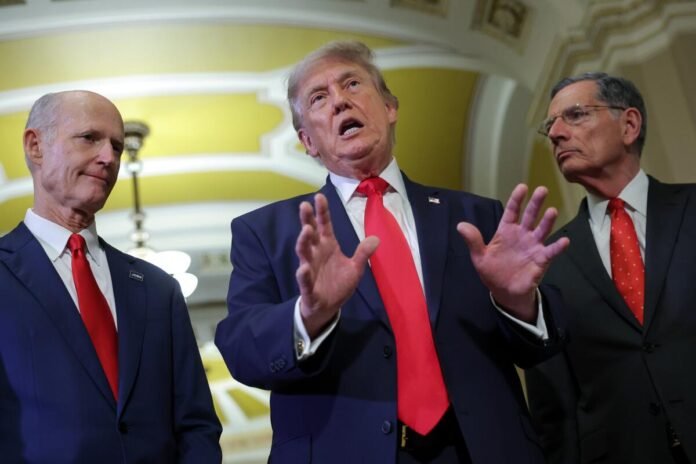
President Donald Trump announced Friday that he will not sign a sweeping bipartisan housing affordability bill passed overwhelmingly by Congress, escalating a standoff that has frustrated members of his own party just months before the midterm elections. The bill, known as the 21st Century ROAD to Housing Act, is nonetheless set to become law automatically at midnight without Trump’s signature, under a constitutional provision that allows legislation to take effect if a president neither signs nor vetoes it within ten days. Trump says his refusal is a protest over the Senate’s failure to pass his preferred election overhaul, the SAVE America Act.
Story Highlights
- Trump says he won’t sign the bipartisan housing bill in protest of Congress not passing his voter ID legislation
- The 21st Century ROAD to Housing Act passed 85-5 in the Senate and 358-32 in the House
- The bill becomes law automatically at midnight without a presidential veto
What Happened
Donald Trump posted on Truth Social Friday morning that he would not sign the housing affordability bill sent to his desk by Congress, writing that he was withholding his signature “in PROTEST” over the Senate’s inability to pass the SAVE America Act, a measure requiring proof of citizenship to register to vote and personal identification at the polls. The post did not clarify whether Trump intends to formally veto the housing legislation, leaving its fate technically undetermined even as the ten-day constitutional clock set to expire at midnight continues ticking.
The housing bill, formally titled the 21st Century ROAD to Housing Act, passed Congress last month with extraordinary bipartisan margins — 85 to 5 in the Senate and 358 to 32 in the House. House Speaker Mike Johnson delivered the bill to the White House on June 29, starting the ten-day countdown. Under the Constitution, if a president does not return a bill within that window while Congress remains in session, it automatically becomes law as though he had signed it. Trump had originally been scheduled to sign the bill in a White House ceremony but abruptly canceled the event on June 24, using the legislation as leverage to pressure lawmakers on his voting overhaul.
The bill itself contains more than 40 provisions addressing barriers to homebuilding, corporate ownership of single-family homes, and manufactured housing construction, among other measures. Press Secretary Karoline Leavitt had previously called it “one of the most significant pieces of housing affordability legislation in American history,” and the White House had touted its passage as a signature win heading into the 2026 midterms. That framing shifted dramatically after Trump began linking the bill’s signing to unrelated election legislation.
Democrats have seized on the episode as evidence of misplaced priorities. House Minority Leader Hakeem Jeffries wrote on social media that “Republicans would rather make it harder to vote than easier to afford a home,” while Colorado Representative Jason Crow highlighted the burden of rising mortgage and rent costs on constituents. Trump, whose reported income exceeded $2.2 billion last year, has dismissed the housing measure in past remarks as “a big yawn” relative to his voting priorities.
The dispute has also created friction within Trump’s own party. Republican lawmakers who viewed the housing bill as a strong pre-election achievement were caught off guard by the president’s refusal to sign, according to reporting from multiple outlets, and some of Trump’s own aides were reportedly surprised as well. The White House had scheduled and then scrapped a signing ceremony, complicating the GOP’s messaging strategy on affordability just as Democrats have made cost-of-living concerns central to their midterm campaign.
Why It Matters
The standoff illustrates how Trump is willing to leverage even broadly popular, bipartisan legislation to advance a separate and more contested policy priority. The SAVE America Act, which would impose proof-of-citizenship requirements for voter registration, does not currently have the votes to pass the Senate, and noncitizen voting — the practice the bill purports to prevent — is already illegal under federal law and occurs rarely. By withholding his signature from the housing bill, Trump is testing how far a president can push legislative hostage-taking on matters with no substantive policy connection to one another.
For everyday Americans, the housing bill addresses a affordability crisis that has become one of the defining economic issues of the decade. The median price of an existing home reached $440,660 in June, according to the National Association of Realtors, up 1.8 percent from a year earlier and far outside the reach of many first-time buyers. Because the measure becomes law regardless of Trump’s signature, its substantive provisions are unlikely to be blocked. But the political theater surrounding its passage sends a signal to both parties about how legislative deal-making will function under continued divided priorities in Washington.
The episode also carries implications for how Congress calibrates future bipartisan efforts. Lawmakers who invested significant political capital in negotiating more than 40 provisions across party lines may become more hesitant to advance major legislation without an explicit signing commitment from the White House in advance, given that Trump abruptly reversed his stated support after the bill had already cleared both chambers.
Economic and Global Context
Housing affordability has emerged as one of the most persistent drags on household finances nationwide. Thirty-year fixed mortgage rates currently hover around 6.5 percent, sharply higher than pandemic-era lows, compounding the effect of elevated home prices on affordability. According to Sarah Brundage, president of the National Association of Affordable Housing Lenders, even if the new law spurs additional homebuilding, the benefits will take years to materialize because development timelines routinely outlast a single elected official’s term in office.
A recent poll conducted by the American Property Owners Alliance, a nonprofit funded by the National Association of Realtors, found that 89 percent of registered voters supported the housing package, reflecting rare consensus across the political spectrum on the need for federal action. That level of public support stands in contrast to the contentious nature of the SAVE America Act, which lacks comparable bipartisan backing in the Senate.
The legislation’s automatic enactment, regardless of White House posturing, underscores a broader economic reality: the housing shortage has become severe enough that congressional leaders from both parties concluded inaction was no longer politically tenable. Still, because federal legislation alone cannot resolve local zoning restrictions, permitting delays, and labor shortages in construction, experts caution that the bill represents only a first step rather than a comprehensive fix to the national housing shortfall.
Implications
For homebuilders, mortgage lenders, and housing advocacy groups that lobbied heavily for the legislation, the automatic enactment offers relief despite the political drama, since the substance of the law remains intact. Businesses in the housing sector can now begin planning around the new provisions without further legislative uncertainty, even as they absorb the reputational fallout of a president publicly disparaging a bill they helped shape.
For congressional Republicans facing difficult midterm races, the episode complicates campaign messaging on affordability, an issue Democrats are prioritizing nationally. GOP lawmakers who hoped to campaign on the housing bill as a concrete legislative win may now find themselves explaining why the president resisted signing it, even as they simultaneously defend his broader agenda.
For voters, the coming months will reveal whether Trump’s gambit succeeds in pressuring the Senate to advance the SAVE America Act, or whether it merely deepens intraparty tension without achieving his stated legislative goal. Either outcome will likely factor into how both parties frame the midterm elections, with housing costs and voting access emerging as parallel points of contrast heading into November.
Sources
Trump says he won’t sign bipartisan housing affordability bill