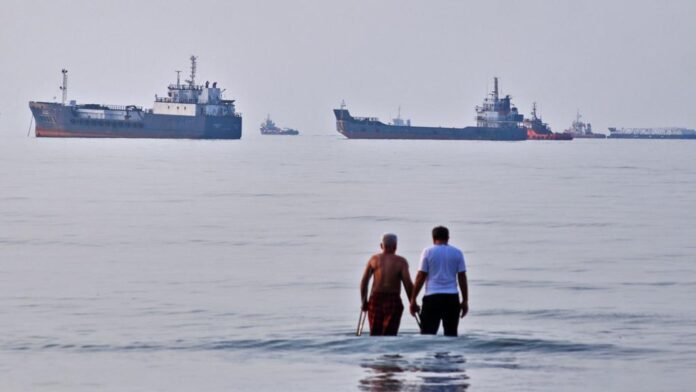
President Donald Trump abruptly reversed course on a plan to charge a 20 percent toll on cargo ships passing through the Strait of Hormuz, announcing instead that Gulf states would make new trade and investment commitments in the United States. The reversal came less than 24 hours after the toll was first announced, as fighting between the United States and Iran entered its fourth consecutive day and threatened to unravel a fragile interim truce. The episode highlights how quickly Middle East policy is shifting as Washington juggles military escalation, energy markets, and diplomacy with Gulf allies.
Story Highlights
- Trump scrapped a planned 20 percent “reimbursement fee” on ships transiting the Strait of Hormuz just a day after announcing it.
- The U.S. instead pushed ahead with a naval blockade targeting Iranian vessels, effective Tuesday afternoon.
- Iran retaliated against U.S. allies, striking tankers linked to the United Arab Emirates and firing on Bahrain, Jordan, and Kuwait.
What Happened
On Monday, Trump announced that the United States would impose a 20 percent fee on cargo shipped through the Strait of Hormuz, framing it as reimbursement for American forces providing security in the waterway. By Tuesday, he had abandoned the idea entirely. “Based on highly productive conversations with Middle East leadership, I have decided to replace the 20% United States Reimbursement Fee with Trade and Investment Deals that the various Gulf States will be making into the United States,” Trump wrote on social media, adding that the investments “will be MASSIVE.”
The about-face followed direct calls from Gulf leaders, including kings and emirs, who Trump said pushed back on the toll proposal. It also came just hours before the U.S. military launched a blockade on ships entering or exiting Iranian ports, a policy Trump has dubbed “the Iranian blockade” since it targets only vessels tied to Tehran. The shift in strategy reflects an effort to distinguish between punishing Iran and burdening America’s regional partners and global shipping more broadly.
The toll proposal had already drawn criticism for contradicting earlier U.S. policy. Secretary of State Marco Rubio stated in June that no country is permitted to charge tolls or fees on an international waterway under existing international law, a position the initial 20 percent fee appeared to undercut. The reversal effectively restored that standard while still asserting American military control over Iranian shipping specifically.
The policy reversal unfolded against a backdrop of intensifying combat. U.S. forces carried out strikes against Iranian military sites for a third and fourth consecutive night, while Iran retaliated by targeting American allies across the Gulf. The Emirati Defense Ministry reported that Iranian cruise missiles struck two UAE-linked tankers, the Mombasa and Al Bahiyah, killing one crew member and wounding eight others. Bahrain, home to the U.S. Navy’s Fifth Fleet, sounded missile alert sirens multiple times, and Jordan’s military said it intercepted four Iranian missiles entering its airspace.
An interim 60-day ceasefire agreement reached in June, which included a 14-point memorandum aimed at reopening the strait and negotiating a permanent resolution, has effectively collapsed. Trump declared the ceasefire “over” during a NATO summit last week, though he has not ruled out renewed negotiations. Regional mediators, reportedly led by Pakistan, are working to revive the truce.
Why It Matters
The whiplash policy reversal underscores the volatility of U.S. Middle East strategy at a moment when American credibility with Gulf allies is directly tied to global energy stability. A toll on one of the world’s most critical shipping corridors, through which roughly a fifth of global oil consumption passes, risked alienating partners the United States depends on for basing rights, intelligence sharing, and investment. Reversing course within a day signals both responsiveness to allied pressure and uncertainty in the administration’s approach to the ongoing conflict.
For American consumers and businesses, the stakes are tangible. Tolls or blockade-related disruptions in the strait ripple through fuel prices, shipping costs, and eventually consumer goods. The administration’s decision to shift from a punitive fee to voluntary investment pledges may ease anxiety among traders, but it does not resolve the underlying military confrontation driving instability in the region.
The episode also illustrates tension within the administration’s own messaging. Rubio’s public assurances that international waterways cannot be tolled were directly contradicted by Trump’s initial announcement, only for the president to walk it back after diplomatic blowback. Such contradictions raise questions for allies and adversaries alike about how firmly White House trade and security policy is coordinated across agencies.
For Congress, the continued military campaign without a new authorization vote remains a point of contention, particularly as strikes stretch into a fourth consecutive day with no clear endpoint. Lawmakers from both parties have raised concerns about the scope of executive war powers being exercised in the Gulf.
Economic and Global Context
Financial markets responded quickly to the shifting signals. Brent crude oil, the international pricing benchmark, climbed to a one-month high above 87 dollars per barrel on Tuesday, though it remains well below the nearly 120 dollars per barrel reached at the height of the earlier fighting. Continued instability in the strait, through which a substantial share of the world’s seaborne oil and liquefied natural gas moves, keeps upward pressure on energy prices that could filter into inflation figures later this year.
Gulf states had already pledged more than 2 trillion dollars in investment commitments to the United States prior to the outbreak of war with Iran, a figure Trump indicated would now grow further under the new arrangement, though specifics remain undisclosed. The lack of clarity about whether these are genuinely new commitments or a repackaging of earlier pledges has drawn skepticism from trade analysts.
Internationally, the European Union’s aviation safety regulator issued formal guidance directing airlines to avoid flying over Bahrain, Kuwait, Qatar, the United Arab Emirates, and sections of the Gulf of Oman, a sign of how the conflict is disrupting commercial aviation well beyond direct combatants. Shipping insurers have also been recalibrating risk premiums for vessels transiting the strait, adding further costs that are likely to be passed on to importers and exporters worldwide.
The parallel diplomatic track involving Lebanon and Israel, with delegations meeting in Rome to discuss a framework agreement on Israeli withdrawal from southern Lebanon, illustrates how the Iran conflict is intertwined with broader regional security negotiations that the United States is simultaneously trying to manage.
Implications
In the near term, the success of the naval blockade against Iranian shipping will be closely watched as a test of whether the administration can degrade Iranian capabilities without drawing the United States into a broader ground conflict. Experts have cautioned that fully closing the strait to Iranian traffic could require a far larger military commitment than currently deployed.
For Gulf allies, the shift from a toll to voluntary investment deals offers a face-saving resolution that preserves the appearance of partnership while leaving open questions about enforcement and specifics. Business leaders in shipping, energy, and logistics sectors will be watching closely for details on what the new investment commitments actually entail.
Domestically, the administration faces pressure to clarify its long-term strategy toward Iran, particularly as the conflict enters territory where congressional oversight and war powers questions are likely to intensify. Voters concerned about gas prices and economic stability will be watching whether the blockade further escalates hostilities or opens a path back toward negotiation.
Globally, allies and adversaries alike are parsing the reversal as a signal of how Trump administration policy can shift rapidly under pressure, a dynamic that could shape how other nations approach future negotiations with Washington on trade, security, and energy issues.
Sources
“Trump backs away from plans to charge fees in the Strait of Hormuz as attacks intensify”