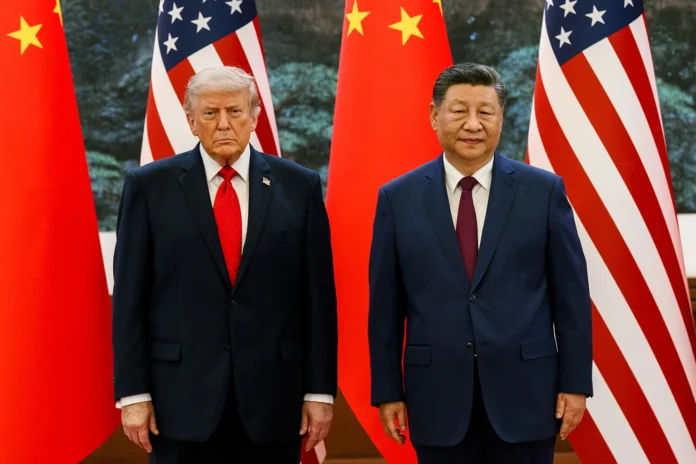
President Donald Trump has renewed explosive claims that China orchestrated a massive interference operation against his 2020 election bid, even as his administration continues preparations for a high-profile state visit by Chinese President Xi Jinping later this year. The allegations, delivered in a nationally televised address, represent one of the most direct accusations Trump has leveled against Beijing since taking office again, and they arrive at a delicate moment for U.S.-China relations. Analysts warn the claims could complicate, or even derail, the planned September visit.
Story Highlights
- Trump alleged China carried out the “largest compromise of election data in history” during the 2020 presidential race
- Xi Jinping is currently planning a state visit to Washington in September, following Trump’s own visit to Beijing in May
- Chinese officials have flatly denied the accusations, stating Beijing does not interfere in U.S. elections
What Happened
In a primetime address delivered from the East Room of the White House, President Donald Trump accused the Chinese government of carrying out what he called the “largest compromise of election data in history,” directly tying the alleged operation to his 2020 loss to Joe Biden. Trump claimed the effort was part of a broader campaign by Beijing to turn American business leaders and journalists against him, and alleged that Chinese officials specifically wanted the sitting U.S. president to lose his 2020 reelection bid. The speech, initially billed by the White House as focused broadly on “election integrity,” instead centered heavily on the China allegations, catching many observers by surprise.
The claims were reportedly tied to newly declassified intelligence materials that Trump and his allies have promoted in recent weeks, though CNN’s early review of the documents found they largely reiterate previously known vulnerabilities in U.S. election infrastructure rather than presenting dramatic new evidence of Chinese interference. Fact-checkers have noted that the specific claim of a coordinated Chinese effort to manipulate 2020 election data goes beyond what is supported by the broader U.S. intelligence community’s public assessments, with reporting suggesting the allegations rely on what has been described as a minority interpretation within the intelligence apparatus.
China’s government responded swiftly and firmly, denying any involvement in American electoral processes. Chinese officials reiterated that Beijing does not interfere in the internal political affairs of other nations, a standard denial the government has issued in response to past accusations from Washington. Despite the sharp rhetorical exchange, officials from both governments have continued working toward maintaining diplomatic contact, with discussions ongoing regarding a possible state visit by Xi Jinping to the United States in September.
The timing of Trump’s remarks is notable given the broader arc of U.S.-China relations this year. Trump made a state visit to Beijing in May, his second visit to China and first as part of his current term, during which he and Xi held extended talks, visited the Temple of Heaven together, and shared a dinner banquet at the Great Hall of the People. During that visit, Trump formally invited Xi to make a reciprocal state visit to Washington, tentatively set for late September. The renewed election interference claims represent a sharp reversal from the warmer diplomatic tone that characterized the May meeting, according to reporting from The Washington Post.
Why It Matters
Trump’s decision to publicly revive election interference allegations against China, just months after a cordial state visit, signals significant volatility in how the administration approaches its most consequential bilateral relationship. For American voters, the claims add another layer of uncertainty to an already contentious national conversation about election security, particularly with the 2026 midterms approaching. If the underlying intelligence does not hold up to independent scrutiny, as CNN’s early review suggests may be the case, the episode risks further eroding public trust in how the administration characterizes and uses classified intelligence for political purposes.
For U.S.-China relations more broadly, the accusations complicate what had appeared to be a genuine, if fragile, effort at stabilizing ties after years of trade disputes and strategic competition. A collapse of the planned September visit would represent a significant setback to diplomatic engagement between the world’s two largest economies at a moment when cooperation on trade, technology, and security issues remains critical.
Policymakers in Congress, particularly members focused on national security and election integrity, will likely demand clearer briefings on the underlying intelligence behind Trump’s claims. The gap between the president’s public characterization of the material and independent assessments of its actual content raises important questions about transparency and the potential politicization of intelligence products.
Economic and Global Context
The renewed tensions arrive as Washington and Beijing continue to navigate a complex economic relationship marked by ongoing disputes over trade tariffs, technology restrictions, and competition in critical sectors such as artificial intelligence. Reports indicate China has been aggressively positioning itself for a larger role in global AI leadership, a point of friction that predates the current election interference controversy but adds to the broader climate of strategic rivalry between the two nations.
Global markets have shown sensitivity to fluctuations in the U.S.-China relationship throughout the year, with technology and manufacturing sectors particularly exposed to shifts in tariff policy and export restrictions. A serious rupture in diplomatic relations, triggered by the election interference dispute, could reintroduce volatility into markets that have only recently stabilized following the trade agreements reached earlier in Trump’s term.
Internationally, allies watching the U.S.-China relationship will be parsing the mixed signals carefully. The contrast between Trump’s warm engagement with Xi in May and his sharp public accusations in July illustrates the unpredictable nature of the current diplomatic approach, complicating efforts by allied nations to align their own China strategies with Washington’s.
Implications
In the near term, expect the Chinese government to continue rejecting the interference allegations while working to preserve the planned September state visit, which both sides appear to view as strategically valuable despite the current friction. Diplomatic channels are likely to remain open even as public rhetoric sharpens, reflecting a broader pattern in which both nations have sought to manage disputes without allowing them to derail high-level engagement entirely.
For lawmakers and intelligence officials, pressure will likely mount for greater transparency regarding the declassified materials Trump cited in his address. Independent verification of the claims, or the lack thereof, could significantly shape how seriously the allegations are treated going forward, both domestically and internationally.
For American businesses with significant exposure to the Chinese market, continued uncertainty in the political relationship adds another variable to already complex planning around trade policy, supply chains, and technology investment. Whether the September visit proceeds as planned will serve as an important signal of the broader trajectory of the relationship heading into the final months of the year.
Sources