Story Highlights
- President Donald Trump said he “loved” the latest inflation numbers after annual consumer-price growth reached 4.2 percent.
- The White House said Trump was emphasizing that inflation remained below some wartime forecasts, not celebrating higher household costs.
- The episode is raising questions about presidential messaging, economic accountability and how the administration explains the Iran war’s effect on prices.
What Happened
President Donald Trump drew criticism after responding positively to a new inflation report showing that consumer prices rose at their fastest annual pace in three years.
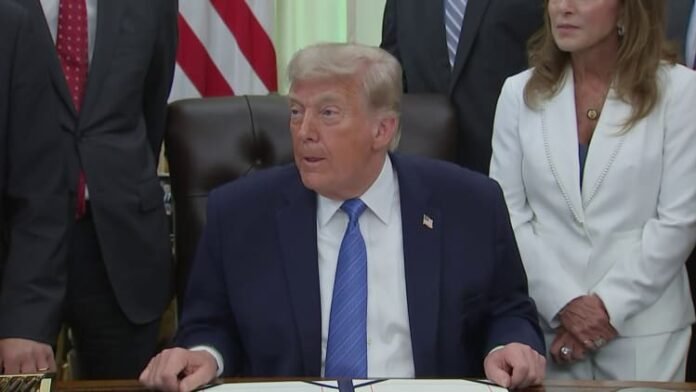
When reporters asked whether the May Consumer Price Index concerned him, Trump said the numbers were “great” and added, “I love the inflation.”
The remark quickly circulated online and was highlighted by Democratic lawmakers as evidence that the administration was not taking rising household costs seriously.
- Consumer prices increased 0.5 percent during May.
- Annual inflation accelerated from 3.8 percent to 4.2 percent.
- Gasoline prices rose 7 percent during the month.
Trump later clarified that he was referring to the economy performing better than some analysts had expected during an active conflict with Iran.
He argued that inflation would decline once the war ended, the Strait of Hormuz reopened and pressure on global energy supplies eased.
The president’s broader response focused heavily on oil.
Trump described a covert operation involving 22 ships moving oil through the region without lights, presenting the mission as evidence that the administration was working to protect supplies despite Iranian threats.
Some early accounts characterized the vessels as seized Iranian ships, but Trump’s reported description focused on secretly moving oil rather than clearly establishing that the United States had taken ownership of 22 Iranian vessels.
That distinction matters because claims involving military seizures, foreign property and oil supplies require precise confirmation from the administration.
Why It Matters
The controversy matters because inflation is not merely an economic statistic. It directly affects gasoline, transportation, housing, food and other expenses paid by American families.
Trump won support in part by promising to restore affordability after the sharp price increases experienced under the previous administration.
That makes the White House’s language especially important when inflation begins rising again.
- The phrase can be separated easily from Trump’s fuller explanation.
- Political opponents can use the clip without discussing the energy-driven nature of the increase.
- Republican candidates may have to explain the comment during the midterm campaign.
The underlying report was more complicated than the headline number.
Core inflation, which excludes food and energy, increased 2.9 percent over the year. That suggests the sharp acceleration was concentrated heavily in energy rather than spread evenly across the entire economy.
This provides some support for Trump’s argument that the increase may ease if the Iran conflict ends and oil markets stabilize.
However, consumers experience headline inflation rather than an adjusted measure. Families still pay the higher gasoline and transportation costs even when economists classify them as temporary or volatile.
The president’s challenge is therefore not only to explain why inflation increased, but also to demonstrate what the administration is doing to reduce it.
Oversight and Accountability Context
The episode raises two separate accountability questions: whether Trump’s comment accurately conveyed his intended meaning and whether the administration’s explanation of the inflation increase is supported by evidence.
The official data confirms that energy was a major driver of the May increase.
The energy index rose 3.9 percent during the month, while gasoline increased 7 percent. Core prices increased at a considerably slower rate.
- The White House has evidence for linking much of the increase to energy.
- The administration still must explain how quickly those pressures can realistically ease.
- Claims about covert oil operations require additional public verification.
Trump’s clarification—that he welcomed a lower-than-feared wartime inflation result—is materially different from saying he welcomes higher prices for consumers.
Even so, presidents are responsible for communicating clearly when discussing figures that directly affect household finances.
The phrase “I love the inflation” created an avoidable opening for critics because it did not initially acknowledge the burden higher prices place on families.
The administration should also provide clearer details about Trump’s statement involving 22 oil ships.
Officials could clarify who owned the oil, whether the vessels were American or foreign, what legal authority governed the operation and whether the oil entered commercial markets.
Without that information, the claim cannot yet be evaluated as evidence that the operation will reduce domestic energy prices.
Congressional oversight may also focus on the economic costs of the Iran campaign, including energy disruptions, military spending and the effect of the Strait of Hormuz restrictions on American consumers.
What Happens Next
The next inflation reports will show whether May’s increase was a temporary wartime shock or the beginning of a more persistent trend.
If oil and gasoline prices decline following progress in the Iran negotiations, Trump will be able to argue that his prediction was correct and that the inflation spike was largely temporary.
If energy costs remain elevated or begin spreading more broadly into goods and services, the administration will face greater economic and political pressure.
- Watch the next monthly Consumer Price Index report.
- Monitor oil and gasoline prices following developments around Hormuz.
- Follow any White House disclosure about the 22-vessel oil operation.
- Track whether the Federal Reserve changes its interest-rate outlook.
The Federal Reserve will examine whether energy inflation is beginning to influence wages, services and consumer expectations.
Persistent price growth could delay interest-rate reductions or create pressure for tighter monetary policy, increasing borrowing costs for households and businesses.
Trump is expected to continue arguing that ending the Iran conflict will deliver substantial economic relief.
That argument may prove persuasive if consumers see visible declines at gasoline stations and in transportation costs.
For the White House, the larger lesson is that favorable economic context cannot substitute for careful communication.
The administration has a defensible case that the May increase was driven largely by wartime energy disruption, but it must present that case without appearing to dismiss the financial strain experienced by American families.