Story Highlights
- Trump visited Walter Reed on May 27 for what the White House described as a routine six-month preventative checkup
- His physician, Navy Capt. Sean Barbabella, has previously declared Trump in “exceptional health” and fully fit for duty
- Critics and medical experts have raised questions about transparency, the frequency of exams, and visible health changes
What Happened
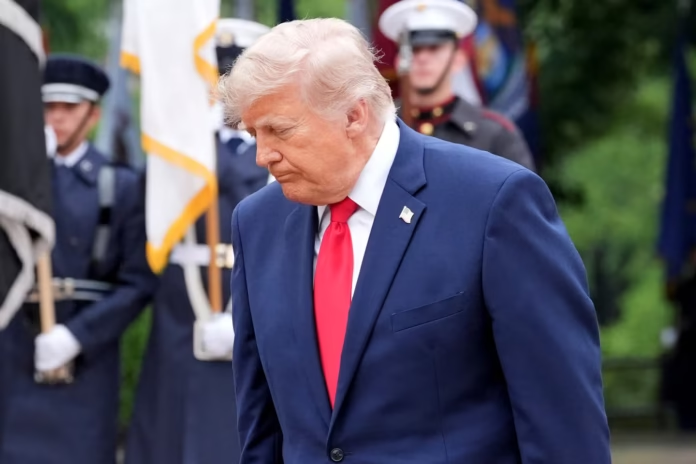
President Donald Trump, who turns 80 next month, said “everything checked out perfectly” after having his physical on Tuesday at Walter Reed National Military Medical Center, following a year of public attention on apparently minor health issues. Trump offered no details of the physical in a brief Truth Social post, saying he had completed his six-monthly exam.
Trump, 79, underwent a “routine” assessment as part of his “regular preventative health care,” the White House said. A memo of the exam results is typically sent out by the White House, but no details on when that will be released were provided. Tuesday’s visit was his third to Walter Reed in thirteen months, following an annual exam in April 2025 and a follow-up visit in October 2025.
His physician, Navy Capt. Sean Barbabella, declared him to be in exceptional health and fully fit to execute the duties of president in his most recent formal report. That report also said Trump achieved a perfect score on a cognitive assessment. The White House has consistently described Trump’s health profile as consistent with someone younger than his chronological age.
Recent photographs showing a blotchy neck rash have added to questions about Trump’s health, following images in July 2025 of swollen ankles and a bruised hand concealed with makeup. These observations, widely circulated on social media and noted by journalists covering the White House, have prompted repeated questions at press briefings that the administration has largely declined to answer in detail.
There was some confusion after Trump told The Wall Street Journal that he received a CT scan during one visit, after previously saying he had undergone an MRI. His physician clarified that it was a CT scan intended to “definitely rule out any cardiovascular issues.” Medical experts noted that MRIs are not typically part of a routine physical and are usually prescribed to obtain detailed images of specific areas of the body, raising questions about why the exam was ordered.
Why It Matters
Presidential health is not merely a matter of personal privacy — it is a matter of national governance. The president of the United States wields enormous executive authority, commands the armed forces, and represents the country’s interests in crises that require immediate, clear-headed decision-making. When there are credible questions about a president’s physical or cognitive condition, those questions are inherently matters of public interest.
Trump is the oldest person ever to serve as president, and he will turn 80 during his current term. The historical precedent for presidential health transparency is mixed, but the post-Watergate era has generally moved toward greater disclosure. The public has a legitimate interest in receiving comprehensive, unfiltered medical reporting — not a brief social media post and a one-page summary from a physician employed by the executive branch.
The frequency of Trump’s Walter Reed visits — three in thirteen months, including a follow-up exam just six months after the primary annual physical — is itself a signal worth examining. Administrations do not schedule additional medical reviews unless there is a reason to do so. The official explanations have been inconsistent, ranging from routine follow-up care to precautionary imaging, but the pattern of visits is more intensive than typical presidential health maintenance, even for a president of advanced age.
The cognitive test component is particularly sensitive. Trump and his allies have repeatedly cited his perfect score on a standardized cognitive screening tool as evidence of sharp mental function. However, medical professionals note that such tests screen for gross cognitive impairment and are not designed to assess the nuanced executive functioning required of a president. Passing a basic screen is not the same as demonstrating the full cognitive capacity demanded by the office.
Economic and Global Context
Markets and foreign governments track presidential health closely, even if they rarely say so publicly. Political stability is a core component of investor confidence, and uncertainty about a sitting president’s health — particularly one engaged in an active military conflict and conducting global trade negotiations — can introduce risk premiums across financial instruments.
The administration’s ongoing conduct of the Iran war, trade policy, and budget battles all depend on Trump’s personal engagement and decision-making. Any sustained health episode that reduced his active involvement would raise immediate questions about continuity of governance, the role of the vice president, and the coordination of executive branch operations. That uncertainty, even if hypothetical, factors into how allies and adversaries assess American reliability.
Globally, foreign leaders and intelligence services maintain detailed assessments of the U.S. president’s health and mental acuity. Those assessments influence negotiating strategies, diplomatic positioning, and military calculations. The more opaque the White House is about Trump’s medical condition, the more those assessments rely on inference from public appearances and leaked information — a situation that creates its own risks for American foreign policy.
Implications
The immediate implication is political. Democrats and several independent observers will continue pressing for a full, unredacted medical report from an independent physician rather than one appointed by and accountable to the administration. That pressure will likely intensify as the midterm cycle heats up, with Trump’s age and fitness serving as a recurring campaign theme for challengers.
For the Republican Party, the health narrative creates a delicate management challenge. Allies have uniformly praised Trump’s energy and sharpness in public statements, creating a feedback loop in which any acknowledgment of health concerns would be seen as political betrayal. That dynamic discourages internal candor and may limit the party’s ability to respond effectively if a genuine health issue emerges.
For the American public, the core implication is simple: voters deserve honest information about the physical and cognitive condition of the person holding the most powerful office in the country. Until the administration provides comprehensive, independently verified medical disclosure, questions about presidential fitness will remain an open and legitimate dimension of the national political conversation.
Sources