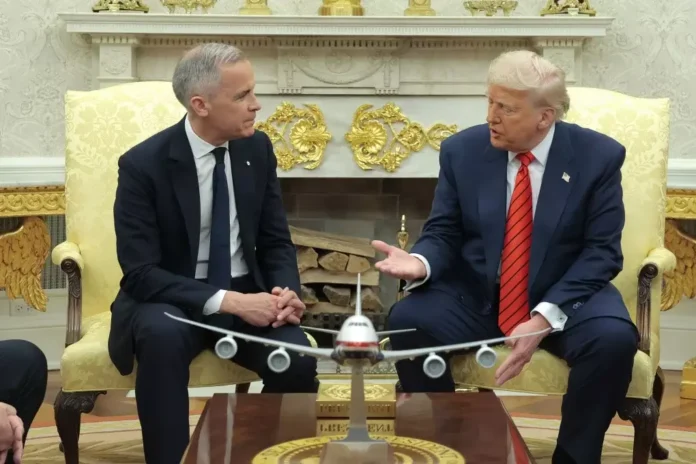
President Donald Trump has imposed sweeping 50 percent tariffs on a broad range of Canadian goods, invoking a Depression-era trade law that has not been used since 1949. The move, formalized through three separate proclamations, targets Canadian automobiles, alcohol and dairy products, along with dozens of other categories, and takes effect in 30 days unless a new trade agreement is reached. The decision marks one of the most aggressive escalations yet in the trade relationship between the two allied nations.
Story Highlights
- Trump signed three proclamations invoking Section 338 of the Tariff Act of 1930 to impose 50 percent tariffs on Canadian goods
- The tariffs cover autos, alcohol, dairy, construction materials, clothing, furniture and technology, but exclude oil, potash, fish and critical minerals
- The measures take effect in 30 days, giving both countries a window to negotiate before the duties are formally applied
What Happened
On Monday, President Trump signed three proclamations under Section 338 of the Tariff Act of 1930, a provision dating to the same legislation historically blamed for deepening the Great Depression. According to senior administration officials, the authority had gone unused since 1949, making Monday’s action the first invocation of the statute in more than three-quarters of a century. Each proclamation applies a 50 percent tariff to a distinct category of Canadian imports, with officials describing the covered goods as ranging “from wine to hockey sticks to cement.”
The administration says the action responds to what it characterizes as long-standing Canadian discrimination against American automakers, alcohol producers and dairy farmers. Officials pointed specifically to Canadian tariffs on U.S. dairy products, which the administration says range as high as 250 to 390 percent under Canada’s supply management system. One senior official told reporters the goal is to “level the playing field for crucial American exports: motor vehicles, alcohol, and dairy,” while another said Canada “has to be held accountable” for what the administration considers unfair trade practices.
The tariffs will not apply universally. The White House confirmed exemptions for oil, of which Canada is a major exporter to U.S. refineries, as well as potash, a critical fertilizer ingredient for American farmers, and fish and select critical minerals. Goods already covered under existing national security tariffs, including steel, aluminum and many auto parts, are also excluded from the new duties to avoid double taxation.
Canada’s business community responded quickly. Candace Laing, president and CEO of the Canadian Chamber of Commerce, called the move “a regrettable escalation” while noting the 30-day delay offers a narrow window for both governments to pursue a resolution. Trade experts, however, described the use of Section 338 as a dramatic legal escalation. Trade analyst Scott Lincicome characterized the move as crossing a threshold, calling the invocation of Section 338 “the nuclear option for Trump tariffs” because it bypasses the World Trade Organization and the U.S.-Mexico-Canada Agreement dispute mechanisms that have governed North American trade for decades.
The tariffs arrive months after the Supreme Court ruled in February that Trump lacked legal authority to impose earlier tariffs by declaring a national economic emergency, a ruling that forced the administration to search for alternative legal justifications to continue its aggressive tariff agenda. Section 338 is one of several statutory tools the administration has since turned to in order to preserve its ability to unilaterally raise import duties.
Why It Matters
The revival of Section 338 signals that the administration intends to keep pursuing an aggressive tariff strategy even after losing its primary legal justification at the Supreme Court. For American consumers, the practical effect could be higher prices on a wide array of everyday goods, since companies that import Canadian products typically pass added costs on to buyers. Dairy, alcohol and automobiles are staples of American households, meaning the tariffs’ impact would likely be felt broadly and quickly once they take effect.
For policymakers, the move raises fresh questions about the balance of power between Congress and the executive branch on trade matters. Several Democratic lawmakers have previously proposed repealing Section 338 specifically because of concerns that a president could use it to unilaterally destabilize trade relationships without congressional input. The provision’s revival after 77 years of dormancy is likely to trigger immediate legal challenges questioning whether such sweeping authority can still be lawfully exercised in the modern trade era.
The economic stakes are significant given how deeply integrated the U.S. and Canadian economies have become since the original North American Free Trade Agreement took effect in the 1990s. Canada remains one of the United States’ largest trading partners, and disruptions to that relationship carry consequences for supply chains in the automotive, agricultural and manufacturing sectors on both sides of the border.
Economic and Global Context
The tariffs come as the administration continues to navigate the fallout from its broader “Liberation Day” tariff push of the prior year, which triggered a financial market selloff amid fears of inflation and recession, ultimately forcing a temporary rollback to allow for negotiations. That episode looms over the new Canada-specific action, as investors and economists watch closely for signs of a repeat market reaction.
Canada has been notably willing to retaliate against U.S. tariffs in the past, and administration officials singled it out, along with China, as one of the only trading partners to respond to previous American duties with countermeasures of its own. That history raises the likelihood that Ottawa could respond with retaliatory tariffs targeting American exports, potentially reigniting a tit-for-tat trade conflict reminiscent of earlier trade disputes.
The dairy dispute in particular reflects a long-running disagreement rooted in Canada’s supply management system, which restricts the volume of foreign dairy that can enter the country without facing steep tariffs once quotas are exceeded. Trump has repeatedly criticized this arrangement, arguing it treats American dairy producers more harshly than their European counterparts. The automobile sector faces similar strain, with cross-border supply chains that see parts and finished vehicles cross the U.S.-Canada border multiple times during production.
Beyond the immediate economic figures, the timing carries political weight. The tariffs land roughly four months ahead of the November midterm elections, a period in which any inflationary pressure from higher consumer prices could become a political liability for the administration and congressional Republicans seeking to defend their majorities.
Implications
In the near term, all eyes turn to whether Washington and Ottawa can use the 30-day window to strike a deal that avoids the tariffs taking full effect. Administration officials have described talks with Canadian counterparts as “substantive” but stopped short of calling them formal negotiations, suggesting significant gaps remain between the two sides’ positions.
Businesses reliant on Canadian imports, particularly automakers with integrated North American supply chains, face difficult decisions about whether to absorb costs, pass them to consumers, or attempt to restructure sourcing before the deadline. Dairy and alcohol distributors are likely to face similar pressures, particularly given the short timeline to adjust contracts and pricing.
For American voters, the coming weeks will offer an early signal of whether the tariffs translate into visible price increases at grocery stores, dealerships and liquor retailers. Should inflationary effects materialize before the midterms, Republican lawmakers in competitive districts may face pressure to distance themselves from the policy. Legal challenges are also expected to test whether Section 338’s broad, decades-old language can withstand modern judicial scrutiny, a question that could ultimately return trade policy authority disputes to the Supreme Court once again.
Sources