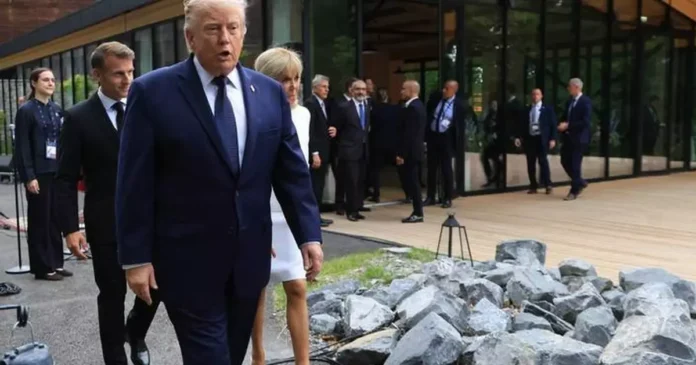
Story Highlights
- Trump signed the agreement at Versailles during a dinner with French President Macron, after the deal’s full 14-point text was revealed for the first time at a G7 press conference earlier that day
- The deal reopens the Strait of Hormuz, lifts U.S. sanctions on Iran, and initiates 60 days of nuclear negotiations — but does not require Iran to surrender its stockpiles of highly enriched uranium
- Republican critics have called the framework a “tremendous foreign policy blunder,” arguing it provides significant sanctions relief in exchange for limited and unverifiable Iranian commitments
What Happened
President Trump said Wednesday night he had formally signed the framework agreement to end the war with Iran during a dinner with French President Emmanuel Macron at Versailles. The Trump administration shared the details of the agreement earlier on Wednesday, as President Trump took questions from reporters in Evian, France, at a press conference that capped off his visit to the G7 summit. Senior administration officials, who briefed reporters on condition of anonymity, read the agreement in its entirety. Trump had announced the two sides struck an agreement on Sunday, but the specifics of the plan had not been made public until Wednesday — causing a lot of speculation and confusion about what it contained.
Under the 14-point deal seeking to end the U.S.-Iran war, the Strait of Hormuz would reopen and Washington would lift sanctions on Tehran. The agreement also contains Iran’s commitment not to acquire a nuclear weapon and establishes a 60-day window for formal nuclear negotiations. Critically, the deal does not require Iran to surrender or destroy its existing stockpiles of highly enriched uranium — a point that became a focal point of criticism from Republican senators and foreign policy analysts immediately after the text was disclosed.
During his press conference, President Trump defended the memorandum of understanding he reached with Iran, arguing that resuming bombing would have caused “economic catastrophe.” Trump said: “If we didn’t do this deal, we could have dropped more bombs for another three weeks, two to four weeks, but you would never have the Hormuz Strait open. You would never have success; your market would have, instead of going up at levels that nobody’s ever seen before, would go down at levels that nobody ever saw before.”
Trump also downplayed the importance of obtaining Iran’s stockpiles of highly enriched uranium, claiming that Tehran cannot access them anyway and asserting that the “nuclear dust” is buried deep under rubble after the U.S. bombed Iran’s three main nuclear sites last year. He also compared the deal favorably to the Obama-era JCPOA, dismissing critics who argued the new framework was inferior by claiming the prior deal involved financial inducements that Iran ultimately dismissed.
Why It Matters
The agreement, if it holds, would represent the most consequential diplomatic development of Trump’s second term, ending a military conflict that destabilized global energy markets, inflicted mass casualties, and raised fears of broader regional war. Before departing for a visit and dinner at the Palace of Versailles in Paris, Trump held a news conference where he defended the proposed agreement and argued it would help avoid further military escalation and economic turmoil. The Strait of Hormuz carries approximately 20% of global oil trade, and its closure since the onset of hostilities drove the energy price spikes that continue to weigh on American household budgets.
Israel is said to overwhelmingly oppose the deal, as it only includes an Iranian pledge not to obtain a nuclear weapon. Beyond that, all Iran has agreed to do is merely discuss making further concessions in follow-up negotiations over the next two months, during which it is slated to receive considerable sanctions relief. Critics argue that rewarding Iran with sanctions relief in exchange for a pledge and 60 days of negotiations incentivizes delay rather than genuine denuclearization, and risks leaving Iran’s nuclear program substantively intact at the end of the process.
U.S. officials downplayed the text of the Iran agreement, saying it doesn’t account for back-channel commitments, suggesting the formal 14-point document may not represent the full scope of arrangements between the two governments. That opacity, combined with the weeks-long gap between Trump’s initial announcement and the text’s public release, has fueled skepticism among lawmakers and analysts about what, if anything, the framework will durably achieve on the nuclear file.
Economic and Global Context
The Strait of Hormuz carries roughly one-fifth of global oil trade, including the bulk of Gulf state exports to Asia and Europe. Its closure since the onset of the Iran conflict was a primary driver of the oil price spikes that drove U.S. gas prices to levels significantly above year-ago benchmarks. The deal’s immediate reopening provision has the potential to ease those pressures, though energy analysts have cautioned that market normalization takes time, and that OPEC+ production decisions — independent of the diplomatic framework — will heavily influence how quickly and how far retail prices decline.
The G7 members also pledged tougher sanctions on Russia at the summit. The U.S. Treasury Department did not publish an extension of its waiver of sanctions on Russian seaborne oil. Trump was noncommittal about reimposition, telling reporters, “We are looking at that. We’re seeing how far the price of oil comes down; it’s really tumbling.” The Russian oil question adds a second dimension to energy market dynamics, with potential implications for European energy security and Ukraine’s diplomatic leverage.
Israel is holding negotiations with the United States as it seeks to continue its deployment of troops in southern Lebanon. One official said the outcome would ultimately depend on whether Trump “decides to force the issue” by threatening repercussions. Meanwhile, Hezbollah conducted fresh rocket attacks on Israeli forces in southern Lebanon while the G7 summit was in session, underscoring that the broader regional conflict has not been resolved by the bilateral U.S.-Iran ceasefire alone. The interplay between Lebanon, Iran’s compliance, and Israeli security calculations will define the diplomatic environment during the 60-day negotiating window.
Implications
For the United States, the next 60 days of nuclear negotiations will determine whether the framework can be converted into a durable, verifiable nonproliferation agreement. The central open question is whether Iran will agree to concrete, measurable reductions in its nuclear capabilities — particularly its stockpiles of highly enriched uranium — rather than merely discussing the possibility. Without verifiable progress on that front, the agreement risks serving as a pause in hostilities that leaves Iran’s nuclear infrastructure substantively intact while the administration claims a diplomatic victory.
Trump basked in what he characterized as a very successful visit to France for the G7 summit, writing on Truth Social: “The trip was a great success but, mostly what people wanted to talk about, is the fact that Iran will not have a Nuclear Weapon, and that the Strait of Hormuz will immediately be opened!” Whether that framing survives contact with the 60-day negotiating process — and whether Congress, allies, and the Iranian government remain aligned throughout it — will shape Trump’s broader foreign policy legacy.
For global markets and American consumers, the Strait of Hormuz reopening is the most immediately consequential element of the deal. Oil-importing nations will benefit from restored supply routes, and successful implementation could reduce crude prices meaningfully over the coming weeks. American households, still paying elevated gas prices relative to last year, stand to gain directly if market relief passes through to the pump before November — a political as well as an economic outcome that the White House is clearly monitoring as midterm season accelerates.
Sources
“Trump signs preliminary agreement with Iran, after releasing details”