Story Highlights
- Trump took his first flight on the Qatar-gifted Boeing 747, calling it “the world’s most luxurious plane”
- The aircraft, an unconditional gift from Qatar’s ruling emir, is estimated to be worth about $400 million, with retrofitting costs projected above $1 billion
- Aviation experts say the jet lacks some missile-detection and countermeasure systems present on the aging Air Force One fleet it is replacing
What Happened
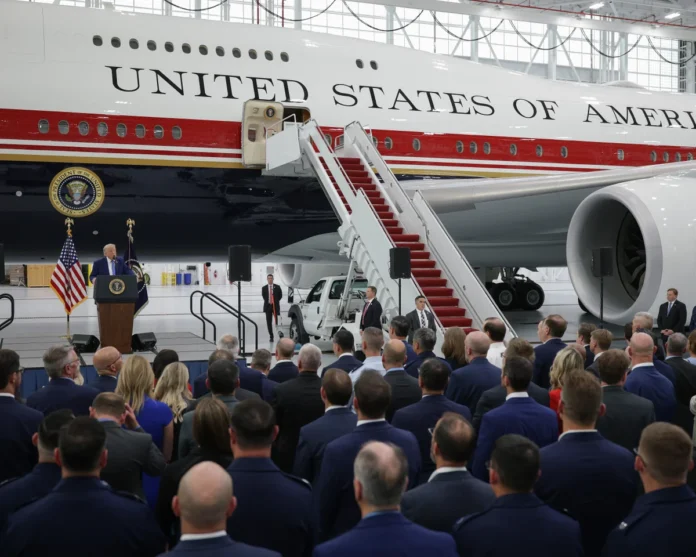
Donald Trump departed Joint Base Andrews on Wednesday aboard the newly designated Air Force One, a heavily modified Boeing 747-8 originally built for Qatar’s royal family, en route to North Dakota for a Theodore Roosevelt Presidential Library event tied to America’s 250th anniversary celebrations. Speaking to reporters before boarding, Trump said he was “excited about the first flight,” adding that “nobody’s ever seen anything like it.” He thanked Qatar’s emir directly, describing the nation as “an ally of us over in the Middle East” that has “treated us very well.”
The aircraft was unveiled last month at Joint Base Andrews, where Trump touted its leather seats that recline flat, gold light fixtures, tan carpeting, and seatbelts embossed with the presidential seal. Reporters traveling with the president on Wednesday were served a formal meal on gold-and-white china. Trump has directed that the jet serve as his primary aircraft for the remainder of his term, functioning as a bridge until two long-delayed Boeing-built replacement jets, originally ordered years ago, are delivered no earlier than 2028.
The gift has drawn bipartisan criticism since it was first proposed, with ethics experts and members of Congress from both parties raising constitutional questions about a sitting president accepting a lavish aircraft from a foreign government. Qatar, a hereditary monarchy and major oil and gas producer, is simultaneously playing a central role as a mediator in ongoing indirect talks between the United States and Iran. Critics argue that a foreign government providing a president with a personal aircraft of this magnitude, even one repurposed as a state plane, creates an appearance of influence-buying that the Constitution’s Foreign Emoluments Clause was designed to prevent.
Trump has repeatedly dismissed these concerns, arguing that the jet cost American taxpayers “very little relative to what it would cost if we did it a different way,” and claiming the United States “couldn’t build a plane like this” domestically. Aviation analysts have pushed back on the technical adequacy of the retrofit. Jeremiah Gertler, a senior analyst with the Teal Group, an aviation and defense consulting firm, noted that images of the aircraft analyzed by the Associated Press show it lacks certain missile-detection and countermeasure systems found on the Cold War-era jets it is replacing, along with what appears to be a reduced communications antenna array. Gertler suggested this points to a rushed, cost-conscious retrofit better suited for domestic travel than the long-haul international missions Air Force One traditionally performs.
Why It Matters
The Qatari jet controversy strikes at fundamental questions about presidential independence from foreign influence. The Constitution’s emoluments provisions exist specifically to prevent American officials from being compromised by gifts, payments, or favors from foreign powers, and critics argue that a $400 million luxury aircraft represents exactly the kind of entanglement the framers sought to avoid. Even if the plane is formally donated to the United States government rather than to Trump personally, the optics of a sitting president touring and praising an aircraft gifted by a nation actively engaged in sensitive diplomatic negotiations, including talks over the future of Iran policy, raise legitimate questions about whose interests are being served.
National security experts are equally concerned about the practical implications of a compressed retrofit timeline. Air Force One is not simply a luxury transport; it is designed to function as a mobile command center capable of withstanding electromagnetic pulses, evading missile threats, and maintaining secure communications during a national crisis. If the Qatari jet genuinely lacks countermeasure systems and full communications redundancy, as aviation analysts suggest, the aircraft may be inadequate for the kind of international missions and crisis scenarios that previous Air Force One jets were built to handle, including the NATO summit trip Trump has said he plans to take aboard the new jet next week.
For voters, the episode fits into a broader pattern this year of Trump blending personal enrichment and international relationships with the machinery of the presidency. Combined with the disclosure of his massive cryptocurrency earnings, the jet has become a symbol for critics who argue that traditional ethical guardrails around the presidency have eroded. Supporters counter that Trump is simply securing a practical upgrade to presidential travel at no direct cost to taxpayers, and that partisan opponents are manufacturing outrage over a gift accepted transparently.
Economic and Global Context
The financial scale of the gift is significant regardless of one’s view of its propriety. Independent aviation experts estimate the full modification and security overhaul of the jet, converting a commercial-configured 747 into a secure presidential aircraft, could ultimately exceed $1 billion, a cost that will be borne by American taxpayers even though the airframe itself was donated. That figure dwarfs the sticker value of the original $400 million gift and raises questions about whether the arrangement genuinely saves public money compared to simply funding the delayed replacement jets already under contract with Boeing.
Qatar’s motivations also carry geopolitical weight. The Gulf nation has increasingly positioned itself as an indispensable diplomatic broker for Washington, mediating indirect talks between the United States and Iran that officials this week described as showing “positive progress.” A gift of this magnitude to the sitting American president, delivered while Doha plays a central role in shaping U.S. policy toward Tehran, illustrates how deeply intertwined personal diplomacy and hard geopolitical interests have become in the current administration.
The delay of the officially contracted replacement Air Force One jets, not expected before 2028, underscores broader challenges in U.S. defense and aerospace procurement, where cost overruns and schedule slippages have become common even for the government’s highest-profile aircraft programs.
Implications
In the near term, expect continued congressional scrutiny, including possible hearings or formal inquiries into the emoluments implications of the gift, though any binding legal challenge would likely require standing that is difficult to establish. Ethics watchdog groups are likely to press the Government Accountability Office or inspector general offices for a formal review of the arrangement’s compliance with federal gift-acceptance statutes.
For Qatar, the gift cements its role as a preferred diplomatic partner of the Trump administration at a moment when its mediation efforts on Iran carry substantial weight for regional stability. Other allied nations may take note of the access and goodwill the gesture appears to have generated, potentially inviting similar overtures from other governments seeking influence in Washington.
Domestically, the controversy is likely to remain a recurring theme in Democratic messaging heading into the November midterms, particularly when paired with Trump’s cryptocurrency windfall. Whether it moves public opinion in a substantive way remains uncertain, but it adds to a growing list of episodes that opponents argue illustrate blurred lines between the presidency and personal or foreign financial interests.
Sources