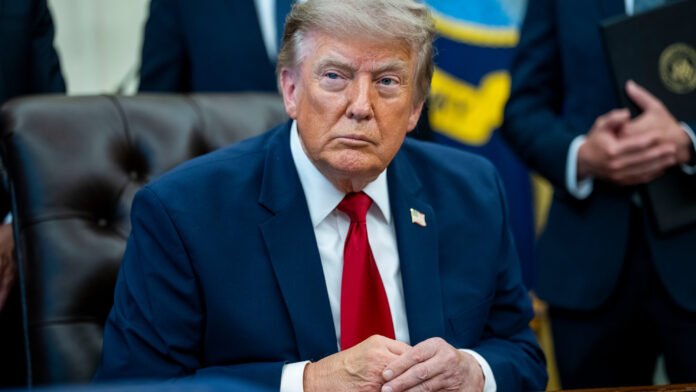
President Trump is set to deliver a rare primetime address Thursday evening centered on claims of vulnerabilities in American election infrastructure, drawing on newly declassified intelligence findings that officials say will revisit disputed allegations about the 2020 election. The speech, scheduled for 9 p.m. Eastern time, arrives as Trump continues pushing a stalled voter identification bill ahead of the November midterms and as Democrats warn the address could be used to sow doubt about upcoming election results.
Story Highlights
- Trump’s primetime address is expected to focus on voting machine security and alleged foreign interference in the 2020 election
- The speech follows a review of Puerto Rico voting machines commissioned under former DNI Tulsi Gabbard, which found known but unexploited security flaws
- Trump has tied his support for FISA reauthorization to passage of the SAVE America Act, a voter identification bill Democrats have rejected
What Happened
Donald Trump announced on social media Monday that he would deliver a “Speech to the Nation” Thursday at 9 p.m. Eastern time, without initially specifying its subject. White House officials later told reporters the address would focus on election integrity, and multiple outlets subsequently reported that Trump plans to cite newly declassified intelligence regarding alleged vulnerabilities in voting machines used during the 2020 election, which he lost by more than seven million votes.
Speaking to reporters in the Oval Office two days before the address, Trump described the speech’s subject in dramatic terms without providing specifics. “It doesn’t get bigger, because without free and fair elections, you don’t have a country,” he said, adding that the announcement would be “really, really big news” and that “our country has to shape up.” He indicated the speech would also touch on other topics, including the ongoing military conflict with Iran, according to an adviser cited by Axios.
The address follows an extended effort by Trump-aligned officials within the intelligence community to reexamine the 2020 election. Former Director of National Intelligence Tulsi Gabbard, who resigned in May citing her husband’s cancer diagnosis, had commissioned a cybersecurity review of voting machines obtained from Puerto Rico. According to Reuters, the contracted firm identified security flaws in the equipment but found no evidence the machines had actually been compromised during the 2020 election. Gabbard was also present in Fulton County, Georgia, in January when FBI agents executed a search warrant tied to a renewed investigation into the 2020 results, an unusual role for an intelligence chief to play in a domestic law enforcement action.
These reviews stand in contrast to conclusions reached shortly after the 2020 election by federal agencies including the Department of Justice, the Department of Homeland Security, the FBI, and the Cybersecurity and Infrastructure Security Agency, which found no evidence that any foreign actor had changed votes, prevented voting, or otherwise compromised the integrity of the 2020 results. Dozens of lawsuits filed to overturn those results were dismissed or withdrawn in the years since.
Trump has continued pressing Congress to pass the SAVE America Act, a voter identification bill requiring proof of citizenship for registration and mandating that states share voter roll data with the federal government, as a condition for supporting reauthorization of a separate lapsed surveillance law. He boycotted signing a bipartisan housing bill last week in protest of the Senate’s failure to advance the voter identification measure, according to reporting from multiple outlets.
Why It Matters
Presidential primetime addresses are historically reserved for major national announcements intended to reach the widest possible audience, and Trump’s decision to devote such a platform to renewed 2020 election claims underscores how central the issue remains to his political messaging nearly six years after that contest concluded. Critics argue the timing, just months ahead of the 2026 midterms, suggests an effort to lay rhetorical groundwork for contesting future results rather than addressing current security concerns.
The involvement of intelligence agencies in reexamining settled election findings represents a significant shift in how those agencies have historically operated. Using resources originally intended for foreign threat assessment to investigate domestic election administration, particularly under direction from a sitting president who has a personal stake in the conclusions reached, raises institutional independence concerns that extend beyond this single speech.
For voters, the address adds to an already contentious environment surrounding ballot access ahead of the midterms. The administration’s parallel push for the SAVE America Act and related administrative changes, including a Postal Service policy restricting mail-in ballot delivery in states that do not share voter data with the federal government, signals a broader campaign to reshape voting procedures using both legislative and executive tools.
Congressional Republicans have reportedly urged Trump to focus more on affordability concerns ahead of the midterms rather than election integrity messaging, suggesting even some within his own party view the emphasis as a political liability given persistent economic pressures facing American households.
Economic and Global Context
While the address itself concerns election administration rather than economic policy directly, it arrives amid broader public frustration over the cost of living, an issue Republicans successfully centered in the 2024 election but which remains largely unresolved. Analysts note that continued focus on election integrity messaging, rather than affordability, could shape how voters perceive the administration’s priorities heading into a critical midterm cycle.
The reexamination of foreign interference claims also intersects with ongoing diplomatic considerations. Intelligence assessments have previously found that Russia pushed narratives critical of the 2020 Democratic campaign while Iran ran an influence operation aimed at undermining Trump’s own reelection prospects, and that China deliberately avoided involvement. Reviving these findings publicly could complicate diplomatic relationships at a moment when the administration is simultaneously engaged in active military conflict with Iran.
State-level election administrators, particularly in Georgia, have already faced disputes over voting machine replacement timelines, with the state legislature deciding last month to retain existing equipment until 2028 despite pressure from election security advocates on multiple sides of the debate.
Implications
The immediate political fallout from Thursday’s address will depend heavily on what specific evidence, if any, Trump presents regarding voting machine vulnerabilities. Independent election security experts and civil liberties advocates are likely to scrutinize any claims closely, particularly given that previous federal investigations found no evidence of compromised results in 2020.
Democratic lawmakers, including Georgia Senator Jon Ossoff, have already signaled they view the speech as an attempt to preemptively cast doubt on the legitimacy of Democratic victories in the upcoming midterms. Continued rhetoric along these lines could deepen partisan distrust in election administration well beyond November.
The stalled SAVE America Act and lapsed FISA authority remain linked in the current legislative standoff, meaning the practical outcome of Thursday’s speech may hinge on whether it generates new momentum for either measure or simply reinforces existing partisan gridlock in the Senate.
For state election officials nationwide, the address may prompt renewed public inquiries and pressure regarding voting machine security protocols, regardless of whether the administration’s specific claims withstand independent scrutiny.
Sources
Trump plans prime-time speech on 2020 election allegations