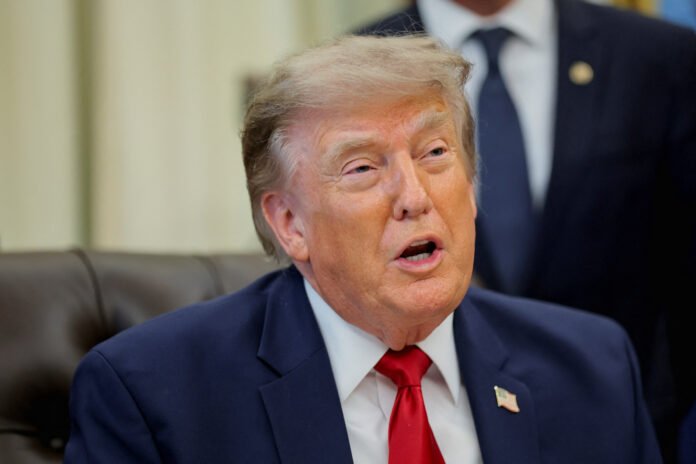
President Donald Trump announced he will deliver a primetime “Speech to the Nation” on Thursday at 9 p.m. Eastern, confirming the address will focus on election integrity while touching on other unspecified subjects. The rare direct-to-camera speech comes as the administration reportedly prepares to present newly declassified intelligence material tied to the 2020 election, a topic Trump has never let go of since his defeat that year.
Story Highlights
- Trump confirmed to reporters the Thursday speech will center on election integrity, calling it “really big news.”
- Multiple outlets report the address will feature newly declassified intelligence the administration says shows foreign interference in the 2020 election.
- CIA Director John Ratcliffe, acting Director of National Intelligence Bill Pulte, FBI Director Kash Patel, and DHS Secretary Markwayne Mullin are reportedly expected to join Trump.
What Happened
Donald Trump announced on Truth Social Monday that he would deliver a “Speech to the Nation” on Thursday evening, without initially specifying the topic. Speaking to reporters at the White House on Tuesday, Trump confirmed the address would concern election integrity. “It will concern that subject, and we’ll have a couple of other things to say also, but I’d rather save it,” Trump said, adding that “it’s really big news” and that “our country has to shape up.”
According to multiple reports citing White House officials, the speech is expected to center on newly declassified intelligence that the administration claims reveals a foreign nation’s efforts to interfere in the 2020 presidential election. Two officials told MS NOW that Trump plans to be joined during the address by Ratcliffe, Pulte, Patel, and Mullin, assembling top leadership from the CIA, the broader intelligence community, the FBI, and the Department of Homeland Security for a single televised presentation.
The White House has not officially confirmed the speech’s content or the reported lineup of officials. Trump himself offered conflicting signals in the days leading up to the announcement, telling radio host Hugh Hewitt in an interview that “it’s just going to be a speech like a lot of my speeches,” while separately telling reporters the announcement would be consequential. A senior adviser described the address to Axios as a “potpourri” likely to include both election integrity themes and an update on the ongoing conflict with Iran.
Separately, a source cited by the Washington Reporter said the speech could include an announcement declaring the 2021 elections of Georgia Democratic Senators Jon Ossoff and Raphael Warnock illegitimate due to alleged fraud, though this claim has not been independently verified or confirmed by the White House. Ossoff and Warnock were elected in runoff elections that flipped Senate control to Democrats at the start of Joe Biden’s presidency; Trump has filed numerous lawsuits over the years challenging election results in Georgia and elsewhere, all of which were rejected in court.
Trump has also continued pushing Congress to pass the SAVE America Act, a stalled bill that would require voters to provide proof of citizenship and photo identification to vote in federal elections, and the speech is expected to renew pressure for its passage.
Why It Matters
A primetime address centered on unproven claims about the 2020 election, six years after that contest was decided and certified, carries significant implications for public trust in democratic institutions. Trump has never conceded his 2020 loss to Joe Biden and has repeatedly claimed without evidence that the election was rigged, claims that have been publicly and repeatedly rejected by his own first-term appointees, including former Attorney General Bill Barr and former FBI Director Christopher Wray.
The reported involvement of top intelligence and law enforcement officials in the address raises questions about the use of classified material for a nationally televised political presentation. If the administration selectively declassifies intelligence to support a preexisting political narrative, as some congressional Democrats have already alleged, it could set a precedent with lasting implications for how intelligence agencies interact with partisan political messaging.
House Intelligence Committee Democrats have already objected to the administration’s handling of election-related declassification efforts, sending a letter to acting DNI Pulte on July 2 demanding details on how records were being reviewed and urging that standard safeguards protecting intelligence sources and methods be preserved. Their concerns underscore bipartisan unease, even before the speech occurs, about how the material might be used.
For the SAVE America Act, renewed presidential attention could reinvigorate a stalled legislative priority ahead of the midterms, giving Republicans a rallying point on voter identification requirements while drawing continued opposition from Democrats who argue such measures could disenfranchise eligible voters.
Economic and Global Context
While the speech’s core subject is domestic politics, its timing places it alongside significant developments in the Iran conflict, with Trump’s advisers indicating the address will also touch on the escalating military situation in the Gulf. Combining election messaging with national security updates in a single primetime format is consistent with Trump’s pattern of using major addresses to consolidate multiple priorities, as seen in his April speech justifying continued military action against Iran, which was followed by rising oil prices and declining approval ratings.
The timing also coincides with a politically sensitive week for the administration, following the sudden death of Senator Lindsey Graham of South Carolina, one of Trump’s closest allies in the Senate on foreign policy matters. Graham’s death and the swearing-in of his sister, Darline Graham Nordone, as his successor add another layer of significance to a week already dominated by major national security and political developments.
Globally, the prospect of the United States publicly attributing 2020 election interference to a specific foreign nation could have diplomatic ramifications, particularly if declassified material implicates a country with which Washington maintains complex relations. Allies and adversaries alike will be watching closely for details, given the potential for the announcement to affect broader diplomatic and security calculations.
Implications
In the immediate term, media organizations and lawmakers will be watching Thursday’s broadcast closely to see whether the administration follows through on reported plans to present specific evidence, or whether the speech proves broader and less substantive than advance reporting suggests. Major networks and the White House’s own digital channels are expected to carry the address live.
For congressional Democrats, the speech is likely to trigger immediate demands for briefings on the underlying intelligence, particularly given concerns already raised about selective declassification. Any claims made about the legitimacy of past elections, including the Georgia Senate races, would likely face swift legal and political challenges given the extensive litigation history surrounding Trump’s 2020 election claims.
For Republicans in Congress, renewed presidential attention on election integrity could provide momentum for the SAVE America Act, though the bill’s prospects remain uncertain given existing legislative gridlock.
For voters ahead of the 2026 midterms, the speech is likely to further polarize an already contentious debate over election security, reinforcing existing divisions rather than resolving lingering questions about the 2020 contest.
Sources
“Trump set to address Iran, election integrity in prime-time speech”