Story Highlights
- Trump warned that Iran’s failure to reach a deal could restart U.S. military operations, which have been paused under a Pakistan-brokered ceasefire
- Trump claimed Iran’s navy, air force, and air defense systems are “gone” — a claim NBC News reporters disputed
- Sunday marked approximately 100 days since the United States and Israel launched joint strikes against Iran beginning February 28, 2026
What Happened
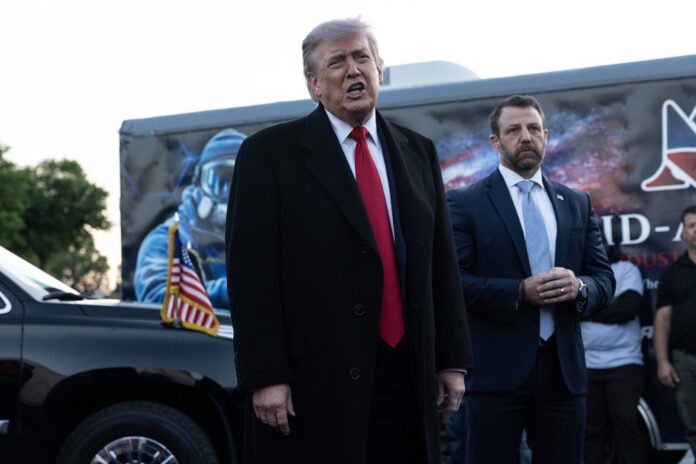
President Donald Trump used his “Meet the Press” interview, taped Friday in Wisconsin, to deliver some of the most explicit threats yet regarding the potential resumption of U.S. military action against Iran. Speaking with moderator Kristen Welker, Trump said the U.S. would maintain military assets in the region “until such time as we have a completion” — and made clear that a failure to reach an agreement could end the ceasefire.
The backdrop is a conflict that has been deeply consequential for global energy markets and regional stability. On February 28, 2026, the United States joined Israel in launching major combat operations against Iran, targeting nuclear facilities, military infrastructure, and command-and-control assets. Among those killed in the strikes was Iran’s Supreme Leader Ali Khamenei, whose son has since been appointed as his successor.
A Pakistan-brokered ceasefire in April extended the pause in direct hostilities, but the war has not formally concluded. Iran has continued launching counter-strikes against U.S. allies in the region, and the Strait of Hormuz — a critical global shipping corridor — remains under Iranian pressure, with negotiations over its reopening ongoing.
Trump told Welker he would not disclose specific military red lines but made unmistakably clear that stalled diplomacy could prompt a return to strikes. During the interview, he also characterized Iran’s military as largely destroyed, saying “their navy is gone, their air force is gone, their anti-aircraft is gone.” NBC News fact-checkers noted those claims were exaggerated — reporting that roughly half of Iran’s unconventional naval forces remain intact.
Why It Matters
The Iran conflict represents arguably the most consequential foreign policy decision of Trump’s second term, and Sunday’s interview underscored how unresolved the situation remains nearly four months after hostilities began. Trump’s insistence that he would restart military action if talks fail is more than rhetorical pressure — it reflects the reality that U.S. military assets are actively staged in the region, positioned for potential re-engagement.
The stakes are enormous. Iran’s closure of the Strait of Hormuz — through which roughly 20 percent of global oil supply transits — has been a primary driver of energy price inflation in the United States and globally. Any resumption of combat operations would likely escalate that pressure significantly, with downstream effects on household costs, transportation, and industrial supply chains.
For American service members and their families, the uncertainty is equally significant. Thirteen Americans were killed in the conflict, a figure Trump referenced during the interview. The question of whether those losses were sufficient to justify continued military pressure — or whether a flawed deal might be worse than continued conflict — is one that divides analysts, military advisers, and Congress.
Diplomatically, the Sunday interview revealed continued tension between Trump’s stated desire for a deal and his administration’s maximalist terms. The draft memorandum of understanding reportedly commits Iran not to pursue a nuclear weapon but includes no specific concessions on enrichment levels, with detailed nuclear talks scheduled to follow in a 30-to-60-day window. Trump has publicly demanded changes to strengthen the deal’s nuclear provisions.
Economic and Global Context
The Iran war has had measurable and severe economic consequences. Consumer price inflation in the United States rose to 3.3 percent year-over-year in March 2026 — the highest rate in nearly four years — driven substantially by energy costs linked to the Hormuz disruption. Markets have shown unusual resilience, with Trump citing 73 stock market record highs since taking office, though analysts caution that equity performance does not capture the burden falling on middle- and lower-income households through fuel and goods prices.
Iran’s enriched uranium stockpile stood at nearly 21,800 pounds as of a February 2026 IAEA assessment — a direct consequence of the 2018 withdrawal from the Obama-era nuclear deal, which Trump defended during the interview while dismissing his failure to renegotiate during his first term. Former Energy Secretary Ernest Moniz, who helped negotiate the 2015 agreement, said it was “very hard to say how we are in a better position” today.
Gulf states including Saudi Arabia, Qatar, and the UAE have urged the U.S. to suspend military operations while negotiations continue. Pakistan’s Prime Minister Shehbaz Sharif has emerged as a key diplomatic intermediary, and Islamabad’s role in brokering the ceasefire has elevated its regional profile significantly.
Implications
If nuclear talks collapse, the United States faces a stark set of options — none of them easy. A resumption of strikes would likely close the Strait of Hormuz entirely, spiking global energy prices and deepening domestic inflation at a politically sensitive moment. A deal without firm nuclear concessions risks criticism that the U.S. sacrificed strategic gains for a fragile peace.
For Congress, the 100-day milestone without a formal war authorization vote remains a constitutional flashpoint. Several lawmakers have questioned the legal basis for the sustained campaign, and any escalation would intensify those calls. Senate and House members who have remained quiet about the conflict’s scope may find their silence harder to sustain if hostilities resume.
For American businesses and consumers, the energy price trajectory is the most tangible near-term implication. Relief at the pump and in home heating costs would require not just a deal but actual restoration of normal Hormuz shipping — a process that could take weeks or months even after an agreement is signed.
The broader signal for U.S. foreign policy credibility is also at stake. Trump’s willingness to exit the 2015 nuclear deal, launch military operations, and now negotiate from a position of military superiority is either a vindication of maximum-pressure strategy or a cautionary tale about the costs of diplomatic volatility, depending on whether a durable agreement ultimately emerges.
Sources
“5 key moments from Trump’s cut-short ‘Meet the Press’ interview”