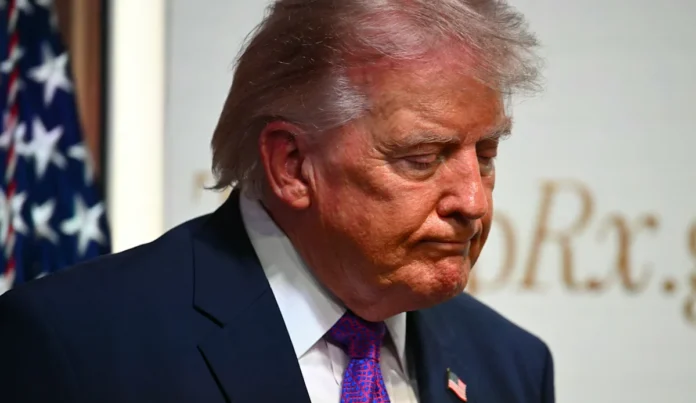
A cascade of new polling data released in May 2026 has painted a troubling picture for President Donald Trump and congressional Republicans ahead of the November midterm elections, with the president’s approval rating sinking to the lowest point of either of his terms and Democrats recording historic enthusiasm advantages. Multiple surveys across partisan methodologies are converging on the same conclusion: Trump’s political standing has eroded across virtually every demographic group, with independents now abandoning the president at rates that historically presage significant House seat losses for the party in power.
Story Highlights
- Trump’s approval rating fell to 38.1 percent in May 2026, the lowest recorded figure of either his first or second presidential term, according to polling aggregators.
- A New York Times/Siena College survey found a 59 percent disapproval rating for the president — the highest ever recorded in that poll series.
- Democrats now lead on the congressional generic ballot by nearly 7 points on average, a margin comparable to the environment that produced a 41-seat Democratic gain in 2018.
What Happened
A New York Times/Siena College poll found Trump’s disapproval rating at 59 percent, the highest recorded in that survey. The poll was conducted from May 11 to May 15, 2026, among 1,507 registered voters using live telephone interviews, with a margin of error of plus or minus 2.8 percentage points.
A Fox News poll conducted from May 15 to May 18, 2026, showed a similar pattern. A slim majority of Republicans — 51 percent — now disapprove of Trump’s handling of inflation, compared with far higher disapproval levels among independents at 85 percent and Democrats at 96 percent. Net approval scores in the same survey show new lows on key issues, including minus 52 on inflation and minus 42 on the economy, both record lows in the Fox News poll series.
Trump’s second-term approval began with a 47 percent inauguration bump, declined steadily through 2025, fell to 41 percent in March 2026, briefly recovered to 43 percent in April, and then dropped sharply to 38.1 percent in May 2026. The May collapse reflects accelerating tariff-driven inflation and first-quarter GDP coming in at 2.0 percent while PCE inflation hit 4.5 percent, raising stagflation concerns.
Independent approval, which stood at 48 percent when Trump took office for his second term, has declined 14 points to 34 percent. Every president who triggered a wave midterm loss saw independent approval fall below 40 percent before Election Day. Trump’s 34 percent puts him well into wave territory, now below the 36 percent level that preceded Democrats’ 41-seat gain in 2018.
The numbers arrive against a backdrop of sustained economic anxiety. Tariff-driven price increases, disruptions to global supply chains from the Iran conflict, and continued pressure on lower-income households have generated persistent frustration among voters who backed Trump in 2024 expecting relief on kitchen table issues.
Why It Matters
Presidential approval ratings are the single most reliable leading indicator of midterm performance. Historically, when a president’s approval drops below 42 percent at this point in the electoral cycle, the party in power suffers substantial congressional losses. Trump is currently running 4 points below that threshold, with six months remaining until Election Day.
In the first four months of 2026, the midterm prospects for Republicans darkened further. Trump’s perceived lack of focus on kitchen table issues may explain why, for the first time since 2010, Democrats are more trusted than Republicans to handle the economy. That trust reversal is particularly alarming for Republican strategists because economic stewardship has been the party’s strongest suit in recent electoral cycles.
Trump has largely disregarded his plunging approval ratings and polls that increasingly show Democrats winning the 2026 midterms by as much as double digits. That posture — projecting confidence while data suggests otherwise — risks delaying strategic adjustments that could arrest the slide before November.
The damage is not uniform across the party. Republicans running in safe seats face little immediate threat. But the approximately 40 members holding districts won by Biden in 2020 or narrowly won by Trump in 2024 are operating in increasingly hostile electoral terrain, and their vulnerability to a national wave cannot be insulated by local factors alone.
Economic and Global Context
The economic environment underlying the polling decline is multifaceted. PCE inflation hitting 4.5 percent has raised stagflation concerns at a moment when the Federal Reserve has limited tools available to provide relief without risking a recession. Interest rates remain elevated, housing affordability has worsened, and consumer confidence indices have trended downward through the spring.
Tariffs imposed as part of Trump’s second-term trade agenda have contributed to higher prices on consumer goods, and the war in Iran has added energy cost pressure that disproportionately affects lower- and middle-income households. These groups, who were central to Trump’s 2024 electoral coalition, are registering the sharpest declines in presidential approval according to multiple surveys.
Democrats have a serious chance of flipping Republican-held seats in North Carolina, Maine, Alaska, and Ohio, while Iowa and Texas are no longer regarded as sure bets for Republicans. The expanding battleground map increases the financial burden on national Republican committees, which must now allocate resources across a wider range of defensive contests than anticipated at the start of the year.
The key recovery scenarios for Republicans include a negotiated trade deal reducing tariff costs, a sharp improvement in consumer confidence, or an external event triggering a rally effect. Without such a catalyst, independent approval below 40 percent through the third quarter of 2026 would represent the most challenging midterm environment for House Republicans since 2018.
Implications
With Democrats leading on the generic congressional ballot by approximately 7 points and maintaining higher enthusiasm than Republicans, the structural conditions for significant House seat gains are in place. Democrats need a net pickup of roughly five seats to reclaim the majority, a target that polling suggests is well within reach if current trends hold.
The Senate presents a more difficult map for Democrats, as the seats up in November skew toward Republican-leaning states. However, the deterioration of Trump’s standing in states like Texas, Iowa, and North Carolina — previously considered safe — means that even Senate control is not entirely beyond reach, a scenario that would have been dismissed as fanciful at the start of 2026.
For Republican incumbents, the most immediate implication is strategic: how much distance to create from Trump while avoiding his wrath in the primary or his endorsement of a challenger. The Cornyn example in Texas — where Trump intervened against an incumbent — has sharpened that calculation dramatically. The room for independent positioning is narrower than it has ever been.
For the White House, the data creates urgency around delivering visible wins, particularly on the economy and on the Iran war, before summer campaigning begins in earnest. A resolution in Iran that brings down energy prices, combined with any moderation in tariff-driven inflation, could provide a genuine recovery catalyst that the polls currently suggest is absent but not impossible.
Source
Donald Trump Breaks Five Unwanted Polling Records Within Days