Story Highlights
- Acting AG Blanche told the House Appropriations Subcommittee on June 2 that the DOJ will not proceed with the anti-weaponization fund
- A federal judge in Virginia had temporarily blocked the fund days earlier, citing constitutional concerns over the disbursement of public money
- The fund was established as part of a settlement in Trump’s $10 billion lawsuit against the IRS over the leak of his personal tax returns
What Happened
Acting Attorney General Todd Blanche told members of the House Appropriations Subcommittee for Commerce, Justice, Science, and Related Agencies on June 2 that the Justice Department would not move forward with the anti-weaponization fund. “We are not moving forward with the fund, period,” Blanche stated during the hearing. His testimony came days after U.S. District Judge Leonie Brinkema, appointed by former President Bill Clinton, issued a temporary restraining order in Alexandria, Virginia, blocking the fund from disbursing any money while constitutional challenges proceeded.
The fund had been announced on May 18 as part of a settlement agreement in a civil lawsuit filed by Trump, his sons Donald Trump Jr. and Eric Trump, and the Trump Organization against the IRS over the 2019 leak of Trump’s personal tax returns by a former government contractor. The settlement, in which the plaintiffs received a formal apology but no direct monetary damages, was structured to redirect nearly $1.8 billion in public funds toward compensating third parties who claimed they had been subjected to government “weaponization” and “lawfare.”
Critics immediately labeled the arrangement a “slush fund” for Trump’s political allies. Democratic senators Sheldon Whitehouse of Rhode Island and Richard Durbin of Illinois held a press conference outside the Capitol on June 2 to denounce the fund. Legal advocacy groups Democracy Forward and Common Cause filed the lawsuit that produced the court injunction, arguing that the administration had engineered a collusive agreement to bypass the Constitution’s Appropriations Clause — the provision that requires all federal spending to be authorized by Congress.
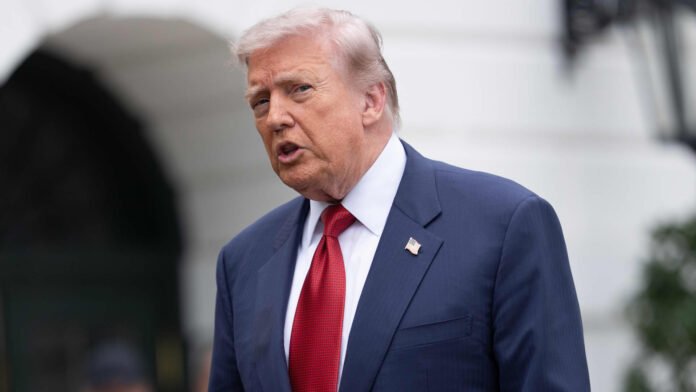
Despite Blanche’s testimony, Trump injected uncertainty into the matter Wednesday by telling reporters that the fund was “very important” and saying “I don’t know” whether it was dead or merely on hold. That statement prompted Senate Minority Leader Chuck Schumer to announce Democrats would push a Senate amendment to ban the fund by statute. Some Republicans, including Senator Thom Tillis of North Carolina, had already announced they planned to offer their own amendment to block any attempt to revive it.
The episode also directly complicated the separate Republican effort to pass the $70 billion ICE and Border Patrol funding bill. Several Republican senators said they needed Blanche’s public testimony to be satisfied before voting for the immigration bill, which had been stalled in part because of the fund controversy. Even after Blanche’s testimony, Trump’s Wednesday equivocation reopened doubts.
Why It Matters
The anti-weaponization fund episode is one of the most explicit illustrations yet of the Trump administration’s use of legal and financial mechanisms to reward political allies and insulate itself from accountability. The fund’s stated purpose was to compensate victims of government targeting. But its design — announced without congressional approval, funded through a lawsuit Trump filed against his own government, and intended to benefit a class of individuals closely associated with Trump’s political network — raised constitutional alarms that crossed party lines.
The Appropriations Clause exists precisely to prevent the executive branch from unilaterally directing public money. The clause requires that Congress authorize all federal expenditures, ensuring democratic oversight of how taxpayer funds are spent. By structuring the fund as a settlement in a self-directed lawsuit, the administration attempted to sidestep that requirement — a maneuver that courts and even some congressional Republicans found constitutionally problematic.
The DOJ’s retreat from the fund, under combined pressure from a federal court and Congress, demonstrates that institutional guardrails can still function. But the episode also illustrates the lengths to which the current administration is willing to go in testing those limits. The fund was not a marginal proposal; it was announced in a formal press release by the Justice Department and framed as a legitimate exercise of executive authority.
For the American public, the fund crystallized a concern that has been building throughout Trump’s second term: that the machinery of the federal government is increasingly being directed toward partisan ends. The $1.8 billion figure — drawn from the public treasury — would have represented one of the largest executive-branch discretionary disbursements in recent memory, made without a single congressional vote.
Economic and Global Context
The fund’s creation and collapse illustrates broader tensions in the Trump administration’s approach to fiscal governance. The administration has simultaneously pursued aggressive spending cuts across federal agencies — including to scientific research, public health infrastructure, and foreign aid — while seeking to redirect nearly $2 billion in public funds toward a politically motivated compensation scheme. That juxtaposition has not gone unnoticed by budget analysts or international observers.
The constitutional questions raised by the fund have direct implications for the broader category of executive settlements. The Obama administration used settlements to fund third-party programs, a practice the Trump DOJ cited as precedent in defending the anti-weaponization fund. The current legal challenge, if it ultimately produces a binding ruling, could constrain how future administrations — of either party — use civil settlement agreements to direct public resources.
Rating agencies and international investors watch institutional integrity indicators closely. Episodes in which the executive branch appears to be directing public money toward political allies without congressional oversight can affect perceptions of rule-of-law reliability — a factor that matters to foreign investment and to the broader credibility of U.S. financial institutions. While a single fund reversal is unlikely to move markets, a pattern of such behavior carries cumulative risk.
The settlement’s other provisions remain in effect, notably including terms that shield Trump, his family members, and the Trump Organization from tax audits and certain IRS enforcement actions for the duration of the agreement. Blanche confirmed this during testimony. That component of the settlement has received less attention than the fund itself but carries its own significant implications for equal application of tax law.
Implications
With the fund scrapped, attention turns to the June 12 federal court hearing at which the DOJ was scheduled to defend the fund’s legality. That hearing may now be moot, but the constitutional arguments raised in the litigation will likely resurface in future legal challenges to other executive branch financial arrangements. The precedent set in this case — whatever it turns out to be — will shape the legal landscape for executive settlements for years.
For Senate Democrats and their Republican allies concerned about the fund, the episode provides evidence that sustained institutional pressure can still produce policy reversals. The combination of a federal court injunction, bipartisan congressional resistance, and political fallout from the ICE funding bill was sufficient to force a retreat, at least for now. Democrats will draw tactical lessons from this outcome as they assess where else similar pressure can be applied.
For Trump, the fund’s collapse represents a rare instance of an announced policy being effectively reversed by a combination of legal and legislative resistance. The president’s Wednesday comments suggesting the fund might not be fully dead indicate that he has not fully accepted the reversal, which could mean a future attempt to revive or repackage the concept through different legal architecture.
For voters, the episode is a window into how executive power can be deployed in ways that are difficult to detect or counter without sustained institutional attention. The fund was announced on a Sunday in mid-May; it was blocked by a federal court, reversed by testimony, and complicated anew by a presidential offhand comment — all within three weeks. Understanding what nearly happened, and why it was stopped, matters as much as the outcome itself.
Sources