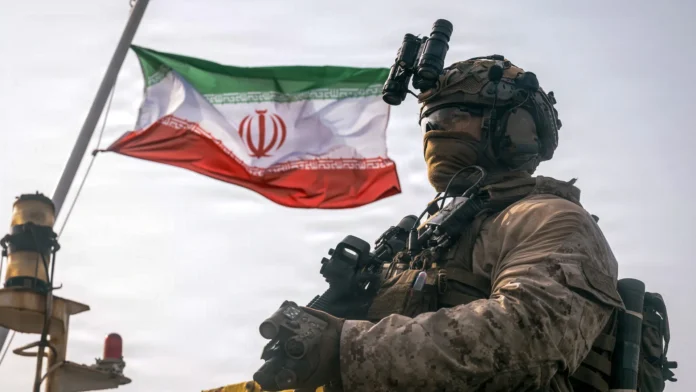
President Donald Trump has ordered new military strikes against Iran after a third American service member was confirmed dead, marking a dangerous new phase in a conflict that shows no sign of slowing after nine consecutive nights of exchanged fire. The Pentagon says two soldiers were killed in an Iranian drone and missile attack on a U.S. base in Jordan, while a separate service member died during the detonation of a downed Iranian drone in northern Iraq. The escalation has reopened fierce debate in Washington over how far the United States should go in a war that has already outlasted early predictions.
Story Highlights
- Three U.S. service members have been killed since Friday, with a fourth still listed as missing after Iranian strikes on American forces in Jordan and Iraq
- Iran has closed the Strait of Hormuz, prompting the U.S. Navy to reinstate a naval blockade of Iranian waters
- The Wall Street Journal reports Trump is weighing an expansion of the war, including a possible ground seizure of Iranian islands near the strait
What Happened
The latest escalation began Friday night when U.S. forces concluded what the Pentagon described as seven planned nights of strikes against Iranian military assets, including underground weapons storage sites and surveillance facilities. Iran responded over the weekend with a barrage of missile and drone attacks on American installations across the region. According to U.S. Central Command, two American troops were killed and a third was reported missing after an Iranian strike on a base in Jordan. A separate incident in northern Iraq claimed the life of another service member during the controlled detonation of a downed Iranian drone, bringing the confirmed death toll to three.
The Jordanian base targeted in the attack had already been struck at least twice within a single week. A strike a day earlier had wounded approximately 20 soldiers, according to reporting from The Washington Post. Additional attacks were reported at King Faisal Air Base, where several soldiers were wounded, and at Prince Hassan Air Base, where Black Hawk helicopters sustained damage. Pentagon spokespeople have largely declined to comment publicly on the string of incidents, a departure from earlier, more transparent briefings on the conflict.
Iran has not limited its retaliation to U.S. military targets. An Iranian strike hit a Kuwaiti power-and-water plant for a second consecutive day, Jordan’s air defenses intercepted three incoming missiles, and Iranian forces struck the port and airport at Aqaba. Tehran’s Islamic Revolutionary Guard Corps declared on July 15 that with American forces blocking Iran’s oil and gas exports, other nations “must await the closure of other oil and gas export routes” that it says serve American interests, a thinly veiled threat aimed at the broader flow of global energy.
President Donald Trump defended the campaign publicly over the weekend, arguing that American troops killed in the fighting had made the “ultimate sacrifice” in defense of the country. Behind closed doors, however, Trump has reportedly expressed serious interest to aides and Republican officials in a chilling next step: deploying American ground troops directly into Iranian territory, according to people familiar with the discussions cited by NBC News. The Wall Street Journal separately reported that a White House Situation Room meeting was convened to weigh the potential seizure of Kharg Island and other territory along the Strait of Hormuz.
Iran’s supreme leader, Ali Khamenei, warned Saturday that continued American strikes would bring the United States “unforgettable lessons,” and dismissed a previous memorandum of understanding signed by Trump as “worthless and invalid.” The rhetoric underscores how far diplomatic efforts have collapsed since the ceasefire that briefly held earlier this year.
Why It Matters
The deaths of three American service members in under a week represent the most serious human cost of the Iran conflict since fighting resumed, and they raise the political stakes for a president who has staked significant credibility on the campaign’s success. Each casualty deepens pressure on the administration to define what victory in this war actually looks like, and how much further Washington is willing to go to achieve it. The prospect of American ground forces entering Iran, something Trump has privately floated, would represent an extraordinary escalation with consequences far beyond the immediate battlefield.
For American families with loved ones stationed across the Middle East, the string of attacks on bases in Jordan, Kuwait, and Iraq is a stark reminder that this conflict has not remained contained to Iranian airspace. U.S. troops and their partner forces are increasingly exposed across multiple countries, and the frequency of strikes suggests Iran retains far more capacity to respond than initial assessments anticipated. Nearly five months into the war, Tehran’s ability to strike American installations across Jordan, Kuwait, and the Gulf has not been diminished, a fact with serious implications for how long this conflict may continue.
Congress faces mounting pressure to reassert its role in decisions over expanding the war. Lawmakers on both sides of the aisle have raised concerns about mission creep, particularly given reports that the administration is actively considering a ground incursion. Without clearer public communication from the Pentagon, which has avoided taking questions on the war since early May, both Congress and the American public are left largely reliant on leaked reports and after-the-fact confirmations to understand the scope of U.S. involvement.
Economic and Global Context
Iran’s closure of the Strait of Hormuz, through which roughly a fifth of global oil supply typically transits, has already reshaped global energy markets. The U.S. Navy’s reinstated blockade of Iranian waters adds a second layer of disruption to a critical corridor that global shippers depend on. Analysts have warned that a sustained closure could push oil prices sharply higher, with ripple effects on inflation and consumer costs across the United States and allied economies still working to stabilize post-pandemic supply chains.
The administration has reportedly moved to replace a previously floated cargo fee on shipping through the strait with a package of Gulf investment deals, an approach that suggests Washington is trying to balance military pressure with economic incentives aimed at regional partners. Qatar has publicly condemned the escalation as a “dangerous escalation” that undermines diplomatic efforts toward regional stability, a notable rebuke from a country that has otherwise sought to maintain close ties with the Trump administration.
Allied nations, including Jordan, Kuwait, and Israel, have all absorbed direct or indirect consequences of the conflict, from missile strikes to disrupted air travel. The U.S. Embassy in Beirut has issued fresh travel warnings urging Americans to avoid Lebanon and reconsider travel throughout the region, a sign that the instability is spreading well beyond Iran’s immediate borders. Global financial markets have shown increasing sensitivity to developments in the conflict, with energy and defense sectors particularly reactive to reports of expanded U.S. military options.
Implications
In the near term, expect intensified congressional scrutiny of the administration’s war strategy, particularly if reports of a potential ground operation in Iran are confirmed through official channels. Lawmakers from both parties may push for classified briefings or, potentially, votes on war powers resolutions, though the likelihood of such measures passing remains uncertain given the current political alignment in Congress.
For military families and service members currently deployed to the region, the coming weeks are likely to bring continued uncertainty and elevated risk, particularly at bases in Jordan and Kuwait that have already proven vulnerable to repeated strikes. The Pentagon’s reluctance to hold regular press briefings on the war leaves open questions about troop safety measures and whether additional protective resources will be deployed.
For global markets and American consumers, the continued closure of the Strait of Hormuz and the reinstated naval blockade could translate into higher energy prices in the months ahead, with downstream effects on everything from gasoline to shipping costs. Businesses with supply chains running through the Gulf region should brace for continued disruption. Diplomatically, allies in the region will be watching closely to see whether the administration pursues further escalation or seeks a renewed off-ramp, especially as Trump’s private interest in ground operations becomes more widely known.
Sources
“As American deaths mount, Trump escalates war against Iran”