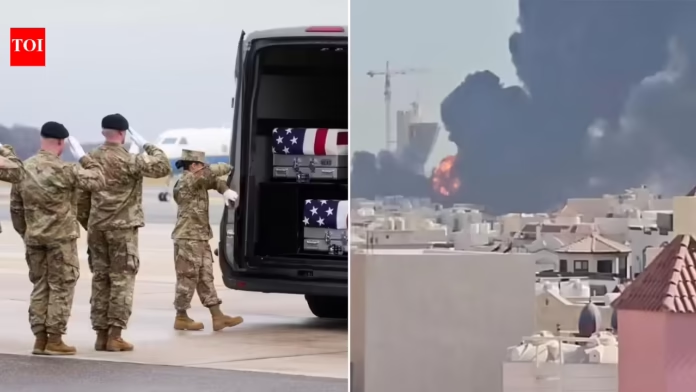
President Trump’s administration escalated its military campaign against Iran into an eighth consecutive night of airstrikes after Iranian drone and missile attacks killed two American service members and left another missing in Jordan. The renewed strikes, which the U.S. Central Command says are aimed at degrading Iran’s ability to threaten shipping through the Strait of Hormuz, come as Tehran claims it is no longer honoring the ceasefire memorandum it signed with Washington in June. The confrontation has pushed the American military death toll in the conflict to 16 and reignited fears of a wider regional war.
Story Highlights
- Two U.S. service members were killed and one remains missing after Iranian drone and missile attacks on American forces stationed in Jordan
- U.S. Central Command carried out more than five hours of renewed airstrikes on Iranian surveillance sites, military logistics, underground weapons storage, and maritime targets
- Iran’s deputy foreign minister says Tehran is no longer honoring the memorandum of understanding signed with the U.S. in mid-June, citing what it calls American violations
What Happened
President Donald Trump confirmed over the weekend that two American service members were killed in action defending against Iranian drone and missile attacks in Jordan, calling their deaths “a very sad thing” in a phone interview with NewsNation. “We hate to see it happen. It’s in service to our country,” Trump said, adding that a third service member remains missing. The attack marked a sharp escalation in a conflict that has simmered since Trump announced major combat operations against Iran in late February, and it triggered an immediate American military response.
Hours after the attack, U.S. Central Command announced it had concluded more than five hours of renewed airstrikes on Iranian territory, describing the operation as intended to “swiftly punish Islamic Revolutionary Guard Corps forces who launched attacks against American service members in Jordan last night.” The strikes targeted surveillance sites, military logistics infrastructure, underground weapons storage facilities, and maritime capabilities, according to CENTCOM. It was the eighth consecutive night of American strikes against Iran since a fragile ceasefire collapsed over control of the Strait of Hormuz, the narrow waterway through which roughly a fifth of the world’s crude oil has historically passed.
The renewed hostilities come after Iran’s deputy foreign minister, Kazem Gharibabadi, told state television that the United States had violated its commitments under the memorandum of understanding signed roughly a month earlier, and that Iran was “no longer implementing” its terms. Trump responded that he “couldn’t care less” about Iran’s declaration, signaling no intention to pull back military pressure. White House press secretary Karoline Leavitt would not say whether the administration considers talks with Iran to be at a standstill, though she maintained that peace talks are technically still ongoing.
CENTCOM also disclosed new details of its naval blockade operations in the Strait of Hormuz, which began earlier in the week. The command said it has redirected three commercial vessels attempting to evade the blockade and disabled one oil tanker, the Curacao-flagged M/T Belma. Officials described the strait and surrounding waters as “free and open, except for vessels attempting to violate America’s steel wall blockade.” Defense Secretary Pete Hegseth issued a statement honoring the fallen service members, writing, “Godspeed, heroes. Their sacrifice only stiffens our resolve.”
Republican lawmakers largely backed the administration’s approach over the weekend. Rep. Riley Moore of West Virginia said he opposes deploying ground troops but supports continued military pressure, arguing that the current strategy remains achievable without an invasion. Fox News senior strategic analyst Jack Keane said the U.S. is on the “right path” to prevent Iran from controlling the strait, calling it Tehran’s “number one strategic asset” now that its nuclear program has been severely degraded by earlier strikes.
Why It Matters
The deaths of American service members mark a grim inflection point in a war that began as a campaign against Iran’s nuclear infrastructure and has since evolved into a broader struggle over control of one of the world’s most important shipping corridors. Every additional American casualty raises the political and human stakes of a conflict that has now stretched on for months, testing the administration’s ability to sustain public support for an open-ended military campaign in the Middle East.
For American families with loved ones in the armed forces, the escalation is a sobering reminder that the war, despite periods of diplomatic engagement and a signed memorandum of understanding, remains far from resolved. The collapse of the ceasefire underscores how fragile diplomatic arrangements with Tehran have proven, and it raises hard questions for policymakers about whether further negotiation is possible or whether the conflict will continue to grind forward through attrition.
The strategic stakes extend well beyond the battlefield. The Strait of Hormuz remains critical to global energy markets, and any sustained disruption threatens to ripple through economies far beyond the Middle East. Lawmakers and voters alike are watching closely to see whether the administration’s strategy of intensifying military pressure while leaving the door open to negotiation will bring Iran back to the table, or whether it will provoke further retaliation against American personnel and allies stationed throughout the region.
The domestic political dimension is significant as well. Trump has staked considerable credibility on his handling of Iran, alternating between claims that Tehran wants a deal and warnings of continued destruction. As the war persists into its eighth month without resolution, the administration faces mounting pressure to articulate a clear endgame, both to reassure allies and to justify continued American military commitments to a public increasingly attentive to the human cost.
Economic and Global Context
The Strait of Hormuz carries a substantial share of the world’s seaborne crude oil exports, and continued instability there has kept global energy markets on alert for months. CENTCOM’s disclosure that it disabled an oil tanker and redirected multiple commercial vessels illustrates the operational reality of an American blockade layered atop an active shooting war, a combination with few recent historical parallels. Analysts have noted the absence of so-called shadow fleet crossings, vessels that conceal their cargo and origin, as one sign that the blockade is having a measurable effect on illicit shipping through the strait.
Regionally, the conflict has drawn in U.S. allies and partners beyond Iran itself. Reports of Iranian attacks reaching Kuwait, Bahrain, and Jordan in the days surrounding the Jordan strike suggest the conflict’s geographic footprint continues to widen, raising the risk of a broader multi-country confrontation. Gulf state governments, many of which host American military infrastructure, face increasing pressure to manage their own exposure to Iranian retaliation while maintaining cooperation with Washington.
Globally, the war has become a proxy for larger questions about American willingness to use military force to secure strategic waterways. Iranian officials, including ambassador Reza Amiri Moghadam, have accused the United States of exceeding the terms of the memorandum of understanding to seize practical control over parts of the strait, a characterization Washington disputes. Pakistan, which mediated earlier negotiations, has yet to signal whether it will attempt to broker a renewed diplomatic track.
Financial markets have shown periodic volatility tied to developments in the strait, with energy traders closely monitoring CENTCOM’s daily statements for signs of further escalation or de-escalation. A sustained closure or serious disruption of Hormuz shipping lanes would represent a significant shock to global oil supply chains, with downstream effects on fuel prices and inflation in the United States and allied economies.
Implications
In the near term, expect continued nightly strikes from both sides as neither Washington nor Tehran shows signs of backing down. The administration has signaled it intends to maintain and possibly intensify pressure on Iran’s military and economic infrastructure, while Iran has indicated it no longer considers itself bound by the ceasefire framework negotiated in June. This dynamic suggests further American casualties are possible, particularly among forces stationed at forward bases throughout the Middle East.
For Congress, the human cost of the conflict is likely to intensify debate over the scope of executive war powers and whether further authorization is needed for sustained military operations against Iran. Lawmakers from both parties will face pressure to weigh in publicly on the administration’s strategy, particularly as the death toll climbs and the war’s endpoint remains undefined.
For American allies in the Gulf, the widening pattern of Iranian strikes against neighboring countries raises the prospect of a broader regional conflagration that could draw additional nations more directly into the fighting. Those governments will need to calibrate their public posture carefully, balancing cooperation with Washington against the risk of becoming primary targets themselves.
For markets and consumers, continued instability in the Strait of Hormuz remains the single largest wildcard. Any significant disruption to oil flows could translate into higher energy costs domestically, adding another variable to an already complex economic picture as the administration pursues its broader agenda heading into the 2026 midterm elections.
Sources
“Trump on 2 troops killed in Iran attack: ‘A very sad thing'”