Story Highlights
- Trump landed in Beijing on May 13, 2026, for a summit with Xi Jinping focused on trade, Iran, and Taiwan.
- The U.S. war against Iran has cost $29 billion so far, with oil prices expected to stay above $100 a barrel.
- China is Iran’s largest trade partner and buys more than 80 percent of Tehran’s crude oil exports.
What Happened
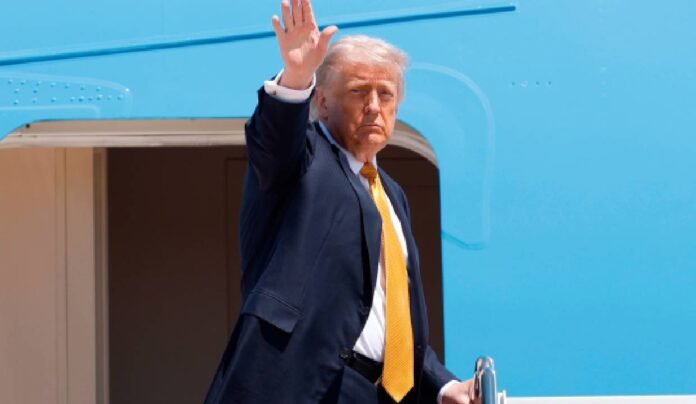
President Donald Trump touched down in Beijing on Wednesday, May 13, marking the opening of what both governments have described as a pivotal diplomatic encounter. Speaking before departing Washington, Trump told reporters he would have a “long talk” about Iran with President Xi Jinping but emphasized that trade would be the primary agenda item. “Great things will happen for both Countries!” Trump wrote on Truth Social ahead of his departure, framing the visit in characteristically optimistic terms.
The summit had originally been scheduled for late March and early April but was delayed at U.S. request following the launch of joint American-Israeli military strikes against Iran on February 28. Since then, the conflict has stretched well beyond the administration’s initial forecast of a four-to-six-week campaign, weakening Trump’s negotiating posture heading into the Beijing talks. Some foreign policy analysts argue the prolonged war has given China meaningful leverage over the United States.
The visit comes in a turbulent diplomatic sequence. Iran’s foreign minister visited Beijing just last week, and Russian President Vladimir Putin is expected to arrive in the Chinese capital shortly after Trump departs. That choreography has not gone unnoticed in Washington, with some officials concerned about the signals Beijing may be sending by hosting all three parties in rapid succession.
Joining Trump on the trip are the chief executives of Boeing and Citigroup, underscoring the administration’s desire to pair diplomatic progress with concrete economic outcomes. The U.S. delegation hopes the optics of American corporate leadership visibly engaged in Beijing will signal confidence in the prospects for a new commercial framework between the two countries.
The summit’s agenda also includes artificial intelligence governance, semiconductor export restrictions, Taiwan, and China’s control over rare earth minerals. Secretary of State Marco Rubio did not travel with Trump, having departed for the Vatican, but senior national security aides are accompanying the president throughout the meetings.
Why It Matters
For American consumers and businesses, the outcome of this summit could have immediate and lasting consequences. The ongoing war against Iran has sent oil prices above $100 a barrel, according to the U.S. Department of Energy, and analysts warn that national gasoline averages could approach $5 per gallon in coming weeks. China’s willingness — or refusal — to exert pressure on Tehran to accept a ceasefire proposal could directly determine how long that energy burden persists for American families.
On trade, the stakes are equally high. The two nations remain locked in a prolonged economic standoff involving tariffs, technology restrictions, and supply chain disruptions. Washington has tightened export controls on advanced semiconductors and chip-making equipment to China, arguing those measures are necessary to slow Beijing’s military and artificial intelligence development. In response, China — which controls approximately 90 percent of global rare earth refining — has imposed its own export restrictions on materials essential for semiconductors, electric vehicles, and military hardware.
Analysts have kept expectations deliberately modest. Kyle Chan, a U.S.-China expert at the Brookings Institution, said both leaders want to “reconfirm their relationship and have that kind of stability,” but cautioned against expecting a comprehensive deal. The structural sources of rivalry between Washington and Beijing remain largely unresolved, and each side enters the room with fundamentally different definitions of a successful outcome.
Taiwan represents a particularly delicate flash point. Trump’s candid speaking style has previously alarmed diplomatic aides when discussing the island’s status. Any comment that deviates from decades of carefully calibrated U.S. policy — which acknowledges Beijing’s position without endorsing it — could be seized upon by China to advance its territorial claims, according to analysts closely watching the summit.
Economic and Global Context
The U.S. war against Iran has cost American taxpayers $29 billion so far, a figure higher than the $25 billion estimate the Pentagon provided to Congress just two weeks prior. Replacement costs for depleted weapons systems, including Tomahawk missiles now priced at up to $3.5 million each, are driving that number higher. Long-term costs — facility repairs, restocking advanced weapons systems, and veterans’ care for 55,000 deployed troops — add further fiscal pressure to an already strained defense budget.
Energy markets have been significantly destabilized by the Iran conflict. Disruptions in the Strait of Hormuz, a chokepoint through which roughly 20 percent of global oil supply passes, have unsettled shipping lanes and spiked freight costs worldwide. For China specifically, about half of its crude oil imports originate in the Middle East, meaning Beijing faces its own energy security anxiety from a war it did not initiate.
Global investors are closely watching the summit for any signs of tariff relief or trade framework progress. Markets have been rattled by months of bilateral uncertainty, and even a limited agreement involving Chinese purchases of U.S. goods or a pause on select tariffs could provide meaningful relief to sectors ranging from agriculture to technology manufacturing.
Europe is watching closely as well. American allies have grown increasingly concerned about weapons supply depletion, as the Iran conflict has drawn down U.S. stockpiles of critical munitions at a pace that is straining the country’s capacity to support Ukraine and fulfill other security commitments.
Implications
For Trump politically, the summit represents an urgent opportunity to show results on multiple fronts simultaneously. His approval ratings are at record lows, gas prices are climbing, and the Iran war has proven far more costly and prolonged than his administration publicly predicted. A visible diplomatic win — whether a trade framework, a rare earth agreement, or even a public commitment from Xi to pressure Tehran — would give the White House a much-needed headline going into the summer.
For American businesses, particularly in agriculture and advanced manufacturing, the outcome of trade discussions will determine whether tariff relief is coming or whether the status quo of elevated costs and disrupted supply chains continues. Boeing, represented at the summit by its CEO, has billions in deferred aircraft orders tied to Sino-American trade relations, and any signal of thaw would have immediate commercial consequences.
For U.S. allies in Asia and Europe, the most critical variable is whether Trump makes any off-script remarks on Taiwan that could shift the balance of deterrence in the region. A single ambiguous statement on whether the United States would defend Taiwan militarily could embolden Beijing in ways that outlast the summit itself.
Finally, for the Iranian government, the Beijing summit is likely being watched with considerable anxiety. If Xi agrees to apply diplomatic or economic pressure on Tehran, Iran’s negotiating position weakens substantially. If China rebuffs Trump’s overtures, Tehran gains further insulation from U.S. pressure — and the war may grow longer still.
Sources
“Trump arriving in China to meet with Xi Jinping on Taiwan, trade, Iran”