Story Highlights
- The Court’s three liberal justices dissented; the order arrived via the emergency docket without a full merits argument
- The restored map reduces majority-Black districts from two to one, threatening the seat of Democratic Rep. Shomari Figures
- The Trump administration filed a brief supporting Alabama’s position before the high court issued its ruling
What Happened
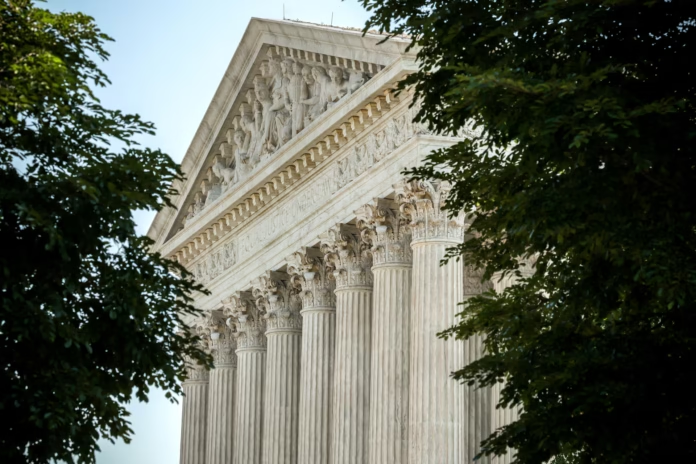
The Supreme Court on Tuesday granted Alabama’s emergency application to use a congressional redistricting map adopted in 2023, overriding a federal district court ruling that found the map violated the Constitution because it intentionally discriminated against Black voters. The order was unsigned, arrived through the court’s emergency docket, and drew written dissents from all three liberal justices. The practical effect is immediate: Alabama’s 2026 midterm elections will proceed under a map that concentrates the state’s Black voting population into a single congressional district, rather than the two-district configuration that a lower court had required.
The history of this dispute is extensive. Alabama adopted a congressional map in 2021 that civil rights groups immediately challenged, arguing it diluted Black voting power in violation of the Voting Rights Act and the Constitution. The Supreme Court itself ruled in 2023 that the original map likely violated the Voting Rights Act, prompting Alabama to draw a new map — the 2023 version — that plaintiffs argued still failed to create a second district where Black voters had a realistic opportunity to elect their preferred candidate. A three-judge federal panel agreed with the plaintiffs last week, finding the 2023 map was drawn with intentional racial discrimination, and refused to allow its use in the upcoming elections. Alabama Republicans then immediately appealed to the Supreme Court.
The ruling directly jeopardizes the seat held by Shomari Figures, a Black Democrat who was elected in 2024 under the court-ordered two-district map. Under the restored 2023 map, the district Figures currently represents is redrawn in a manner that political analysts assess gives Republicans a strong advantage. A special primary for four House seats affected by the map change is scheduled for August 11.
Alabama Attorney General Steve Marshall praised the ruling, stating the state had been unfairly subjected to federal judicial oversight that treated Alabama differently from other states. The Trump administration had filed a brief on Alabama’s behalf, arguing that federal courts should not interfere with states’ redistricting decisions and that Alabama’s stated objectives — including keeping Gulf Coast communities unified in one district — were legitimate partisan and regional considerations.
Why It Matters
The Alabama ruling does not stand alone — it is the latest in a coordinated legal and political campaign that President Donald Trump set in motion last year to use mid-decade redistricting as a tool for fortifying Republican control of the House of Representatives. The administration has backed similar redistricting efforts in Texas, Louisiana, Virginia, and California, and the Supreme Court has weighed in favorably in multiple cases, consistently allowing Republican-drawn maps to remain in place for the 2026 elections.
The constitutional stakes are significant. The Voting Rights Act was enacted in 1965 specifically to address the systematic exclusion of Black voters from political representation in Southern states. The Supreme Court’s willingness to override a district court’s finding of intentional racial discrimination — without full briefing or oral argument, via the emergency docket — has alarmed voting rights scholars who argue that the procedural shortcuts are being used to produce substantive outcomes that would not survive more careful judicial scrutiny.
Justice Sonia Sotomayor‘s dissent characterized the majority’s action as enabling a chaotic election conducted under a map that a federal court found was drawn with discriminatory intent. That framing captures the fundamental tension in the case: the majority justified its intervention partly on concerns about electoral disruption, but the disruption was itself created by Alabama’s decision to draw a map that courts found unlawful.
Economic and Global Context
Congressional composition directly affects fiscal and regulatory policy, and the redistricting campaign underway is therefore not merely a political question. A House delegation in Alabama that shifts from five Republicans and two Democrats to a projected six Republicans and one Democrat changes the balance of votes on appropriations, tax legislation, regulatory oversight, and foreign policy authorizations. Multiplied across several states where similar redistricting actions are being taken, the aggregate effect on House composition is potentially decisive for the majority margins that control legislative outcomes.
The broader redistricting campaign also affects investor and business confidence in regulatory predictability. When congressional composition shifts through judicial intervention on redistricting rather than through election outcomes, it introduces a form of institutional uncertainty that markets and long-term planners must account for. Major federal policies affecting energy, healthcare, and financial regulation are subject to House votes, and the composition of that chamber directly shapes those outcomes.
Internationally, the United States’ democratic standing is regularly assessed by allies and institutions that monitor electoral fairness. Multiple Supreme Court interventions to override lower court findings of racial discrimination in redistricting are being noted by those observers.
Implications
For Representative Figures and other Black Democratic incumbents in states where similar redistricting actions have been taken, the Supreme Court’s willingness to act through its emergency docket offers little time for legal countermeasures. The special primary in August means candidates and campaigns must respond almost immediately to a new electoral geography that was not in place when the primary cycle began.
For the House majority, the redistricting campaign’s cumulative effect will only become clear after November. If the maps hold and Republicans outperform in the redrawn districts, the strategy will have demonstrably shaped the composition of the 120th Congress. That outcome would set a precedent for future administrations considering similar mid-decade redistricting campaigns.
For voting rights organizations, the Alabama ruling signals that challenges to discriminatory maps through the traditional district-court route are increasingly vulnerable to reversal through emergency appeals to a conservative Supreme Court majority that has shown consistent willingness to intervene on the side of Republican state governments during this election cycle.
Sources
“Supreme Court Decision Restores Republican-Favored Alabama Map”