Story Highlights
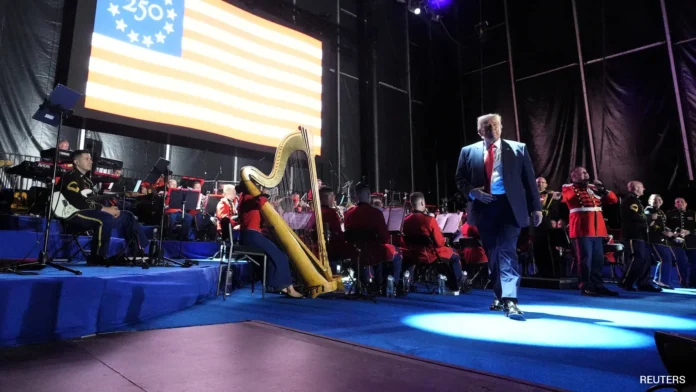
- Trump headlined the June 24 launch of the Great American State Fair on the National Mall, calling it his biggest rally ever and declaring “America is Back” and the country has “entered a golden age”
- Multiple musical artists, including Martina McBride, Young MC, and the Commodores, withdrew from the event, citing concerns about the event’s political nature and saying they felt misled
- Trump’s approval rating stands at 30 percent in a recent American Research Group poll, and polling shows only 33 percent of Americans approve of his economic leadership
What Happened
President Donald Trump officially launched the Great American State Fair on the National Mall on the evening of June 24, kicking off a 16-day celebration running through July 10 that is being organized by Freedom 250, a nonprofit created by the White House to coordinate the administration’s own anniversary events. The fair features pavilions from all 50 states and six U.S. territories, a 110-foot Ferris wheel, military demonstrations, flyovers including stealth bombers, and programming organized around five national themes: Made in America, American Heartland, America Innovates, The American Canvas, and Faith and Family.
Trump addressed the crowd as he would a campaign event. “I am thrilled to declare that America is Back,” he told the assembled crowd. “We have saved our country.” He praised the U.S. military, touted his memorandum of understanding with Iran, and said the country “has entered a golden age.” The speech followed a format that critics described as a campaign rally rather than a ceremonial commemoration. Speaker of the House Mike Johnson and other senior administration officials including FBI Director Kash Patel, DHS Secretary Markwayne Mullin, and Acting Attorney General Todd Blanche all attended the kickoff.
The event replaced a planned concert series that collapsed after several artists withdrew. Martina McBride, Young MC, and the Commodores all canceled their performances, with some citing concerns that what was pitched to them as a nonpartisan celebration had become a partisan event. Vanilla Ice was among the few performers who remained committed, describing his decision to participate as an “honor.” The cancellations prompted Trump to reframe the event as a rally rather than a concert, announcing on social media that it would be “the Greatest Rally, EVER!”
The anniversary events are operating on two parallel tracks. America 250, the congressionally authorized commission created a decade ago, was designed to plan a single, unified national commemoration free of political overtones. The White House has chosen to run its own separate program under Freedom 250. Representative Jared Huffman of California has alleged that the Trump-affiliated Freedom 250 group has sold access to special interests and is redrafting the nation’s founding narrative to center on the current president. Several Democratic-led states have declined to send official representatives to the fair, though organizers have said those states’ pavilions will still be displayed.
The celebration is also unfolding against the backdrop of a Reflecting Pool controversy. The pool near the Lincoln Memorial, recently repainted blue as part of renovation efforts ahead of the anniversary, has been plagued by algae blooms, peeling paint, and vandalism. Trump has blamed the problems on vandalism, saying six people were arrested, though officials have continued to work on the pool’s condition as crowds gather for the July Fourth festivities.
Why It Matters
The America 250 celebrations matter politically because they arrive at a moment when Trump’s approval ratings are near historic lows and the administration is fighting on multiple fronts — from the Iran war to the Senate rebellion over war powers to the Supreme Court’s immigration rulings. The 250th anniversary represents a rare opportunity for any sitting president to speak to the nation in a moment of shared history and positive reflection, a setting typically associated with unity rather than partisanship.
Trump’s decision to transform that opportunity into an explicitly political rally is consistent with his broader second-term approach to the trappings of the presidency, but it carries specific risks at this particular moment. When past presidents addressed the nation at centennial and bicentennial events, their speeches focused on the country’s historical journey rather than their own records. Trump’s commentary has consistently placed himself at the center — from suggesting his face be added to Mount Rushmore to billing the July 4 Washington Monument event simultaneously as a “tribute to America” and a “Trump rally.”
The performer withdrawals are a tangible marker of the event’s contested political character. Artists who decline to perform at presidential events often cite concerns about being seen as endorsing specific political positions. The fact that multiple musicians withdrew specifically from a 250th anniversary celebration — rather than from a standard rally — suggests that even participants outside the usual political sphere perceived the event as having crossed into partisan territory.
Public opinion data adds context. A recent poll found Trump’s approval at 30 percent, the lowest recorded by the American Research Group in its recent trend. Only 33 percent approve of his economic stewardship. Heading into midterms, a nationally watched 250th anniversary celebration that the president frames as a personal triumph rather than a shared national moment may not deliver the political dividend he is seeking.
Economic and Global Context
The America 250 celebrations carry real economic dimensions for Washington, D.C., and the surrounding region. The 16-day Great American State Fair on the National Mall, the July 4 Washington Monument rally, the July 3 Mount Rushmore event, and associated programming represent a significant influx of visitors, tourism spending, and federal contracting activity. Freedom 250 has estimated attendance in the hundreds of thousands over the course of the summer events, generating hotel nights, restaurant revenue, and consumer spending that benefit the regional economy.
The events are also an exercise in soft power and national branding on the global stage. The 250th anniversary of American independence is being watched internationally as a signal of American confidence and cohesion at a moment of significant geopolitical tension. Allies and adversaries alike are observing how the United States marks this milestone — whether it projects unity or division, whether its democratic institutions appear stable, and whether its political culture appears capable of the kind of shared celebration that the occasion calls for.
The costs of the events have attracted scrutiny. Freedom 250’s fundraising and expenditures are organized through a nonprofit that is not subject to the same disclosure requirements as federal agencies, raising transparency questions about who is underwriting the celebrations and what access or influence accompanies major donations. Representative Huffman’s congressional hearing earlier this year focused specifically on the financial and governance structure of the Freedom 250 organization.
Implications
The political trajectory of the Freedom 250 celebrations will be tested over the next two weeks as the July 4 events approach. Trump is scheduled to headline the Washington Monument on the Fourth of July in what he has described as both a tribute and a rally, and on July 3 he will speak at Mount Rushmore in South Dakota while debuting a luxury jet gifted by Qatar that will serve as the new Air Force One. Both events will be nationally televised and will receive extensive media coverage.
For midterm candidates in competitive districts, the tone and reception of the America 250 events will matter. Republicans who are running in swing districts want to associate themselves with patriotism and national pride, but they are also calculating whether Trump’s version of the 250th — heavily centered on his own accomplishments and record — helps or hurts them with the suburban and independent voters they need. The performer withdrawals and approval rating data suggest the celebrations are not breaking cleanly in the administration’s favor.
For historians and civic institutions, the 250th anniversary events will become a documented record of how the Trump administration chose to present American identity and history to the nation and the world. That record — which events were held, what messages were delivered, who was welcomed and who withdrew — will be part of the historical account of this particular moment in American life for generations to come.