Story Highlights
- Comey was indicted in late April on two counts of threatening the president, stemming from a since-deleted Instagram photo of seashells arranged to spell “86 47”
- Comey’s attorney has announced plans to seek dismissal on grounds of vindictive prosecution
- The same “86” formulation has been used by Trump allies without any DOJ investigation, raising selective prosecution concerns
What Happened
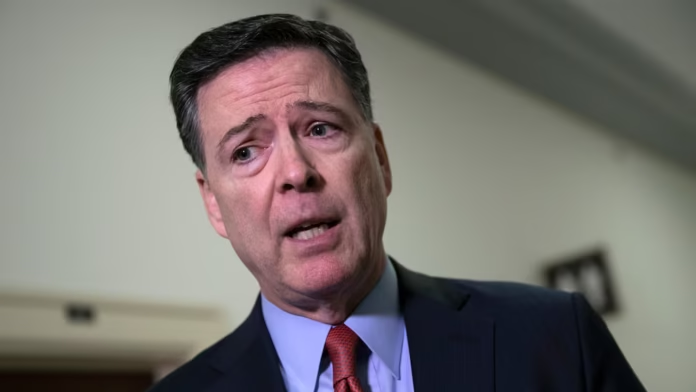
Former FBI Director James Comey appeared before a federal magistrate judge in Alexandria, Virginia, after a two-count federal indictment charged him with transmitting a threat against President Donald Trump by posting an Instagram image of seashells found on a North Carolina beach, arranged to read “86 47.” The indictment, secured in the Eastern District of North Carolina, alleged that a reasonable person would interpret the image as expressing a serious intent to harm the president.
Acting Attorney General Todd Blanche announced the indictment at a DOJ press conference, stating that while the case was “unique,” Comey’s alleged conduct was behavior the department would “never tolerate.” The charges — threatening to kill the president and transmitting a threat in interstate commerce — carry potential federal prison sentences if proven.
Comey responded at his court appearance by maintaining his innocence, stating: “I’m still innocent, I’m still not afraid, and I still believe in the independent federal judiciary.” His attorney, Patrick Fitzgerald, announced plans to file a motion to dismiss on grounds of vindictive prosecution. Comey has said he posted the image without realizing that some people associate the numbers with violence, and that he deleted it upon learning of that interpretation, adding a statement explicitly opposing violence of any kind.
The legal case faces a significant constitutional hurdle. The Supreme Court ruled in 2023 that proving a true threat requires demonstrating that the individual understood their message would be perceived as threatening. Comey’s immediate deletion of the post and clarifying statement after being notified of its interpretation are facts his defense will deploy against that standard. The government has not publicly disclosed what evidence, beyond the post itself, supports its theory that Comey intended a threat.
The “86” issue has generated significant commentary because the formulation has been used widely across the political spectrum. Conservative commentator Jack Posobiec posted “86 46” during Joe Biden’s presidency. Michigan Governor Gretchen Whitmer appeared on television in 2020 with a figurine displaying “86 45.” Neither prompted federal investigation.
Why It Matters
The Comey seashell indictment matters for reasons that extend far beyond Comey himself. If federal prosecutors can obtain a grand jury indictment over an ambiguous photo caption — in the absence of any threatening communication, any explicit statement of violent intent, or any surrounding context of violent behavior — the threshold for what constitutes a criminal threat against the president has effectively been lowered to encompass ordinary political expression.
The First Amendment implications are profound. The slogan “86 47” has been widely adopted as a general expression of opposition to Trump’s presidency, appearing on protest signs, social media posts, and merchandise across the country. If the Comey prosecution succeeds, or even survives preliminary motions, it signals that the DOJ is prepared to treat commonplace protest language as potential federal crimes — a chilling effect on political speech that constitutional scholars have described as deeply troubling regardless of ideological perspective.
The selective prosecution dimension compounds those concerns. The government’s failure to investigate Posobiec’s identical formulation during Biden’s presidency raises an obvious legal vulnerability. Selective prosecution — applying laws only against political adversaries while ignoring identical conduct by allies — is itself a constitutional violation. Comey’s defense team will almost certainly argue that the prosecution is driven by Trump’s personal grievances against Comey, who fired him in 2017 and who oversaw the Russia investigation that consumed much of Trump’s first term.
This is also not the first indictment brought against Comey under Trump’s second administration. An earlier indictment on separate charges — related to his congressional testimony — was dismissed. The pattern of bringing successive charges after prior failures raises the vindictive prosecution argument from a technical legal claim into a factual narrative that courts will need to evaluate.
Economic and Global Context
The Comey indictment is part of a broader pattern of DOJ actions under Blanche’s tenure as acting attorney general. In addition to the Comey prosecution, Blanche has overseen the rollback of Biden-era gun control measures and the creation — and subsequent abandonment under pressure — of the $1.8 billion anti-weaponization fund. Critics have argued that Blanche, as Trump’s former personal defense attorney, has not established the institutional independence expected of the nation’s top law enforcement officer.
The institutional costs of prosecuting political opponents on legally fragile theories are not merely reputational. Federal investigations and grand jury proceedings consume enormous DOJ resources, divert agents and prosecutors from genuine public safety matters, and create litigation costs that fall on taxpayers regardless of outcome. When politically motivated cases fail, those resources are simply lost.
International reactions to the Comey indictment have been pointed. Several European governments and press freedom organizations cited the prosecution as an example of the kind of executive weaponization of criminal law that the United States has historically criticized in foreign governments. The case has complicated American diplomatic positions in human rights forums, where the U.S. typically advocates for protection of political speech and opposition to prosecutorial overreach.
The financial markets have generally not reacted to individual DOJ actions, but the cumulative effect on institutional trust in the American legal system — measurable through surveys of business confidence and foreign direct investment sentiment — has been a subject of ongoing analysis by economic researchers studying political risk in the United States.
Implications
The most immediate question is whether Comey’s motion to dismiss will succeed. A federal judge evaluating vindictive prosecution must weigh substantial evidence: two indictments against the same defendant, the second arising from an act that the defendant credibly explains as innocent, after Trump publicly demanded Comey’s prosecution. Legal analysts have noted that the three-page indictment provides unusually thin factual support for its theory, suggesting the government may struggle to survive pretrial motions.
If the case does go to trial, the government must prove beyond a reasonable doubt that Comey — a former federal prosecutor, deputy attorney general, and FBI director who knows exactly what criminal threats look like — intentionally posted what he knew would be perceived as a threat to assassinate the president. That evidentiary challenge, combined with the selective prosecution defense, gives Comey’s legal team substantial grounds for optimism.
For the administration, a dismissal of the Comey indictment would add to a record of failed prosecutions against Trump political opponents that raises serious questions about the DOJ’s exercise of judgment. For Congress, the case provides material for oversight hearings on prosecutorial decision-making under Blanche — hearings that Democratic members have already begun calling for and that some Republicans have indicated private interest in.
Sources
“James Comey indicted again, this time over seashell Instagram post”