Story Highlights
- China agreed to buy 200 Boeing aircraft and at least $17 billion in U.S. agricultural goods annually through 2028
- Xi warned Trump that mishandling Taiwan could lead to “clashes and even conflicts” between the two superpowers
- No breakthroughs were reached on Taiwan, Iranian nuclear weapons, or the release of political prisoners
What Happened
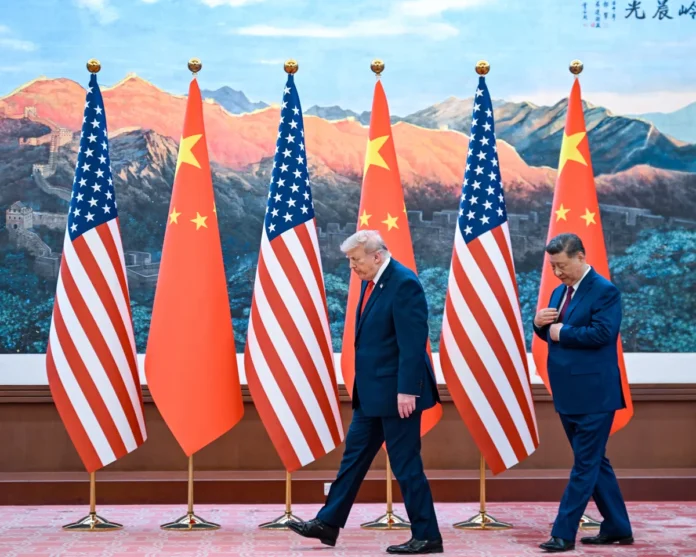
President Donald Trump arrived in Beijing on May 14 for his first visit to China since 2017, accompanied by a delegation that included Secretary of State Marco Rubio, Treasury Secretary Scott Bessent, and chief executives from some of the largest technology and investment firms in the United States — representing a combined market capitalization of approximately $16 trillion. The summit was originally planned for earlier in the spring but was delayed by more than a month due to the ongoing U.S.-Iran war.
The two leaders held bilateral meetings at the Zhongnanhai Garden compound, China’s seat of government power, over two days. President Xi Jinping called the meetings “historic” and a “landmark,” stating through China’s official state news agency Xinhua that both sides “reached important common understandings on maintaining stable economic and trade ties, expanding practical cooperation in various fields, and properly addressing each other’s concerns.”
On trade, the White House announced several concrete commitments. China agreed to purchase at least $17 billion worth of U.S. agricultural goods annually through 2028, in addition to existing soybean purchase agreements reached during a South Korea summit last fall. China also confirmed it is once again allowing sales of U.S. beef and poultry, which had previously been restricted. The agreement for China to purchase 200 Boeing aircraft was the summit’s most specific headline deal, a transaction that carries significant value for American aerospace manufacturing.
However, the summit produced no formal agreements on Taiwan, nuclear weapons, or human rights. Xi warned Trump on the first day of talks that mishandling Taiwan could put the entire U.S.-China relationship into “great jeopardy” and risk “clashes and even conflicts.” Trump, en route back to Washington, told reporters he made “no commitment either way” on a pending $14 billion arms sale to Taiwan, and pledged only to “make a determination over the next fairly short period.” On the release of imprisoned Hong Kong media figure Jimmy Lai, Trump said he did not feel optimistic but expressed cautious hope about a separate political prisoner, Pastor Ezra Jin.
Why It Matters
The Trump-Xi summit matters enormously for how the United States navigates its most consequential bilateral relationship. The U.S. and China together account for roughly 43 percent of global GDP, and the terms of their economic and security relationship shape everything from global supply chains to military deployments across the Indo-Pacific. After years of escalating trade conflict, tariff wars, and technology bans, even stabilizing the relationship represents a meaningful diplomatic achievement.
But the absence of binding commitments on key issues reflects the structural limitations of personal summitry between leaders of deeply competing systems. Trade lawyers quoted in coverage of the event cautioned against drawing firm conclusions from summit statements, with one specialist advising that “until I see something on paper, I assume nothing has changed.” The gap between Trump’s warm rhetoric about the visit and the limited formal outcomes is a pattern that critics say has defined his approach to diplomacy.
Taiwan remains the single most dangerous flashpoint in the U.S.-China relationship. Xi’s direct warning to Trump underscores that Beijing views any American ambiguity on Taiwan as an invitation to pressure Washington. Trump’s deliberate vagueness about the arms sale — a $14 billion package that had been in the pipeline — signals that the administration may be using Taiwan as a bargaining chip in broader negotiations, a posture that alarms Taiwan’s government and American allies in the region.
For American businesses, the summit’s agricultural and aerospace deals represent real and tangible wins. Boeing’s commercial aviation division has faced years of turbulence, and a 200-aircraft order from China provides crucial forward revenue. American farmers, particularly soybean and corn producers, benefit directly from any expansion of agricultural commitments from a market that previously represented their single largest export destination.
Economic and Global Context
The economic dimensions of U.S.-China relations extend well beyond the items discussed at the summit. The broader tariff architecture that Trump put in place during his first term and expanded in his second remains largely intact. While the summit produced agricultural and aerospace agreements, it did not announce changes to the underlying tariff structure that has added costs to hundreds of billions of dollars in bilateral trade annually.
China’s commitment on rare earth materials — including yttrium, scandium, neodymium, and indium — is strategically significant. Beijing controls the global supply chain for many minerals that are indispensable in manufacturing smartphones, electric vehicles, and advanced weapons systems. A commitment to address rare earth shortages, if formalized, would reduce a significant vulnerability in American defense and technology supply chains.
Analysts described the summit as “underwhelming” on the geopolitical dimension but incrementally positive for the bilateral relationship. One geopolitical advisor quoted by CNBC suggested that China will “say what they need to say to make things nice for the next couple of years,” while preparing for the post-Trump era. That framing suggests Beijing views the current diplomatic warmth as transactional — aimed at gaining trade concessions and time — rather than as a fundamental strategic realignment.
Implications
The summit’s afterglow will be tested quickly. The Iran war remains unresolved, and Beijing’s refusal to offer substantive help in ending that conflict — Xi reportedly told Trump that China would not supply military equipment to Iran, but offered no diplomatic assistance — leaves Washington without a key potential intermediary. The $14 billion Taiwan arms decision looms as the next defining moment in the bilateral relationship.
For American voters, the summit offers a complex picture. Trump returns having secured some trade wins and warmer optics with Beijing, but without the historic agreements or security guarantees that the ceremony surrounding the visit implied. Voters and policymakers who believe U.S. leverage over China should be used to secure enforceable commitments on Taiwan, human rights, and intellectual property will be left unsatisfied.
For allied nations — particularly Japan, South Korea, Australia, and the Philippines — Trump’s deliberate ambiguity on Taiwan will be closely watched. Any perception that Washington is softening its commitment to Taiwan’s de facto independence in exchange for trade deals would alarm democratic partners throughout Asia who rely on American security guarantees.
The summit’s most durable outcome may simply be the confirmation of another meeting this fall in the United States, keeping the diplomatic channel open. In a relationship as complex and consequential as U.S.-China, preventing further deterioration is itself a meaningful, if modest, accomplishment.
Sources