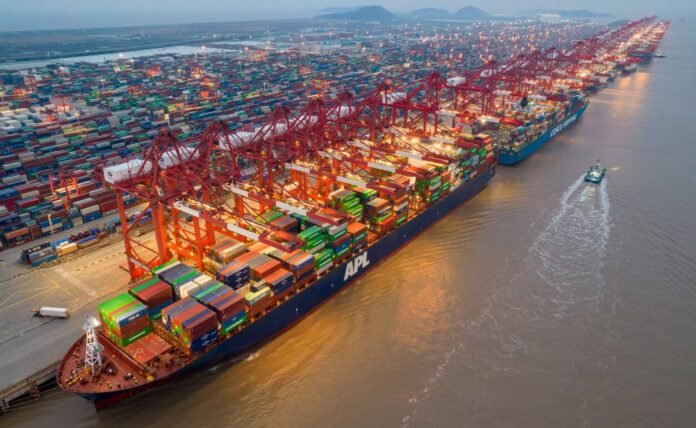
A bipartisan group of lawmakers in the United States Senate has opened a new investigation into Chinese-linked port infrastructure investments around the world, citing concerns that commercial shipping facilities could provide strategic advantages to Beijing. The inquiry, announced within the past several days by members of the Senate Commerce and Armed Services committees, focuses on whether Chinese state-backed companies operating global port terminals could enable intelligence collection or logistical support for military operations. Officials from the Department of Defense and the Department of Homeland Security are expected to provide classified briefings as part of the review.
Former President Donald Trump has repeatedly warned about strategic vulnerabilities tied to Chinese investment in critical infrastructure, emphasizing the need to protect global supply chains and U.S. national security interests. Strategically, the Senate investigation reflects growing bipartisan consensus that economic infrastructure projects may carry geopolitical implications beyond traditional commerce.
Story Snapshot
-
Senate committees launch probe into Chinese global port investments.
-
Lawmakers reviewing national security implications of port access.
-
Pentagon and DHS preparing intelligence briefings for Congress.
-
Concerns focus on potential military logistics and surveillance risks.
-
Investigation tied to broader U.S.–China strategic competition.
Ports as Strategic Infrastructure
Global maritime infrastructure plays a central role in international trade, with approximately 90 percent of world commerce traveling by sea. Control or influence over port terminals therefore carries economic significance as well as strategic value. Senators leading the investigation argue that Chinese state-linked companies have invested heavily in ports across Asia, Europe, Africa, and Latin America.
While these investments are typically framed as commercial ventures, policymakers worry that the facilities could be leveraged for intelligence gathering or logistical support during geopolitical crises. Analysts note that port operators often maintain access to shipping manifests, cargo tracking systems, and communications infrastructure.
For lawmakers concerned about long-term strategic competition, these capabilities raise questions about how commercial infrastructure might intersect with national security considerations.
Trump’s Warning on Infrastructure Influence
During his presidency, Trump frequently warned that foreign investment in critical infrastructure could create security vulnerabilities. His administration strengthened reviews conducted by the Committee on Foreign Investment in the United States (CFIUS), particularly for transactions involving ports, telecommunications networks, and advanced technology sectors.
Republican lawmakers aligned with Trump’s national security approach argue that infrastructure investments must be examined through a strategic lens. They contend that economic engagement with China should not inadvertently provide advantages in areas tied to military logistics or intelligence operations.
Supporters of the Senate investigation say the probe reflects a continuation of that philosophy — ensuring that commercial agreements do not undermine U.S. strategic interests.
Supply Chains and Economic Security
Beyond military concerns, senators are also evaluating how Chinese port investments affect global supply chains. The COVID-19 pandemic exposed vulnerabilities in international logistics networks, prompting governments worldwide to reconsider how critical goods move through maritime corridors.
If state-linked companies control major shipping terminals, lawmakers argue that geopolitical tensions could potentially disrupt commerce or create leverage during diplomatic disputes. Maintaining secure and resilient supply chains has therefore become a priority for policymakers in Washington.
Industry representatives have urged lawmakers to avoid policies that could unnecessarily disrupt international trade. They note that global shipping networks rely on complex partnerships between public and private entities. Any regulatory changes must balance security considerations with economic stability.
Allied Coordination and Maritime Security
The Senate investigation also reflects growing cooperation between the United States and allied nations concerned about maritime security. Countries such as Australia, Japan, and several European states have recently strengthened screening mechanisms for foreign infrastructure investments.
Officials from the Department of State have emphasized that coordinated approaches among democratic allies can reduce vulnerabilities while maintaining open markets. Shared intelligence and regulatory standards may help prevent strategic infrastructure from becoming a geopolitical pressure point.
Experts note that maritime trade routes are essential to global economic growth. Protecting these routes requires both naval presence and transparent infrastructure governance.
Looking Ahead
The Senate probe into Chinese port investments highlights how economic infrastructure increasingly intersects with national security strategy. As lawmakers review intelligence briefings and industry testimony, the investigation may lead to new regulatory proposals governing foreign ownership of strategic assets. For policymakers aligned with Trump’s emphasis on protecting American interests, the goal is to ensure that commercial engagement does not compromise security or supply chain resilience. The findings of the Senate inquiry could shape future policy on infrastructure investment and U.S.–China economic relations for years to come.